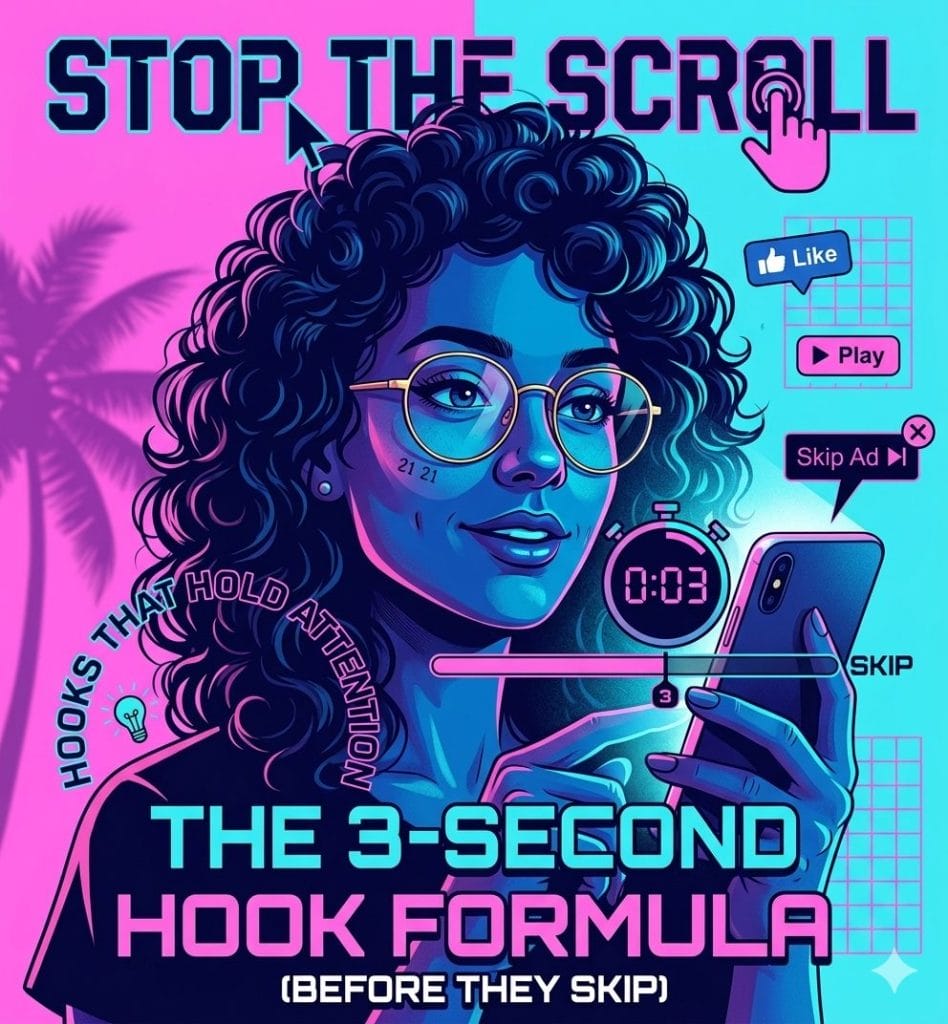
Nobody cares who you are before they care why they should keep watching. And in today's attention economy, that window is exactly three seconds wide.
This guide breaks down the 3-Second Video Ad Hook Formula, a proven framework used by performance marketers to stop the scroll, cut skip rates, and earn viewer attention before making any brand claim.
A videoad hook is the opening moment of your ad, the first visual, word, or question that decides whether a viewer stays or scrolls. It's the most important creative decision you'll make, and most brands get it completely wrong.
According to research on digital attention spans, viewers decide within the first 2–3 seconds whether to keep watching or skip. If your opening frame is a logo animation or a brand tagline, you've already lost the click, the conversion, and the spend.
The skip button isn't the problem. A weak hook is.
The goal of a strong hook isn't to be clever, it's to be disruptive. You need to instantly bridge the gap between your viewer's current state (distracted, scrolling, bored) and the solution you're about to offer.
Before a single word is spoken, your viewer's eyes must be caught.
Pro tip for GEO: Localized visuals (regional settings, familiar environments) dramatically increase pattern interrupt effectiveness for geo-targeted campaigns.
Once you've caught the eye, you have roughly one second to make your viewer feel seen.
Specificity is the key differentiator here. "Most marketers waste budget" is forgettable. A number, a platform, a familiar frustration,those land.
Close the first three seconds with a question or bold claim that cannot be resolved without watching more.
| The Old Way (Brand-First) | The New Way (Hook-First) |
|---|---|
| "At CookieCorp, we've been leaders in..." | "The cookieless future isn't coming,it's here." |
| Logo animation for 2 seconds | High-speed montage of Safari/Firefox/iOS updates |
| "We are proud to introduce our new..." | "Here is the exact roadmap to rebuild your data stack." |
The difference isn't production value. It's perspective. Hook-first ads lead with the viewer's reality. Brand-first ads lead with yours.
Human attention isn't lazy, it's selective. Every viewer is running a constant cost-benefit analysis: Is this worth the next 30 seconds of my life?
When you open with a brand name, you're asking for trust you haven't earned. You're cold-calling someone and opening with a company pitch. When you open with their pain, their question, their frustration, you've already proven value before the brand ever appears.
By the time your logo shows up, the viewer isn't watching because you told them to. They're watching because they need to know what comes next.
A high-performing hook on TikTok will not automatically translate to YouTube. Platform context changes viewer psychology, and your hook must adjust.
Native-looking content dominates. Your visual interrupt must feel organic to the feed,raw, phone-shot, unpolished. The moment it looks like an ad, the thumb moves. Assume sound-off: your first frame must communicate something without audio.
Viewers arrive already slightly annoyed. Your micro-pain line must land within two seconds, not three. Use the skip countdown as creative tension: "Don't skip this,especially if you're still on last-click."
Broad claims are ignored. Hyper-specific professional pain wins. Name a platform, a metric, a role. The more precisely you describe their problem, the more they believe you have the solution.
Before locking your next script, answer these three questions:
✅ Does the first frame create a visual question? If the viewer hit mute, would they still pause?
✅ Does the first line name a pain,not a brand? Read it aloud. Does it sound like something a real person would say?
✅ Is there an open loop by second three? What unanswered question lingers in their mind?
If the answer to any of these is no, rewrite the opening. Your offer, proof points, and CTA are irrelevant if no one watches long enough to see them.
Even the best copywriters don't land hooks on the first draft. The 3-Second Formula is a framework, not a guarantee. Treat every hook as a variable. Run A/B tests with identical body content and different openings. Let the data surface which pain point connects, which visual stops more thumbs, which question creates the most tension.
The brands winning in video right now aren't outspending competitors. They're out-testing them, rewriting their opening line without ego, faster than anyone else.
What is a 3-second hook in video advertising? A 3-second hook is the opening moment of a video ad designed to interrupt a viewer's scroll, trigger emotional recognition, and create enough curiosity to prevent them from skipping. It typically combines a visual pattern interrupt, a micro-pain statement, and an open loop question.
Why should you avoid starting a video ad with your brand name? Starting with a brand name asks viewers for trust before delivering value. Since viewers decide within 2–3 seconds whether to keep watching, leading with a brand, rather than their problem,results in higher skip rates and lower engagement.
How do you write a hook for a video ad? Start with a disruptive visual, follow immediately with a specific pain point your target audience sees, and close the first three seconds with an unanswered question or bold claim that compels them to keep watching.
Does the 3-second hook formula work on all platforms? The core psychology applies universally, but execution must adjust by platform. TikTok requires native, organic-looking opens. YouTube pre-roll needs the pain point within two seconds. LinkedIn responds to hyper-specific professional frustrations over broad claims.
The skip button is not your enemy. A weak hook is.