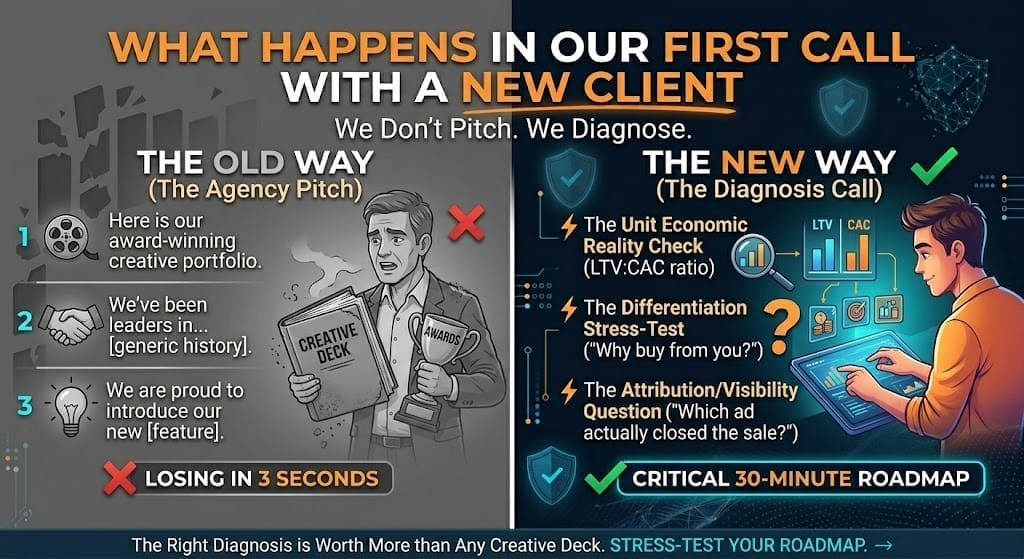
Most agency first calls follow the same script.
Introductions. A credentials slide. A case study or two. A transition into scope and pricing. A follow-up email with a proposal deck that looks almost identical to the last one they sent.
We don't do any of that.
No Pitch. No Deck. Here's Exactly What Happens in Our First Call With a New Client
No Pitch. No Deck. Here's Exactly What Happens in Our First Call With a New Client
In our first 30 minutes with a prospective client, we don't pitch. We don't present. We don't show you what we've done for other brands. We ask questions, specific, uncomfortable, diagnostic questions that most agencies never think to ask because they don't have the expertise to act on the answers.
Because in 2026, the right diagnosis is worth more than any creative deck ever built.
There's a version of this industry that treats every client engagement the same way: take the brief, build the creative, launch the campaigns, report the clicks. Repeat.
That model works well for agencies. It doesn't work particularly well for clients.
If the underlying business model has a fundamental flaw, a unit economics problem, a differentiation gap, a broken attribution setup, no amount of brilliant creative will fix it. It will just fail faster and more expensively.
We are business-first, creative-second. Before we discuss a single ad format, channel, or hook, we need to know whether the business can support the growth we'd be building toward. If the foundation doesn't hold, we say so. If we can fix it, we explain how. And if we're not the right fit, we tell you that in the first call rather than six months into a retainer.
This is what a Diagnosis-First approach actually looks like in practice.
These aren't discovery questions designed to make you feel heard before we pitch. They are the literal diagnostic framework we use to determine whether we can work together, and what needs to be fixed before we should.
What we ask: "What is your Target Customer Acquisition Cost (tCAC) relative to your current Customer Lifetime Value on a 3-month basis?"
Most brands cannot answer this question with confidence. That inability is itself diagnostic.
A viable LTV:CAC ratio is the non-negotiable foundation of scalable growth. If you are spending $50 to acquire a customer who generates $30 in revenue over their first three months, no ad platform, no creative strategy, and no agency relationship can save that business. You are not running a marketing problem, you are running a unit economics problem, and marketing spend will accelerate the loss, not reverse it.
We will not discuss creative, channel mix, or campaign structure until we understand whether the business is economically positioned to scale. This is the first gate, and it disqualifies more prospective engagements than any other factor.
Why most agencies skip this: They don't ask because they don't want to lose the deal. We ask because we don't want to take a deal we can't win.
What we ask: "If you are standing in front of your ideal customer, and your two biggest competitors are showing their best ads at the exact same moment, why does that customer have to buy from you? And it cannot be quality or service."
Quality is not a differentiator. It is the minimum requirement to exist in your category. Every competitor claims quality. Every competitor claims service. If your answer to this question relies on either of those, your differentiation has not been stress-tested.
In video advertising, this matters at the three-second level. If your hook cannot communicate a specific, compelling reason to choose you over a competitor in the time it takes someone to decide whether to skip, your creative is losing before it starts. Not because the production was poor. Because the underlying differentiation wasn't strong enough to compress into a five-word hook.
The Differentiation Stress-Test reveals whether the problem is a creative execution issue or a strategic positioning issue. Those require completely different solutions.
Why most agencies skip this: Because answering it honestly sometimes means telling a client their core offer needs work before advertising will perform, and that's a harder conversation than presenting a media plan.
What we ask: "Do you know exactly which marketing channel is driving the leads that actually close, not just the ones that click?"
In 2026, the gap between what ad platforms report and what is actually happening in your business is significant and growing. iOS privacy restrictions, cookie deprecation, and cross-device customer journeys mean that pixel-based attribution is hiding a meaningful portion of your actual conversion activity.
Brands operating in this environment without reliable attribution are making budget allocation decisions based on incomplete or actively misleading data. They pause campaigns that are working because the dashboard says they aren't. They scale campaigns that look efficient but are mostly recapturing existing customers rather than acquiring new ones.
Before we invest a dollar of a client's budget, we need to know whether the measurement infrastructure can tell us if that dollar is working. If it can't, the first investment isn't in ads, it's in visibility.
What fixing this looks like: Server-side tracking deployment, MER and Blended CAC as primary KPIs, conversion zone reporting for location-based campaigns, and a clear separation between new customer acquisition metrics and retargeting performance.
If the unit economics are viable, the differentiation is defensible, and the attribution infrastructure can be built or already exists, we have the foundation for a campaign worth running.
If any of the three are broken, we identify which one is the priority fix and what it takes to resolve it. Sometimes that work happens before a campaign launches. Sometimes it runs in parallel. But it always happens before we ask a client to scale spend.
The brands we work with aren't looking for an agency to agree with their current strategy and execute it. They're looking for a partner who will tell them the truth in the first 30 minutes, and then build something that actually works.
That conversation starts with three questions. Not a deck.
What should I expect on a first call with a digital marketing agency? A Diagnosis-First agency will prioritize understanding your unit economics, competitive differentiation, and attribution infrastructure before discussing creative or channel strategy. If an agency's first call is primarily a credentials presentation, they are selling before diagnosing, which typically leads to misaligned campaigns and wasted budget.
What is an LTV to CAC ratio and why does it matter for advertising? The LTV:CAC ratio compares the revenue a customer generates over a defined period to the cost of acquiring them. A healthy ratio (typically 2:1 or higher on a 3-month basis) is the prerequisite for scalable advertising. Brands with inverted ratios will lose money faster as they increase ad spend.
What is a differentiation stress-test in marketing? A differentiation stress-test challenges a brand to articulate why a customer must choose them over a direct competitor without relying on quality or service claims. If the answer cannot be compressed into a compelling hook within five words, the differentiation is not strong enough to win in competitive digital advertising environments.
Why is marketing attribution important before scaling ad spend? Without reliable attribution, brands cannot accurately identify which channels are driving revenue versus which are recapturing existing customers. Scaling spend without attribution visibility means optimizing against incomplete or misleading data, often resulting in paused campaigns that were working and scaled campaigns that weren't.
How do iOS privacy changes affect marketing attribution in 2026? iOS 14+ privacy restrictions limit pixel-based tracking, hiding a significant portion of conversion activity from platform dashboards. Brands relying solely on platform-reported data may systematically undervalue campaigns that are driving real business results. Server-side tracking and business-level metrics like MER and Blended CAC provide more reliable performance signals.
The right diagnosis in the first 30 minutes is worth more than six months of misaligned execution. That's why we start with questions, not decks.