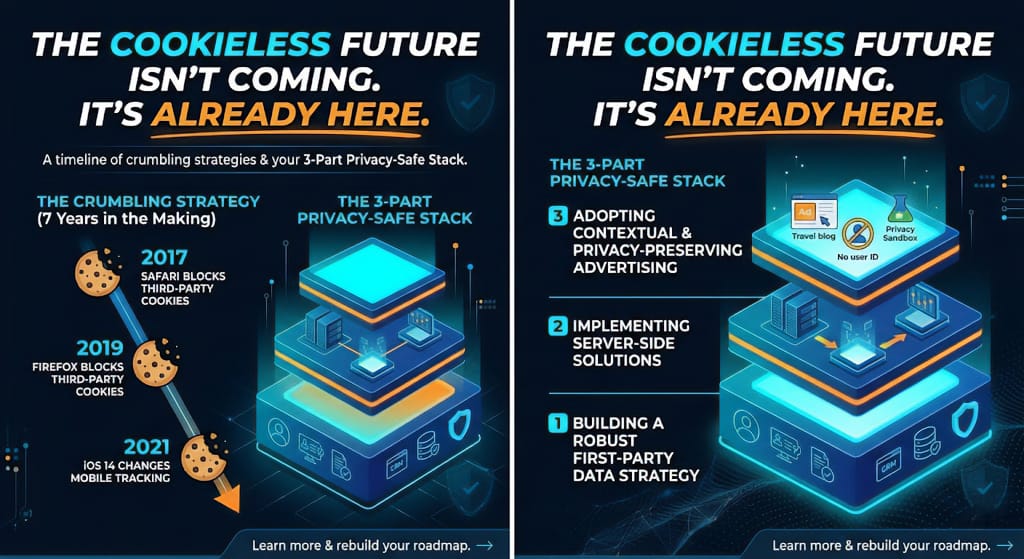
The cookieless future isn't a looming threat on the horizon.
It has been arriving, incrementally and irreversibly, for the past seven years. And most brands are still operating on a data strategy built for a tracking environment that no longer exists.
Here is the timeline of what has already happened:
The writing has been on the wall for nearly a decade. Brands that treated each of these changes as isolated platform updatesrather than as signals of a permanent directional shift have been building on a foundation that has been quietly degrading beneath them.
The result, in 2026, is a majority of advertisers whose reported ROAS is inflated, whose attribution is incomplete, and whose audience targeting is less precise than their dashboards suggest.
The rebuild starts with three components.
A future-proofed data strategy doesn't just survive cookie deprecation, it performs better without third-party data than most competitors do with it. The brands winning in 2026 built their infrastructure around data they own, tracking they control, and targeting that doesn't depend on browser permissions.
Here is what that infrastructure looks like.
The most valuable marketing asset in a cookieless environment is data you own outright, collected directly from your audience through their voluntary interactions with your brand. No platform can deprecate it. No browser update can block it. No privacy regulation can take it from you.
What building a first-party data strategy requires:
Value exchange at every touchpoint. Users will share their information when the return is clear and meaningful. Exclusive content, early product access, loyalty program enrollment, personalized recommendations, and meaningful discounts are all mechanisms that convert anonymous visitors into identified, consented contacts. The exchange has to be genuine, transactional opt-ins with no perceived value produce low-quality lists that don't activate.
Consent and transparency infrastructure. Privacy regulations across the US, EU, and increasingly in APAC markets require explicit, informed consent for data collection and use. Beyond compliance, transparent data practices build the kind of audience trust that produces higher engagement rates and lower unsubscribe rates over time. Your privacy policy should be readable, not just legally defensible.
CRM and Customer Data Platform (CDP) deployment. Centralizing your first-party data in a CDP allows you to activate it across every channel, CTV audience matching, geofencing seed lists, email, SMS, and lookalike modeling, from a single, governed source of truth. Without centralization, first-party data sits in silos and underperforms relative to its potential.
Browser-based pixel tracking is structurally compromised. Ad blockers, Intelligent Tracking Prevention in Safari, and iOS privacy restrictions combine to block or degrade a significant percentage of client-side conversion events before they reach your ad platform. The result is systematic underreporting of actual performance.
Server-side tracking moves data collection from the user's browser to your own server, then transmits verified conversion data directly to ad platforms and analytics tools through server-to-server integrations, bypassing browser-level restrictions entirely.
What server-side implementation delivers:
Signal recovery. Brands that have migrated to server-side tracking consistently recover 20–40% of conversion events that were previously hidden by browser restrictions. That recovered signal improves algorithm optimization, attribution accuracy, and bidding efficiency across every platform running on that data.
Data governance and security. When data collection runs through your server, you control what is captured, how it is processed, and what is transmitted to third parties. This makes consent management more precise and compliance documentation more defensible.
Attribution reliability. Server-side conversion APIs, Meta's CAPI, Google's Enhanced Conversions, TikTok's Events API, provide a direct, privacy-compliant channel for sending first-party conversion data to platforms without dependence on browser cookies. For brands running multi-channel campaigns across CTV, native, search, and social, this is the infrastructure layer that makes cross-channel attribution possible.
The third component shifts the targeting methodology itself, away from user-level behavioral tracking and toward approaches that perform without it.
Contextual advertising places ads based on the content environment rather than the individual user's browsing history. A financial services brand running contextual targeting appears alongside content about personal finance, investment planning, or economic news, reaching an audience that is demonstrably engaged with relevant subject matter, without any individual-level tracking required.
In 2026, contextual targeting has matured significantly. Semantic analysis technology can now identify content relevance at a granularity that matches or exceeds the precision of interest-based behavioral targeting in many categories, particularly for brands whose buyers consume identifiable content verticals.
Privacy Sandbox and emerging attribution alternatives. Google's Privacy Sandbox initiative continues to develop API-based alternatives to third-party cookies for attribution, audience cohort analysis, and conversion measurement. Staying current with these developments,and testing your attribution infrastructure against them before they become the default, is standard practice for any performance marketing team operating at scale in 2026.
Continuous creative testing. When individual-level targeting becomes less precise, creative relevance becomes more important. Brands that invest in testing message variants, hook formats, and offer structures across contextual placements develop a compounding creative intelligence advantage that behavioral targeting historically allowed them to bypass. In a cookieless environment, the creative has to do more of the work.
Every quarter a brand delays rebuilding its data infrastructure, three things happen simultaneously: first-party data assets that could have been growing sit uncollected; attribution blind spots compound as more conversion events go unmeasured; and competitors who built earlier are pulling further ahead in algorithm efficiency and audience quality.
The cookieless transition was never going to be a single event that forced universal adaptation overnight. It has been a gradual erosion, and gradual erosions are the most dangerous kind, because they're easy to defer until the damage is severe.
The rebuild roadmap is not complex. It is three components: data you own, tracking you control, and targeting that doesn't depend on permissions that are being revoked.
The brands that execute all three in 2026 will not be chasing the privacy-safe future. They will already be living in it.
What is a cookieless marketing strategy? A cookieless marketing strategy replaces reliance on third-party browser cookies with first-party data collection, server-side tracking, and contextual advertising methods. It is designed to maintain targeting precision, attribution accuracy, and campaign performance as browser-level tracking restrictions continue to expand.
Why did third-party cookies start disappearing? Third-party cookie deprecation began in 2017 when Safari introduced Intelligent Tracking Prevention, followed by Firefox in 2019 and iOS 14's App Tracking Transparency in 2021. Each change reduced the ability of advertisers to track users across websites and devices without explicit consent, reflecting growing regulatory and consumer privacy expectations.
What is server-side tracking, and how does it help marketers? Server-side tracking routes conversion data through a brand's own server rather than a browser-based pixel, bypassing ad blockers and browser privacy restrictions. It recovers conversion events that client-side tracking misses, improves attribution accuracy, and provides a more reliable signal for platform algorithm optimization.
What is a Customer Data Platform (CDP), and do I need one? A CDP centralizes first-party data from all customer touchpoints into a single, governed database that can be activated across advertising channels, email, SMS, and CRM systems. For brands building a cookieless data strategy, a CDP is the infrastructure layer that makes first-party data usable at scale across multiple platforms.
How does contextual advertising work without cookies? Contextual advertising targets ad placements based on the content of the page or app rather than the individual user's behavioral history. It uses semantic analysis to match ads to relevant content environments, reaching audiences based on what they are actively reading or watching rather than what they have previously browsed.
The cookieless future has been arriving since 2017. The brands rebuilding now aren't preparing for a transition; they're completing one.