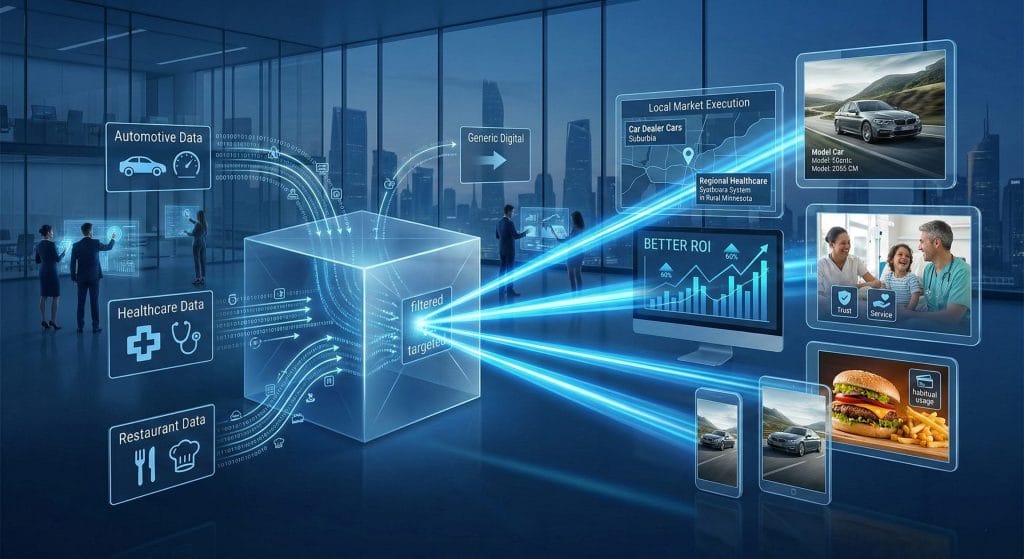
Not all businesses advertise the same way, and they shouldn't. A car dealership in suburban Atlanta has fundamentally different advertising needs than a healthcare system in rural Minnesota or a fast-casual restaurant chain in Southern California. Yet many advertising agencies apply the same generic strategies to every client regardless of industry, and wonder why results are mediocre. Industry-specific digital advertising strategies consistently outperform one-size-fits-all approaches, and here's why.
Consumer buying behavior varies dramatically across industries. The purchase journey for an automobile, which may involve months of research, multiple dealership visits, and real financial decision-making, looks nothing like the decision to try a new restaurant for dinner tonight. The regulatory environment for healthcare advertising is entirely different from retail. The competitive dynamics of the legal industry require different positioning than the home services market.
An advertising agency that understands these nuances builds campaigns that speak to industry-specific consumer psychology, use appropriate messaging, comply with relevant regulations, and use the data sources most relevant to your category.
Automotive advertising requires reaching consumers at multiple stages of a long purchase journey, from early brand awareness through model research to dealer visit intent. The most effective automotive digital strategies combine streaming TV for brand storytelling, conquesting campaigns targeting competitor brand loyalists, and in-market audience targeting using automotive purchase intent data.
For dealerships, local market execution is critical. Campaigns must be tailored to specific make and model inventory, local competitive pricing, and geographic trade area analysis. Automotive advertisers who use industry-specific data partners, including IHS Markit automotive data, in-market buyer signals, and service appointment targeting, consistently outperform dealerships running generic digital campaigns.
Healthcare advertising operates under strict regulatory requirements and requires a particularly thoughtful approach to audience targeting and messaging. Effective healthcare digital campaigns prioritize trust-building creative, clearly communicate service services and accessibility, and use compliant audience targeting based on health interests and demographic indicators.
For hospital systems and medical practices, targeted digital advertising can drive patient acquisition for specific service lines, orthopedics, cardiology, women's health, by reaching consumers who have demonstrated relevant health interests and geographic proximity to your facilities. Privacy-compliant health audience targeting is a specialized capability that not all agencies possess.
Restaurant advertising is fundamentally about driving physical visits and building habitual patronage. The most effective restaurant digital strategies combine daypart targeting, serving ads before meals when purchase intent is highest, with location-based mobile advertising that reaches consumers near your locations. Loyalty program promotion through retargeting helps convert occasional visitors into regular customers.
For restaurant chains, consistent brand messaging across all locations combined with locally relevant offers and promotions creates the strongest combination of brand equity and immediate transaction driving. Streaming TV and video advertising are particularly effective for restaurant brands because food imagery is highly compelling and drives immediate hunger response.
Home services companies, HVAC, plumbing, roofing, electrical, benefit most from local market targeting with strong urgency messaging. Homeowners in their service area who have demonstrated home improvement intent or who own older homes are the most useful audience to reach. For legal services, reaching adults who have recently experienced life events relevant to specific practice areas, accidents, business formation, estate planning triggers, drives the highest quality leads.
Retail advertisers benefit most from closed-loop measurement that connects digital ad exposure to in-store purchases. Using purchase data to identify lookalike audiences and retarget past customers creates efficient campaigns that build on existing brand affinity.
The most important implication of industry-specific advertising strategy is choosing an agency partner with genuine experience in your category. An agency that has run hundreds of campaigns for automotive dealers understands the data sources, creative approaches, and optimization tactics that work in that market. The same applies to healthcare, restaurants, legal, and every other industry.
Ask potential agency partners about their experience in your industry, request case studies from similar businesses, and look for agencies that have invested in building vertical-specific capabilities, audience data, creative templates, performance benchmarks, rather than applying generic digital tactics across every category.
Industry-specific advertising strategies consistently outperform generic digital campaigns because they use category-relevant data, consumer psychology, and market dynamics. Whether you're in automotive, healthcare, restaurants, legal, or home services, working with an agency that understands your industry's unique advertising challenges and opportunities is one of the highest-return investments you can make in your marketing program.