
The Truth About Programmatic Advertising. 5 myths.
Programmatic advertising has become one of the most talked-about topics in digital marketing, and one of the most misunderstood. For every business that has embraced it successfully, there are others that tried it, got mediocre results, and concluded it doesn't work. The reality is that programmatic advertising is a powerful technology that requires experience to execute well. Let's separate the myths from the facts and talk about what actually drives results.
This is perhaps the most persistent and damaging myth in digital advertising. The reality is that programmatic platforms are accessible to businesses of virtually any size, and many of the most effective programmatic advertisers are small and mid-sized local businesses with focused targeting strategies.
In fact, smaller advertisers often see more efficient results than large brands because they can concentrate their budgets on highly specific geographic areas and audience profiles. A national brand running programmatic campaigns across the entire country will built-inly have more waste than a local business targeting a 15-mile radius with precision audience data.
Early programmatic advertising had a reputation for placing ads in questionable contexts , the so-called 'ads next to bad content' problem. While this was a legitimate concern in the early days of real-time bidding, the industry has developed sophisticated brand safety tools that give advertisers real control over where their ads appear.
Premium publishers, including major news organizations, streaming platforms, and leading consumer websites, now offer their inventory programmatically. With the right brand safety settings, whitelist targeting, and premium inventory partnerships, programmatic campaigns can achieve the same placement quality as direct buys , often at lower CPMs.
The click-through rate (CTR) fixation is one of the most counterproductive habits in digital advertising. CTR measures the percentage of people who click on an ad, but most display and video advertising creates value through brand exposure and recall, not clicks. The vast majority of people who see your ad and later visit your website or your store don't click the ad first.
View-through attribution, reach and frequency metrics, brand lift studies, and conversion measurement (including in-store visits and phone calls) are far more meaningful indicators of campaign performance than click-through rate. Don't let any agency optimize purely for CTR without accounting for these downstream outcomes.
The word 'automated' in programmatic advertising refers to the automated buying process, not the strategy, targeting, creative, or optimization. A successful programmatic campaign requires ongoing human experience: analyzing performance data, adjusting targeting parameters, refreshing creative, shifting budget between channels, and interpreting results in the context of market conditions.
Businesses that set up campaigns and walk away consistently get poor results. Those that work with engaged agency partners who actively manage and optimize their campaigns see dramatically better performance. Automation is the engine; experience is the driver.
Volume is seductive, it feels good to report that your campaign delivered 10 million impressions. But 10 million impressions delivered to broadly wrong audiences will generate fewer conversions than 1 million impressions delivered to precisely the right households. Efficiency is more important than volume.
The best programmatic campaigns are designed around targeted reach and optimal frequency, reaching the right number of people the right number of times, not maximizing raw impression counts. Before approving any campaign, understand not just how many impressions you're buying, but who specifically will see those impressions.
After debunking the myths, here's what the evidence shows consistently drives programmatic advertising success: precise audience targeting built on quality data; compelling, professionally produced creative designed for each specific channel; coordinated messaging across multiple channels for reach and frequency; active campaign management with regular optimization; and clear measurement frameworks tied to real business outcomes.
Businesses that invest in all five of these elements, and work with agency partners who do too, consistently see strong returns from programmatic advertising. Those who cut corners on any of them typically confirm their preexisting skepticism that 'programmatic doesn't work.'
Programmatic advertising works when executed correctly, with the right strategy, targeting, creative, and ongoing management. The myths that surround it often stem from experiences with poorly executed campaigns, misaligned expectations, or agencies that weren't equipped to deliver results. Work with a full-service programmatic agency that can show you case studies, explain their methodology, and hold themselves accountable to the metrics that actually matter for your business.
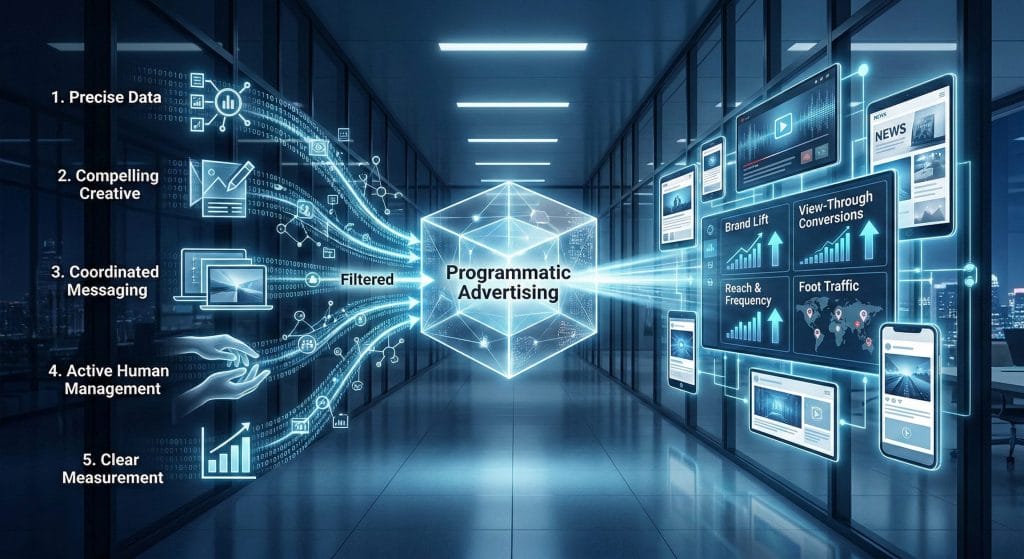
Programmatic Advertising
