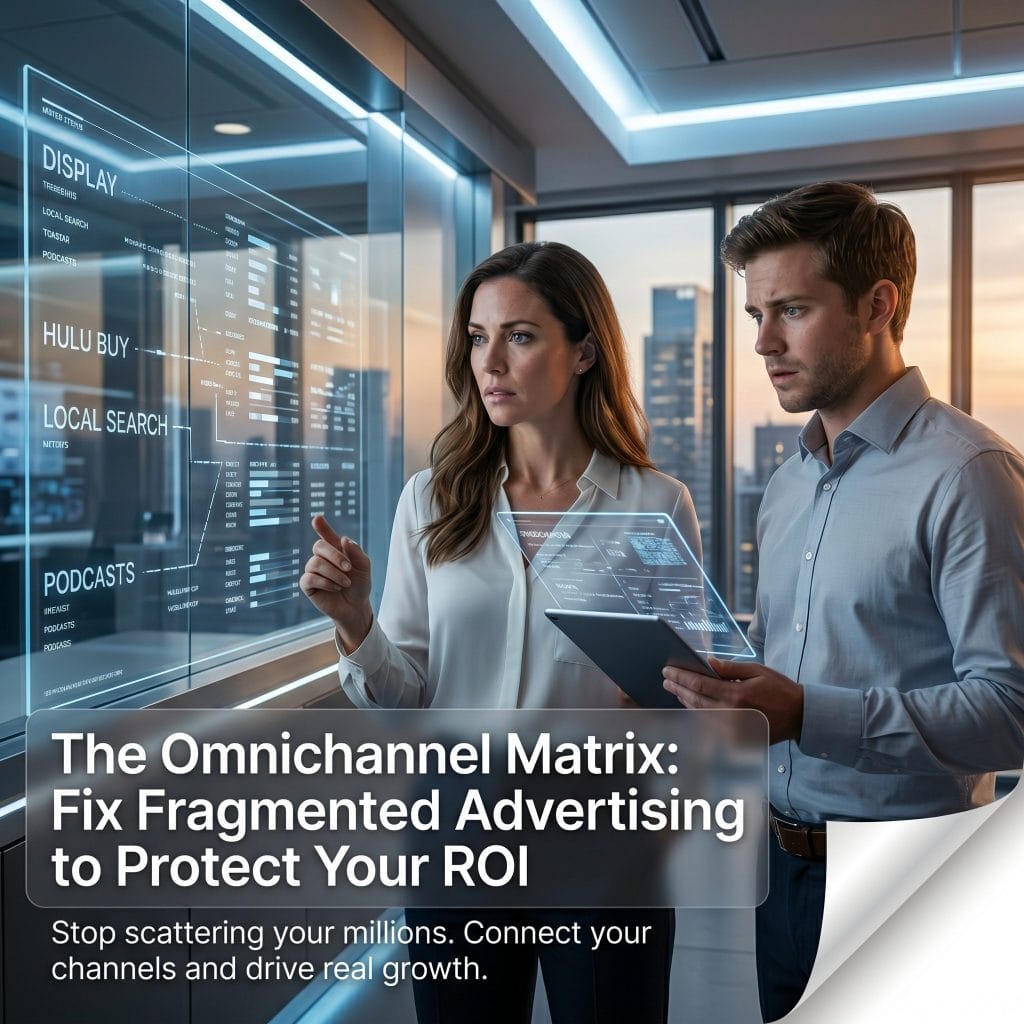
Chief marketing officers and business owners are staring at dashboards that look like a broken window. One vendor handles display. Another manages a disconnected Hulu buy. A third promises results with localized search, while a separate agency tries podcast sponsorships. Millions of dollars scatter across the web, and no one knows which dollar drives the bottom line.
The problem is noise, not data. Consumers don't live in single-channel silos. They move across screens, devices, and platforms all day long.
If your marketing strategy relies on separate vendors who don't communicate, your brand talks to fragments of a person. To protect your market share, you need to switch from fragmented media buying to an integrated approach.
Technology changes quickly, but human behavior stays the same. To convince a buyer to switch to your brand, your advertising has to overcome cognitive load, choice paralysis, and low trust.
The average American sees thousands of ads daily. The human brain filters out most of this noise. A generic banner ad or a random pre-roll video gets ignored instantly.
To bypass this filter, your message needs immediate context. A consumer reading about home renovations will notice an ad for a local mortgage broker. The brain accepts the ad as information rather than an interruption. When you align your message with what the reader is already thinking about, you remove the friction that ruins traditional campaigns.
Familiarity builds preference. If a prospective client sees your brand once on a LinkedIn ad, they forget it. If they see your brand in a publication, hear an audio ad on Spotify, and see your commercial on Roku or Fire TV, their perception changes. The buyer starts viewing your company as an industry leader. Multi-channel saturation builds credibility and lowers the perceived risk of buying from you.
Omnichannel execution requires an understanding of how media channels interact throughout the customer journey.
Traditional cable can't deliver targeted audiences. Viewership has shifted to platforms like Hulu, Roku, Fire TV, and Apple TV.
Streaming TV combines big-screen storytelling with precise digital targeting. You can run unskippable video assets directly to verified households, eliminating expensive and wasteful local news slots. Unlike legacy linear TV with its massive waste and static demographics, Streaming TV offers household-level targeting, digital tracking and attribution, and dynamic behavioral layering.
Video captures attention through sight, sound, and motion. Digital video acts as the foundation for your brand building, whether you use a 15-second pre-roll before a video or an outstream unit inside an industry publication. It holds attention and primes users for retargeting.
Consumers spend a lot of time away from screens. They listen to Spotify while working out, Pandora while cooking, and podcasts during commutes. Audio advertising enters the listener's mind through a focused channel, keeping your brand top-of-mind when phones are in pockets.
Display and native ads support your broader video and audio campaigns. Display banner ads across websites offer cost-effective reach and form the baseline for site retargeting. Native ads match the visual style of the host website, and because they look like content, they generate engagement among skeptical audiences.
Car dealerships operate in competitive, tight geographic environments. A customer looking for a vehicle rarely travels more than 30 miles if a choice exists closer to home. Winning the local market requires precision.
Picture a buyer walking onto a competitor's lot on a Saturday morning. They're testing vehicles and speaking with a rival salesperson. Their intent to purchase is immediate.
Using geofencing technology, we draw a virtual boundary around that competitor's lot. The moment that prospect opens a mobile app, our system logs their device ID. While standing on that lot (or shortly after leaving), the prospect sees ads highlighting your dealership's incentives, including higher trade-in valuations or lower monthly lease rates. This intercepts high-intent buyers exactly when they're making a decision.
Geofencing extends beyond the physical lot. We match the device ID back to the individual's residential network. When the shopper returns home and turns on their television to watch a movie on Hulu, they see your 30-second commercial. The next day, they walk into your showroom.
Data gives life to media channels. We use five targeting strategies to maximize your budget.
Addressable Targeting. We take a physical list of home or business addresses from your CRM and match them against the digital ecosystem. We inject targeted display, video, and streaming TV ads directly into those specific households, warming up cold accounts before your sales team calls.
Site Retargeting. Most website traffic leaves without filling out a form or calling. Site retargeting ensures that when a prospect leaves your site, your tailored messaging follows them across the web to bring them back.
Search Retargeting. Search engine marketing can get expensive for competitive keywords. We track the keywords users search for across major platforms, then target those users with cost-effective display and native ads as they browse the web over the next 30 days. You capture search intent at lower programmatic prices.
Contextual and Behavioral Targeting. By analyzing browsing behavior and demographic profiles, we place your ads alongside content that matches your audience's habits. Your brand appears next to the topics your buyers care about.
Here's a framework to align your channel configuration with your specific business goals:
| Your Goal | Channel Mix | What It Does |
|---|---|---|
| Local Market Awareness | Geofencing + Display | Drive local foot traffic with location targeting |
| Competitor Conquesting | Geofencing + Addressable | Intercept active buyers at rival locations |
| Enterprise Brand Building | Streaming TV + Video + Audio | Establish market authority with CRM data |
| High-Volume Web Traffic | Native + Search Retargeting | Drive traffic with intent keywords |
| Pipeline Reclamation | Site Retargeting | Reclaim lost traffic and lower acquisition costs |
| Database Monetization | Addressable + Streaming TV + Native | Convert existing lead lists |
Running a business requires efficiency. Your marketing infrastructure should match that standard.
The gap between companies using unified ad networks and those relying on fragmented models is widening. Your audience is moving across screens right now. Visit Full Force Ads to schedule a platform demonstration.