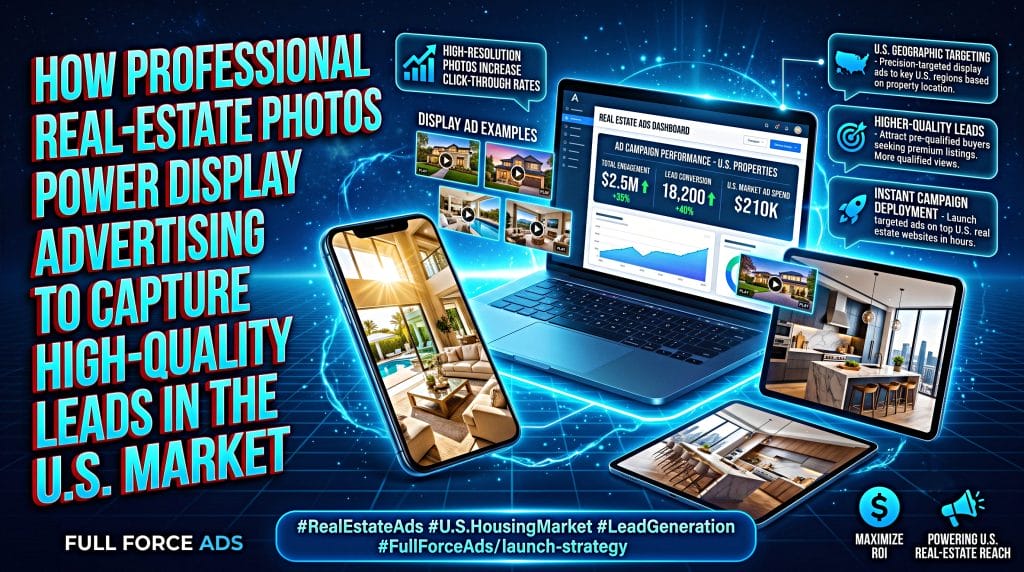
In a crowded online marketplace, a picture truly is worth a thousand clicks. For U.S. real-estate agents, brokers, and developers, the visual quality of a listing can be the single deciding factor that turns a browser into a qualified lead. When high-resolution, professionally staged photos are paired with a well-targeted display-advertising campaign on a self-serve platform, the result is a steady stream of interested prospects ready to schedule showings, request more information, or begin the buying process.
This article explains why professional estate photography is essential for display ads, outlines a step-by-step launch strategy that complies with Google E-E-A-T (formerly E-A-T) and Amazon's AEO guidelines, and shows how you can implement the plan on a self-serve platform without agency overhead.
| Key Metric | Industry Insight (2023-2024) | What It Means for You |
| Click-through rate (CTR) for image-rich ads | 1.8% vs. 0.7% for text-only ads (IAB) | Visuals boost engagement by more than 150% |
| Average time on page after clicking a photo-heavy ad | 2 minutes 34 seconds | Higher dwell time signals intent, improving lead quality |
| Conversion rate for listings with professional photography | 32% higher than listings with amateur photos (National Association of Realtors) | Professional shots directly translate into more inquiries |
Users form an opinion within the first 0.1 second of seeing an image, so a crisp, well-lit photo instantly conveys credibility. Staged rooms that showcase lifestyle — a sun-lit breakfast nook, for example — tap into the buyer's imagination and prompt the emotional response that fuels action. Professional photography also signals that the seller has invested in the property, reducing perceived risk for prospective buyers and increasing the likelihood they reach out.
A self-serve advertising platform gives you full control over creative assets, targeting, budgeting, and performance reporting — all in one dashboard. For U.S. real-estate professionals, the most useful features are geofencing and ZIP-code level targeting to reach prospects in specific neighborhoods, school districts, or commuting corridors; dynamic creative optimization (DCO) to automatically serve the best-performing photo variant to each viewer based on device, time of day, and past behavior; lead-capture integrations that sync click-throughs directly to your CRM (e.g., Follow Up Boss, HubSpot); and real-time reporting on impressions, viewability, CTR, and CPL so you can pivot quickly. Because the platform is self-serve, you skip the agency markup, maintain data ownership, and stay compliant with Google's E-E-A-T and Amazon's AEO (Advertising Experience Optimization) guidelines.
Below is a step-by-step launch strategy you can implement on any leading self-serve platform.
Resource Tip: This framework is also featured on FullForceAds.com/launch-strategy, which offers downloadable templates and a checklist for quick execution.
| Checklist | Why It Matters |
| Photos should be at least 1200 x 628 px (Google Display Network minimum) | Ensures images render crisply on high-DPI screens |
| Shoot in RAW, export as JPEG or WebP (<150 KB per image) | Balances quality and load speed |
| Include at least 5 rooms: exterior, living room, kitchen, master bedroom, backyard | Gives buyers enough context to envision daily life |
| Use a professional photographer with real-estate experience | Correct focal length and lighting equipment make a measurable difference |
For the ad copy, keep the header under 30 characters — something like "Your Dream Home Awaits – See Inside!" — with a sub-header under 90 characters and a CTA like "Schedule a Showing →". On the visual side, use a single hero image that showcases the property's most compelling room. Keep white space generous, limit overlay text to no more than 10% of the image width, and add a small "Professional Photos" badge to reinforce credibility.
| Targeting Layer | Example for a Mid-Size Suburban Home |
| Geography | 30-mile radius around ZIP 78704 (Austin, TX) |
| Demographics | Age 30-55, household income > $100k |
| Behavioral | Recent searches for "4-bedroom homes" or "family-friendly neighborhoods" |
| Device | Prioritize desktop & tablet (higher likelihood of detailed property browsing) |
| Retargeting | Serve a second ad to visitors who spent > 30 seconds on the listing page during research hours |
Start with a daily budget of $75-$100 and adjust based on CPL as data comes in. For the bidding model, use Cost-Per-Click (CPC) with a maximum bid of $2.50, or Cost-Per-Lead (CPL) if the platform offers it. Set a frequency cap of 3 impressions per user per week to avoid ad fatigue.
The landing page should open with the same hero photo used in the ad to maintain visual continuity. Follow it with bullet-point property highlights (sq ft, lot size, schools), a short lead form asking only for name, email, phone, and preferred contact time, and trust badges such as "Member of NAR" or "Professional Photographer Certified." Integrate the form with your CRM via Zapier or native API so leads flow instantly into your follow-up pipeline.
| Optimization Loop | Action |
| Day 1-3 | Review viewability (> 70%) and initial CTR. Pause under-performing placements. |
| Day 4-7 | Activate Dynamic Creative Optimization: rotate alternate photos (kitchen vs. backyard) and let the algorithm choose the winner. |
| Day 8-14 | Refine targeting based on geographic performance (e.g., ZIP 78702 outperforms 78705). Adjust bids accordingly. |
| Ongoing | Conduct A/B tests on CTA copy ("Schedule a Tour" vs. "Get a Private Showing"). Track CPL; aim for <$20 for high-value homes, <$40 for entry-level listings. |
Even though display advertising lives outside organic search, SEO best practices still influence ad performance. Add descriptive alt tags to every photo (e.g., "sun-lit modern kitchen with stainless steel appliances – Austin TX") to improve accessibility and signal relevance to ad platforms that use image recognition. On landing pages, implement RealEstateListing schema (price, address, image, description) so search engines and AEO tools can confirm authenticity and boost ad trust scores. Target a PageSpeed Insights score of 90 or higher, since slow pages increase bounce rates and raise CPL. Finally, ensure images scale properly on mobile — over 55% of U.S. home-search traffic comes from smartphones (Zillow 2024) — and that forms are touch-optimized.
By aligning your display assets with SEO fundamentals, you reinforce the E-E-A-T signals that Google and other search engines reward, even when traffic originates from a self-serve ad network.
| Metric | Ideal Range for Real-Estate Display Ads |
| Impressions | 10,000-20,000 per week (depends on budget) |
| Viewability | > 70% (AEO standard) |
| CTR | 1.5%-2.5% (image-rich ads) |
| Cost-Per-Click (CPC) | $1.50-$2.80 |
| Cost-Per-Lead (CPL) | $15-$35 for upscale listings; $30-$50 for entry-level |
| Lead-to-Appointment Ratio | 20%-30% (qualified leads booked) |
For the Experience signal, showcase the photographer's credentials and a brief "About the photographer" snippet on the landing page. For Knowledge, include a short market analysis paragraph — for example, "Austin's Oak Hill sees 5% YoY price growth." Build Authority by linking to reputable sources like NAR statistics and local MLS data. Establish Trustworthiness with SSL (HTTPS), a clear privacy policy, and an opt-out for communications. On the ad quality side, ensure all images meet platform-specified size and format requirements with no deceptive overlays and accurate property details. Checking these boxes protects you from policy suspensions and builds confidence with prospective buyers.
Case study — Sunnyvale, CA townhome
A professional photographer captured 22 high-resolution images, including drone footage of the neighborhood, achieving an average 98% viewability when served. The ad was a single-image display unit featuring the open-concept living area with a "Schedule a Private Tour" CTA, which produced a 2.1% CTR — above the industry average. Targeting covered a 10-mile radius, ages 28-45, household income $120k+, and delivered a CPL of $18 with 12 qualified leads in the first week. The landing page used schema markup, loaded in 0.9 seconds, and integrated with HubSpot: 35% of clicks converted to leads, 5 showings were booked, and 1 sale closed at $950k. Against a $750 ad spend, that works out to a ROAS of over 1,200:1.
Start by hiring a local real-estate photographer or using a high-end camera with a wide-angle lens to capture or upgrade your property photos. Next, sign up for a self-serve display platform that offers DCO, geofencing, and CRM integration. From there, follow the launch plan at FullForceAds.com/launch-strategy — download the free checklist, plug in your assets, and go live within 48 hours. Then monitor, test, and refine using the metrics table above to keep CPL low and lead quality high.
In the American real-estate market, buyers are visual shoppers who scroll through countless listings before they pick up the phone. By investing in professional estate photography and pairing those images with a laser-targeted, self-serve display advertising campaign, you create a seamless visual narrative that captures attention, builds trust, and turns browsers into qualified leads — all while staying compliant with today's SEO, E-E-A-T, and AEO standards.
Start showcasing your properties the way they deserve to be seen, and watch the leads flow in.