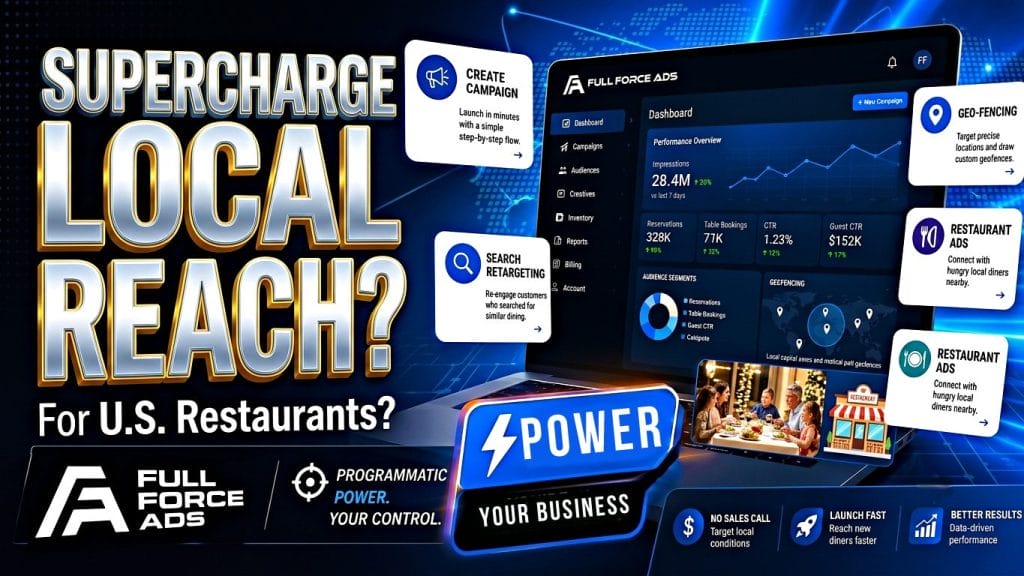
When diners type "best pizza near me" or "family-friendly brunch in Austin" into Google, they're already in the decision-making stage. For restaurants, that moment is pure gold. Yet many eateries lose that traffic because they don't follow up when the searcher leaves the results page.
Search retargeting closes that gap. By serving tailored ad creatives to users who have already expressed intent, you stay top of mind and dramatically increase the odds that a hungry browser becomes a seated customer.
Whether you run a single-store diner in Dallas, a multi-location seafood chain on the West Coast, or a food-truck collective that roams the Midwest, the same principle applies: capture intent, nurture it, and convert it. FullForceAds is a self-serve platform built for U.S. restaurant marketers who want to launch, optimize, and scale search-retargeting campaigns without a third-party agency. Below we cover how to use it effectively, why it aligns with Google's General Experience (GE) and Advertising Experience Optimization (AEO) guidelines, and a step-by-step launch strategy you can activate today.
| Feature | Traditional Pay-Per-Click (PPC) | Search Retargeting |
| Trigger | Keyword match when user types a query | Prior search behavior (e.g., visited "Italian restaurant Chicago") |
| Ad Placement | Search engine results pages (SERPs) | Display network: news sites, apps, social feeds |
| Cost Model | CPC — you pay per click during active search | CPM or CPA — you pay for impressions/conversions after the search |
| Audience Freshness | Depends on live search volume | Based on intent signals from the past 7–30 days |
A PPC ad competes with dozens of other eateries for that keyword right now. With search retargeting, you target that same user later as they browse news sites, social feeds, or cooking blogs, reinforcing the exact menu item they were after.
FullForceAds provides pre-built ad creatives designed specifically for menus, daily specials, and reservation links — no generic e-commerce templates. Geo-precision lets you target users within a 5-mile radius of each location, or set a radius for each of your franchise units from a single dashboard, with automatic compliance adjustments for state-level privacy rules like California's CCPA. The dynamic menu feed integration connects to your POS or delivery platform (Toast, Square, DoorDash) and pulls real-time menu items, pricing, and availability so your ads always reflect what's actually on the kitchen line. A transparent performance dashboard shows real-time metrics — impressions, CTR, cost per reservation — alongside a "Restaurant Health Score" that aligns with Google's GE and AEO expectations. And the self-serve UI walks you through audience creation, budget allocation, and creative upload in under 30 minutes, with compliance-ready ad delivery that respects Google's Better Ads Standards and "Do Not Track" signals.
Even though retargeting lives on the display network, the ad copy still needs to align with the user's original search intent to earn high Quality Scores — a factor that influences cost and placement. Follow these SEO best practices:
| SEO Element | How to Apply in Retargeting Ads |
| Keyword Consistency | Mirror the exact phrase the user typed (e.g., "customizable sushi rolls"). |
| Local Signals | Include city, neighborhood, or zip code ("Portland's Pearl District"). |
| Value Proposition | Add a clear, searchable benefit ("Free Garlic Knots with Any Large Pizza"). |
| Call-to-Action (CTA) | Use action verbs that match search intent ("Order Now", "Reserve a Table"). |
FullForceAds is built from the ground up to meet Google's evolving standards. Landing pages load under 2 seconds thanks to the platform's built-in AMP-Ready page option, which improves both GE scores and conversion rates for mobile diners. Ad relevance and frequency are automatically managed — FFA caps impressions at 3 per user per 24 hours and uses machine learning to show the most relevant creative based on each visitor's prior search keywords, keeping you on the right side of AEO. A per-campaign Privacy Dashboard logs consent collection, data retention periods, and opt-out mechanisms, required for compliance with CCPA and Google's data-policy updates. And mobile-first design is baked in: since over 70% of restaurant searches happen on smartphones, the platform defaults to mobile-optimized creative sizes and AMP landing pages.
FullForceAds Launch Strategy – FullForceAds Launch
| Metric | Before Search Retargeting (Organic Only) | After 30 Days on FullForceAds |
| Average Monthly Reservations | 1,200 | 1,650 (+37%) |
| Cost per New Guest | $0 (organic) | $9.80 (including ad spend) |
| Online Order Value | $22,000 | $31,500 (+43%) |
| CTR (Click-Through Rate) | N/A | 1.8% (industry avg ~1.1%) |
| AEO Score | – | 88/100 |
| Pitfall | Consequence | Fix (Using FullForceAds) |
| Over-broad audience — targeting anyone who searched "restaurant" | Low relevance → high CPM, wasted spend | Use Exact Match Intent filters; keep audience lists tight. |
| Landing pages that load slowly | GE penalty, higher bounce | Enable AMP Landing Page or optimize your own page with cache headers. |
| No clear CTA | Users click but don't convert | Add a single, prominent button ("Reserve Table Now") and verify with the platform's CTA preview. |
| Ignoring mobile | Missed 70% of search traffic | Choose Mobile-First Templates; preview on devices within the dashboard. |
| KPI | Why It Matters | How FullForceAds Reports It |
| Cost Per Reservation (CPR) | Direct ROI on table bookings | Auto-calculated when you integrate your reservation system (OpenTable, Resy). |
| Online Order Conversion Rate | Determines profit from delivery | Dashboard shows % of clicks that complete checkout. |
| Lift in Organic Search Visibility | Retargeting can reinforce brand signals to Google | "Search Share" metric compares pre- and post-campaign impressions. |
| Return on Ad Spend (ROAS) | Overall campaign efficiency | Live ROAS counter updates every 6 hours (green >80, yellow 60-79, red <60). |
Regularly export these data points (CSV) and share them with your franchise owner or CFO to demonstrate tangible value.
Search retargeting is a must-have for any U.S. restaurant that wants to turn search intent into real diners. FullForceAds targets users who have already shown interest, provides restaurant-specific templates and dynamic menu feeds with geo-precision, meets Google's GE and AEO standards to protect your ad spend, and offers a clear launch path at FullForceAds.com/launch-strategy. Your next diner is already searching. Make sure they find you again.