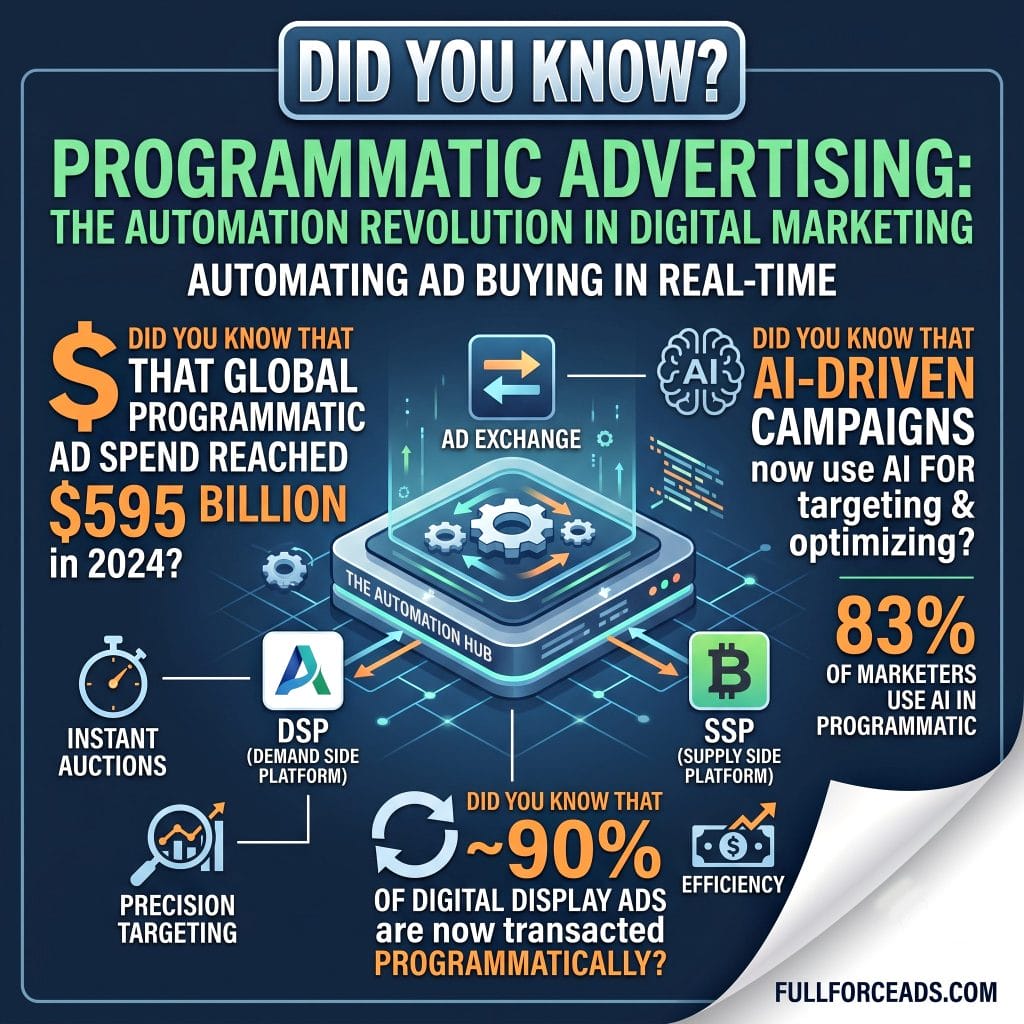
Programmatic advertising has transformed the way digital ads are bought, sold, and served. What was once a manual process involving phone calls, email negotiations, and insertion orders is now a sophisticated, automated ecosystem that transacts billions of ad impressions every day. By using data, algorithms, and real-time technology, programmatic advertising enables marketers to reach the right audience, at the right time, in the right context, at the right price — all in the time it takes a webpage to load.
Programmatic advertising refers to the automated buying and selling of digital advertising inventory through software and algorithms rather than human negotiation. Instead of advertisers manually requesting proposals, negotiating rates, and placing orders with publishers, programmatic systems handle these transactions electronically in real time.
The scale is staggering. The vast majority of digital display advertising in developed markets is now transacted programmatically. Every time a user loads a webpage or opens an app, a tricky chain of events unfolds in milliseconds: the available ad space is identified, information about the content and potential audience is transmitted to advertisers, algorithms evaluate whether the impression is worth bidding on, bids are submitted, a winner is determined, and the winning ad is served — all before the page finishes loading.
Programmatic advertising is not a single technology but an ecosystem of platforms, protocols, and processes that work together to automate the advertising transaction chain.
Understanding programmatic advertising requires familiarity with the key players and platforms that make up the ecosystem.
Demand-Side Platforms (DSPs): DSPs are the advertiser's gateway to programmatic buying. They allow advertisers to manage multiple ad exchange accounts and data sources through a single interface. DSPs provide targeting capabilities, bidding algorithms, budget management, and performance analytics. Major DSPs include The Trade Desk, DV360 (Google), Amazon DSP, and Xandr.
Supply-Side Platforms (SSPs): SSPs serve the publisher side of the equation. They help publishers manage their ad inventory, connect with multiple demand sources, and maximize revenue through automated auction processes. Major SSPs include Google Ad Manager, Magnite, PubMatic, and OpenX.
Ad Exchanges: Ad exchanges are digital marketplaces that connect DSPs and SSPs. They help the real-time auction process where ad impressions are bought and sold. Think of them as the stock exchanges of the advertising world.
Data Management Platforms (DMPs): DMPs collect, organize, and activate data from various sources. They help advertisers build audience segments, understand their audiences better, and target their campaigns more effectively. DMPs aggregate first-party data (from the advertiser's own sources), second-party data (from trusted partners), and third-party data (from external data providers).
Ad Servers: Ad servers are the technology that actually delivers the ad to the webpage or app. They manage the logistics of ad delivery, including frequency capping, creative rotation, and geographic targeting.
Verification and Analytics Tools: These tools ensure that ads are served to real humans in brand-safe environments and provide measurement and attribution capabilities. They help advertisers verify that their programmatic spend is delivering real value.
Not all programmatic transactions work the same way. Different buying methods offer different levels of control, pricing, and access.
Real-Time Bidding (RTB): The most common form of programmatic buying, RTB involves auctioning individual ad impressions in real time. Each time a user loads a page, an auction is held where multiple advertisers bid for the impression. The highest bidder wins and their ad is served. RTB is open to all advertisers and offers maximum flexibility.
Programmatic Direct: In a programmatic direct deal, the advertiser and publisher negotiate a fixed price for a guaranteed volume of impressions. The transaction is still automated — the ad serving happens through programmatic infrastructure — but the pricing and volume are predetermined. This offers more certainty than RTB.
Private Marketplaces (PMPs): PMPs are invite-only auctions where a select group of advertisers can bid on premium inventory from specific publishers. PMPs offer the quality and exclusivity of direct sales with the efficiency and targeting of programmatic buying.
Preferred Deals: In a preferred deal, an advertiser gets first look at a publisher's inventory at a fixed price before it is offered in the open auction. There is no guarantee of volume, but the advertiser has the option to buy at a set price.
Programmatic Guaranteed: The most premium form of programmatic buying, programmatic guaranteed offers fixed pricing, guaranteed volume, and premium inventory — all delivered through automated systems. It combines the certainty of traditional direct sales with the efficiency of programmatic.
The RTB process is a marvel of modern technology, completing a tricky transaction in approximately 100 milliseconds — faster than the blink of an eye.
Step 1 — User Visits a Page: A user navigates to a webpage or opens an app that contains programmatic ad inventory.
Step 2 — Bid Request Sent: The publisher's SSP sends a bid request to one or more ad exchanges. This request includes information about the ad slot (size, position), the page content (URL, category), and available data about the user (device type, location, browser — but not personally identifiable information in privacy-compliant systems).
Step 3 — Bid Request Forwarded to DSPs: The ad exchange forwards the bid request to connected DSPs. Each DSP evaluates the impression against its advertisers' targeting criteria, budget constraints, and bidding strategies.
Step 4 — Bids Submitted: DSPs that determine the impression is valuable submit bids. The bid amount is calculated in real time based on factors like the user's predicted value, the context of the page, the time of day, and the advertiser's campaign goals.
Step 5 — Auction Held: The ad exchange holds an auction among all submitted bids. Most programmatic auctions use a second-price model, where the winner pays one cent more than the second-highest bid.
Step 6 — Ad Served: The winning bidder's ad creative is transmitted to the publisher's ad server, which renders it on the page. The entire process is complete before the user perceives any delay.
Programmatic advertising offers transformative benefits that have made it the dominant method of digital ad buying.
Efficiency: Automation eliminates the manual processes that once consumed notable time and resources. Campaigns can be launched, adjusted, and optimized in real time without human intervention for routine tasks.
Precision Targeting: Programmatic platforms can evaluate hundreds of signals for each impression — context, location, device, time, weather, and more — to determine whether a specific user is worth bidding on. This precision far exceeds what is possible with manual buying.
Scale: Programmatic provides access to billions of ad impressions across millions of websites, apps, and connected devices. No manual buying process can match this scale.
Real-Time Optimization: Programmatic campaigns can be optimized in real time based on performance data. If a particular audience segment, placement, or creative is performing well, the system can automatically shift budget toward it. If something is not working, it can be paused immediately.
Transparency: Programmatic provides detailed reporting on where ads were shown, who saw them, and what results they generated. This transparency enables data-driven decision-making and continuous improvement.
Cost Efficiency: By bidding on individual impressions rather than buying bulk inventory, advertisers only pay for impressions that meet their targeting criteria. This eliminates waste and improves return on ad spend.
Despite its many advantages, programmatic advertising faces notable challenges that advertisers must navigate.
Ad Fraud: The programmatic ecosystem is vulnerable to various forms of ad fraud, including domain spoofing (fraudulent sites impersonating legitimate publishers), bot traffic (non-human impressions), and click injection (fraudulent attribution of organic installs). Industry estimates suggest that ad fraud costs advertisers billions of dollars annually.
Brand Safety: The automated nature of programmatic buying means that ads can appear alongside inappropriate content if proper safeguards are not in place. High-profile incidents of ads appearing next to extremist content or misinformation have made brand safety a top concern.
Ad Blocking: The growth of ad blockers reduces the reach of programmatic display advertising. Advertisers must balance the desire for reach with the need to respect user experience and avoid driving users to install ad blockers.
Complexity: The programmatic ecosystem is tricky, with multiple platforms, data sources, and intermediaries involved in each transaction. This complexity can make it difficult for advertisers to understand exactly where their money is going and what value they are receiving.
Viewability: Not all programmatic impressions are actually seen by users. Ads may be served below the fold, on background tabs, or on pages that users quickly abandon. Viewability measurement and optimization are essential for ensuring that programmatic spend delivers real value.
Privacy Compliance: Programmatic advertising relies heavily on data, making it subject to privacy regulations like GDPR and CCPA. The deprecation of third-party cookies is forcing notable changes in how programmatic targeting works.
The programmatic market is evolving rapidly, driven by technological innovation and regulatory change.
Connected TV (CTV): Programmatic buying is expanding beyond digital display and into television. CTV programmatic allows advertisers to reach streaming TV audiences with the same precision and measurement that digital advertising provides.
Audio Programmatic: Podcasts and streaming music services are increasingly offering programmatic ad inventory, enabling automated buying of audio ads at scale.
Retail Media Networks: Retailers like Amazon, Walmart, and Target are building programmatic advertising platforms that use their first-party purchase data to offer highly targeted advertising on their properties.
Privacy-First Programmatic: The industry is developing new approaches to programmatic advertising that work without third-party cookies. Google's Privacy Sandbox, Unified ID 2.0, and other initiatives aim to preserve targeting effectiveness while respecting user privacy.
AI and Machine Learning: Artificial intelligence is making programmatic advertising smarter and more efficient. AI-powered bidding algorithms can process vast amounts of data to make better bidding decisions, predict conversion probabilities, and optimize campaigns in real time.
Supply Path Optimization (SPO): Advertisers are increasingly focused on optimizing their programmatic supply paths — choosing the most efficient routes to reach their target audiences rather than buying through every available intermediary. SPO reduces costs and improves transparency.
Programmatic advertising represents a fundamental shift in how the advertising industry operates. By automating the buying and selling of ad inventory, programmatic technology has made advertising more efficient, more measurable, and more effective than ever before. While challenges like ad fraud, brand safety, and privacy compliance require ongoing attention, the trajectory is clear: programmatic is the present and future of digital advertising. Marketers who master programmatic buying — understanding the ecosystem, using data effectively, and optimizing continuously — will be best positioned to deliver results in an increasingly automated and data-driven advertising market.