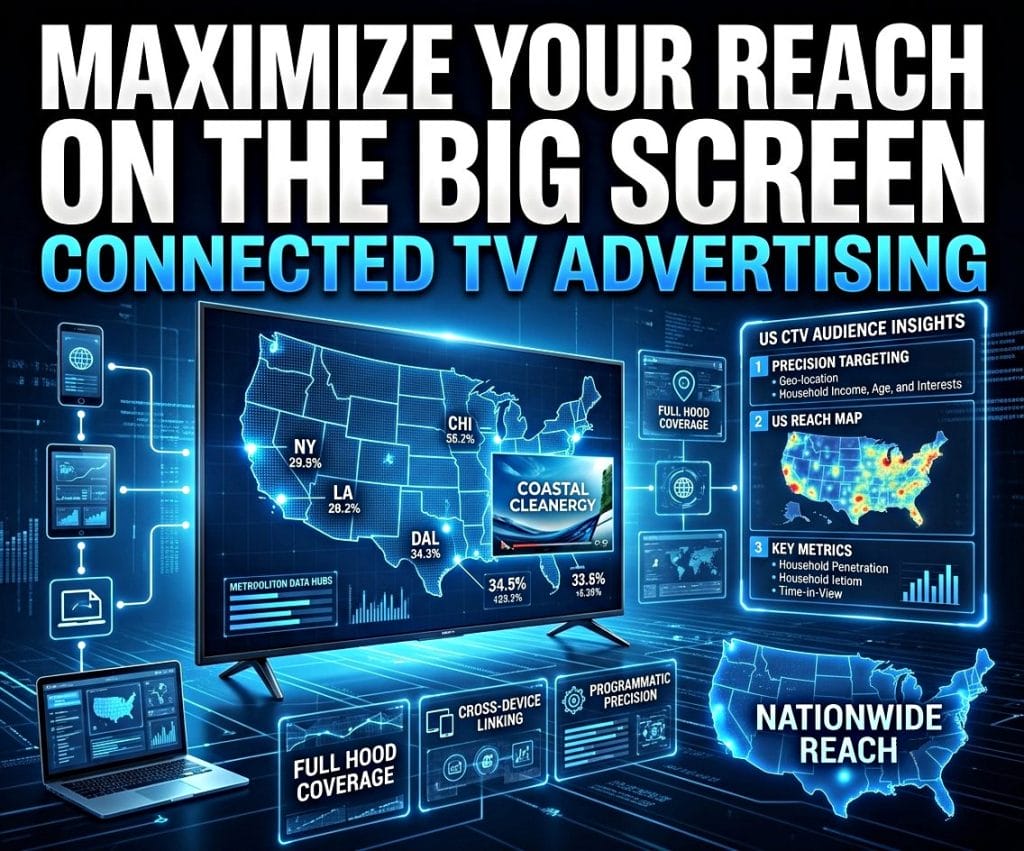
Connected TV (CTV) has transformed the way US consumers watch television. With over 85% of households now watching content on streaming devices, smart TVs, gaming consoles, or over‑the‑top (OTT) apps, CTV offers a premium, brand‑safe environment to reach audiences at scale. Unlike traditional linear TV, CTV provides granular targeting, real‑time measurement, and the ability to serve dynamic creative. For US advertisers looking to complement digital channels with a high‑engagement TV experience, CTV delivers a unique blend of broadcast reach and digital precision. This guide outlines the core components of CTV advertising, practical tactics for implementation, and strategies to maximize ROI in the American market.
More than 150 million US households now stream content every week, outpacing traditional broadcast viewership. Ads can be served based on demographics, viewing habits, device type, and even household composition, and CTV platforms report impression counts, view-through rates, and conversion tracking that line up with digital KPIs. OTT inventory tends to be curated, which cuts the risk of an ad landing next to unsafe content. Pairing CTV with mobile, desktop, or email retargeting creates a fuller omnichannel experience, and viewers are more likely to notice and remember an ad on a large screen than on a mobile banner.
| Format | Description | Typical Length | Best Use Cases |
|---|---|---|---|
| Pre‑Roll | Video ad played before the main content (e.g., before a movie or TV episode). | 5‑30 seconds | Brand awareness, short‑form messaging. |
| Mid‑Roll | Ad inserted in the middle of longer content (e.g., a 45‑minute series). | 5‑15 seconds | Reinforce message, support offers. |
| Post‑Roll | Ad shown after content finishes; often used for sponsorship credits. | 5‑10 seconds | Call‑to‑action, brand recall. |
| Interstitial | Full‑screen ad that appears between scenes or episodes. | 5‑15 seconds | High‑impact moments, limited‑time offers. |
| Sponsored Content | Branded content integrated directly into the streaming service (e.g., a show segment). | Variable | Long‑form storytelling, product placement. |
| Display Overlay | Graphic overlay on top of video without interrupting playback. | Variable | Subtle brand reinforcement, product placement. |
Demographic targeting covers age, gender, household income, and education level, while geographic targeting can drill down to state, DMA, ZIP code, or even city level. Device and platform targeting distinguishes between smart TVs, streaming sticks, gaming consoles, mobile, and web apps. Audience segments include affinities such as sports fans or health-conscious viewers, in-market audiences, and custom segments built from data partners. Contextual targeting aligns ads with content categories like sports, lifestyle, or entertainment using IAB taxonomy, and first-party data such as CRM lists, website visitors, or app users supports precise match-based targeting. Frequency capping controls how many times a household sees the same ad to avoid fatigue, and dayparting schedules ads during peak viewing hours, such as prime time between 8 and 11 PM, for maximum impact.
Vertical video at 9:16 works well for mobile-first viewers who may start watching on their phone before casting to the TV. High-resolution assets, whether 1080p or 4K, keep the picture sharp on a large screen, and file size should stay under 5 MB for fast loading. A clear call to action, using concise copy like "Shop Now" or "Learn More" paired with a prominent button or URL, gives viewers an obvious next step. Brand consistency means keeping logo placement, color palette, and tone the same across every CTV creative. Storytelling works best within a 15 to 30 second arc: open with a hook, present a benefit, and close with a CTA. Audio should stay balanced and include captions, since roughly 40% of CTV sessions run with the sound off, and on platforms that support it, clickable overlays like "Tap to Learn More" add an interactive layer.
Viewability follows the IAB standard of 50% of the ad visible for at least one second for display or two seconds for video. Completion rate tracks the percentage of viewers who watch an ad all the way through, and higher rates point to stronger creative relevance. Conversion tracking, through pixel or server-side methods, attributes purchases, sign-ups, or app installs back to CTV impressions. Multi-touch attribution combines CTV data with first-click, view-through, and cross-device data to piece together the full customer journey. Incrementality testing uses holdout groups, such as 5% of households left unexposed, to measure the true lift in sales or leads. ROAS and CPA benchmarks should be compared against traditional TV, which carries a high CPM and low measurability, and digital channels, which run lower CPM with higher measurability. Heatmaps and attention tracking use eye-tracking or platform analytics to show where viewers actually focus within the frame.
Google Ads and Display & Video 360 bring together CTV inventory across YouTube TV, Roku, and other OTT partners. The Trade Desk offers CTV programmatic buying with access to premium inventory and advanced audience segments. Amazon OTT draws on Amazon's first-party data for precise household targeting and shoppable ads. SpotX, now part of Xandr, provides programmatic CTV inventory with real-time bidding. Nielsen, comScore, and TVision offer measurement solutions for reach, frequency, and audience demographics, and Adobe Advertising Cloud enables cross-device attribution and folds CTV data in with other digital channels.
Rotating ad creative every two to three weeks keeps messaging fresh and fights viewer fatigue. Dynamic creative optimization automatically swaps product images, pricing, or offers based on the audience segment being served. Dayparting means increasing spend during high-view periods, like prime time or weekend evenings, and pulling back during off-peak hours. Frequency capping limits impressions to two or three per household per week, adjusted based on whether the goal is awareness or conversion. Audience layering combines demographic, behavioral, and contextual signals to build high-value audience slices. Creative testing through A/B tests on hooks, CTAs, and visual styles helps identify the concepts that perform best. Budget allocation should favor top-performing formats, such as pre-roll, over weaker mid-roll slots, and pairing CTV ads with concurrent digital retargeting, like display or email, reinforces the message across channels.
Addressable CTV enables real-time, household-level targeting that serves a different ad to each TV based on user data. Generative AI will increasingly produce dynamic video variants tailored to individual viewer profiles. Privacy-first targeting is drawing more on contextual signals and first-party data as third-party cookies fade out. Shoppable CTV builds a purchase path directly into the viewing experience, letting someone click a CTA and buy from the TV interface. Interactive CTV adds clickable hotspots within videos so viewers can explore product details without leaving the stream. Data-driven creative adjusts in real time based on viewer engagement metrics, including attention heatmaps.
Connected TV advertising offers US brands a powerful, measurable way to reach a large, engaged audience on the biggest screen in the home. By using precise targeting, high‑impact creative formats, and robust measurement tools, marketers can drive awareness, consideration, and conversion while maintaining brand safety. As CTV continues to grow and technology evolves, staying ahead of trends, such as addressable TV and AI‑driven creative, will help ensure that CTV remains a cornerstone of any modern US media mix.