Most businesses don't have an attention problem. They have an attention fragmentation problem. A customer might watch a show on Hulu at 8pm, catch a podcast on the drive to work, read an industry newsletter at lunch, and scroll their phone before bed, all in one day, all on platforms owned by different companies that don't talk to each other.
Betting your whole marketing budget on one channel used to work. Build a business on Google Ads, or grow fast through Meta alone. Those days are gone. A single-channel strategy is a single point of failure: an algorithm update can cut your traffic overnight, a platform can raise its prices without warning, and a privacy change can blind your tracking with no notice at all.
This guide covers how full-funnel digital advertising actually works: the channels, the targeting layers, and why running them together beats running them separately.
An omnichannel strategy works by building a chain of touchpoints that reinforce each other, not by throwing ads everywhere and hoping something sticks.
Someone might first notice your brand through an ad on their Roku while they're on the couch. The next morning, they hear an audio spot on Spotify. That afternoon, a native ad blends into an article they're reading, and later a display banner shows up because they match a behavioral profile you're targeting. By the time that person is ready to buy, you're not one option among many. You're already familiar.
That's the real value of running channels together instead of separately: awareness compounds instead of resetting every time a prospect switches screens.
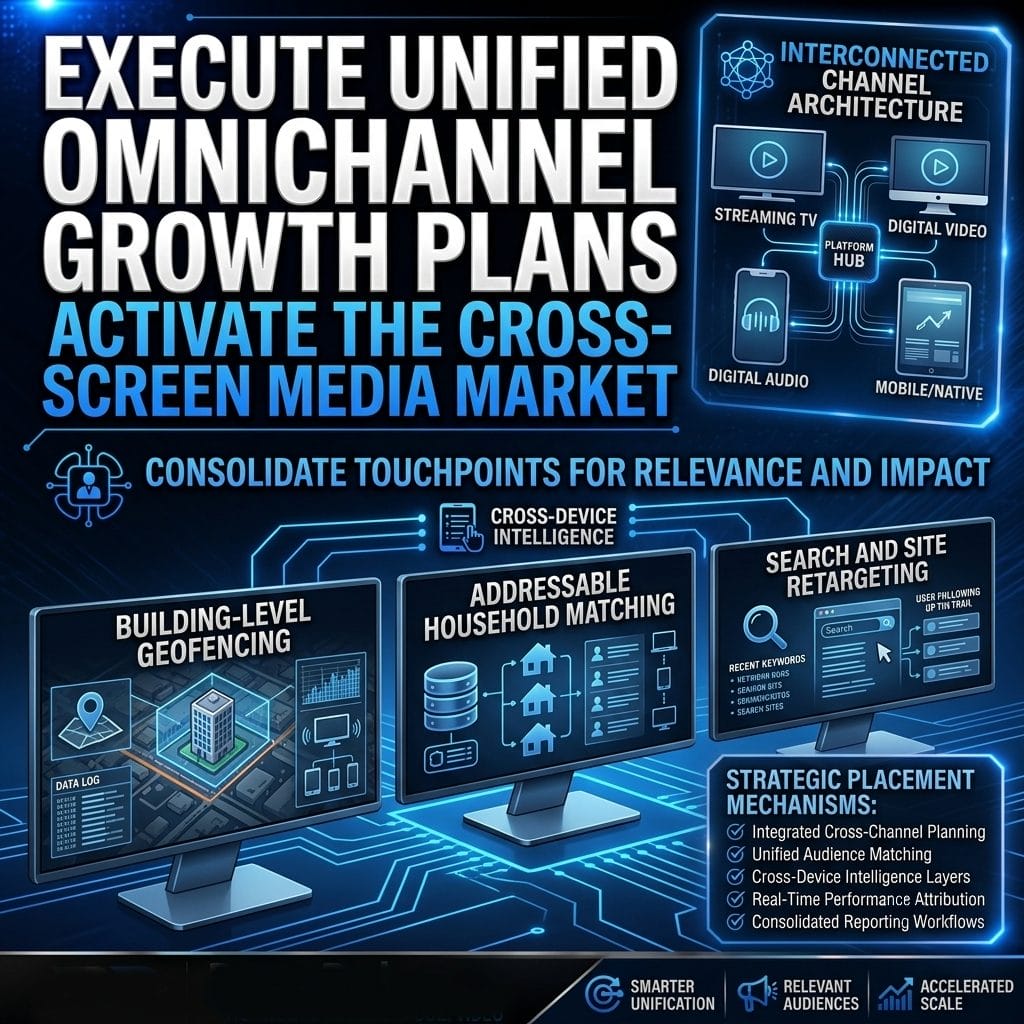
Connected TV used to require a network-size budget. Now any business can run targeted ads on Roku, Fire TV, Apple TV, and Hulu.
Two things make it different from linear television. People can't skip it the way they skip a YouTube pre-roll, so completion rates run high. And targeting is based on actual household data instead of the broad demographic guesswork that traditional broadcast buys rely on.
Where CTV owns the living room, digital video owns the workday. Pre-roll, mid-roll, and outstream video units run across news sites, apps, and editorial content, catching people while they're already reading or watching something else. It works because it hits sight, sound, and motion at once. Done well, an outstream ad expands as someone scrolls through an article without feeling like an interruption.
A lot of the day happens with a phone in someone's pocket and their eyes elsewhere: driving, working out, cooking, walking the dog. Audio placements on Spotify, Pandora, iHeartRadio, and podcasts reach people in exactly those moments. Because people choose their audio on purpose, these placements tend to land with more trust than something they're half-ignoring on a screen.
Phones go everywhere their owners go, which makes mobile the channel best suited to real-world context. A location-aware campaign can react to where someone is standing right now, close enough that a walk past a storefront turns into an ad on their lock screen an hour later.
Display gets dismissed as old news, but it's still the workhorse of most campaigns. It's cheap, it scales, and it's rarely the thing that closes a sale on its own. Its job is to keep a brand visible after the first contact and to feed the audience pools that other channels use for retargeting.
People have gotten good at ignoring banner ads. It's a learned reflex, sometimes called banner blindness. Native ads sidestep it by matching the look and format of the surrounding content instead of visually competing with it. An ad that reads like the article next to it gets read.
None of the channels above matter if the ad reaches the wrong person. Buying impressions without targeting is just funding waste. Here are the five targeting methods that make the spend count.
A geofence draws a virtual boundary around a real-world location, like a competitor's storefront, a trade show, or a specific neighborhood, and captures the device IDs of people who walk through it. Once someone's device is in that pool, you can serve them ads while they're still nearby, or follow them home and show up on their TV and desktop days later. It's especially effective for competitor conquesting and account-based B2B targeting.
Addressable targeting takes a CRM list or a direct-mail database and maps those physical addresses to household IPs and connected devices. Instead of printing flyers that end up in the recycling bin, you can put the same message in front of the same households digitally, with far less waste.
Most first-time visitors, somewhere around 95 to 98 percent by most estimates, leave a website without converting. Site retargeting is the follow-up: it tracks what pages someone viewed and shows them an ad built around that specific interest, like a case study tied to the exact service page they read.
Search retargeting goes after people who've never visited your site but who typed in a search term related to what you sell. It's a way to reach high-intent traffic without paying search-ad prices for every click.
And contextual targeting places your ad next to content on the same topic. A logistics software company's ad shows up next to an article about supply chain disruptions. The person reading it is already thinking about the problem, which makes the ad land differently than if it showed up at random.
As companies grow, it's common to hand different channels to different vendors: one for search, one for social, one for streaming TV, one for local geofencing. It feels like specialization. In practice it usually creates three problems.
The first is attribution. Each vendor tracks its own conversions in its own silo, and each one tends to claim full credit for any sale that touched its channel. Add up all three reports and the numbers won't come close to matching actual revenue, which leaves whoever's in charge of the budget guessing at what's really working.
The second is frequency exhaustion. Without shared frequency caps, the same person can get hit with your ad six times on one platform and four times on another in a single afternoon. That doesn't build brand recognition. It builds annoyance, and it burns spend on redundant impressions.
The third is slow reallocation. If display is underperforming and CTV is picking up steam, shifting budget between four separate vendor contracts means calls, renegotiations, and delays. By the time the money moves, the opportunity that prompted the shift is often gone.
Running the whole mix through one platform fixes all three: shared tracking gives one clean number, shared frequency caps stop the pile-on, and budget can move to whatever's working without a contract renegotiation.
There's no universal campaign template. A strategy built to drive local foot traffic looks nothing like one built to establish a national brand.
Local awareness usually comes down to mobile, display, and native layered with tight geofencing, with foot traffic as the number to watch. Competitor conquesting leans on geofencing and addressable targeting aimed at competitor locations and event zones, measured in market share and conquest conversions. Brand building at scale wants streaming TV, video, and audio, using contextual and behavioral targeting to build recall over time. Lead generation tends to run on display, native, and video paired with search retargeting to lower cost per acquisition. Recovering an abandoned funnel is a job for site retargeting and display aimed at recent visitors, to cut drop-off. And activating an existing customer database works best through addressable targeting combined with streaming TV and display, since it gets the most out of first-party lists.
A car dealership and a regional medical group, for example, don't measure success in clicks. They measure it in people walking through the door. A local awareness play surrounds a facility's radius with mobile and display ads layered on geofencing, so anyone nearby keeps seeing the brand. A conquesting play takes it further, fencing a competitor's lot directly so that someone browsing cars two miles away sees an offer from you before they've even left.
A lot of agencies still hide behind vague reports full of impression counts and click-through rates that don't tell a client much of anything. That's a choice, not a technical limitation, and one clients shouldn't accept.
Good reporting means you can see the actual sites, apps, and networks your ads ran on, not just a category like "premium streaming platforms." It means tracing a line from a specific ad view to a specific form fill or sale by connecting placement data to your CRM. And it means an invoice that breaks down media cost, platform fees, and management fees separately, with nothing buried.
When you can actually see which channels are driving results, budget decisions stop being guesswork.
At Full Force Ads, the process runs in four stages.
It starts with discovery: a conversation about your business, your ideal customers, your competitors, and what success looks like. No pitch, just figuring out where the gaps are.
From there comes strategy, a media mix and targeting plan built around your specific budget and goals, with a clear explanation of what's being deployed and how it'll be measured.
Launch usually takes 5 to 7 business days once creative is in hand, since everything runs through one platform instead of being coordinated across separate vendor systems.
And then optimization and reporting continue every week after that: budget shifts toward what's converting, and you get a report that actually shows where the money went and what it did.
Advertising keeps splintering across more platforms, more devices, and more apps, and neither a single-channel strategy nor a pile of disconnected vendors holds up well against that. Running streaming TV, audio, native, geofencing, and retargeting together, through one platform with one data set, is what makes the difference between chasing a fragmented audience and actually staying in front of it.
If you want to see what this looks like for your specific market, Full Force Ads runs discovery calls to map out a channel mix built around your goals.