American retail and B2B buying no longer happens in one place. A shopper in Salt Lake City might check reviews on their phone while browsing a store, hear a podcast ad on the drive home, and finish the purchase from a link on their TV over the weekend. None of that feels like separate "channels" to the shopper. It's just Tuesday.
For agencies managing client growth, that creates a real problem: marketing built around a single channel can't keep up with attention that's scattered across five screens a day. Reaching people now means showing up, with the right message, wherever they happen to be.
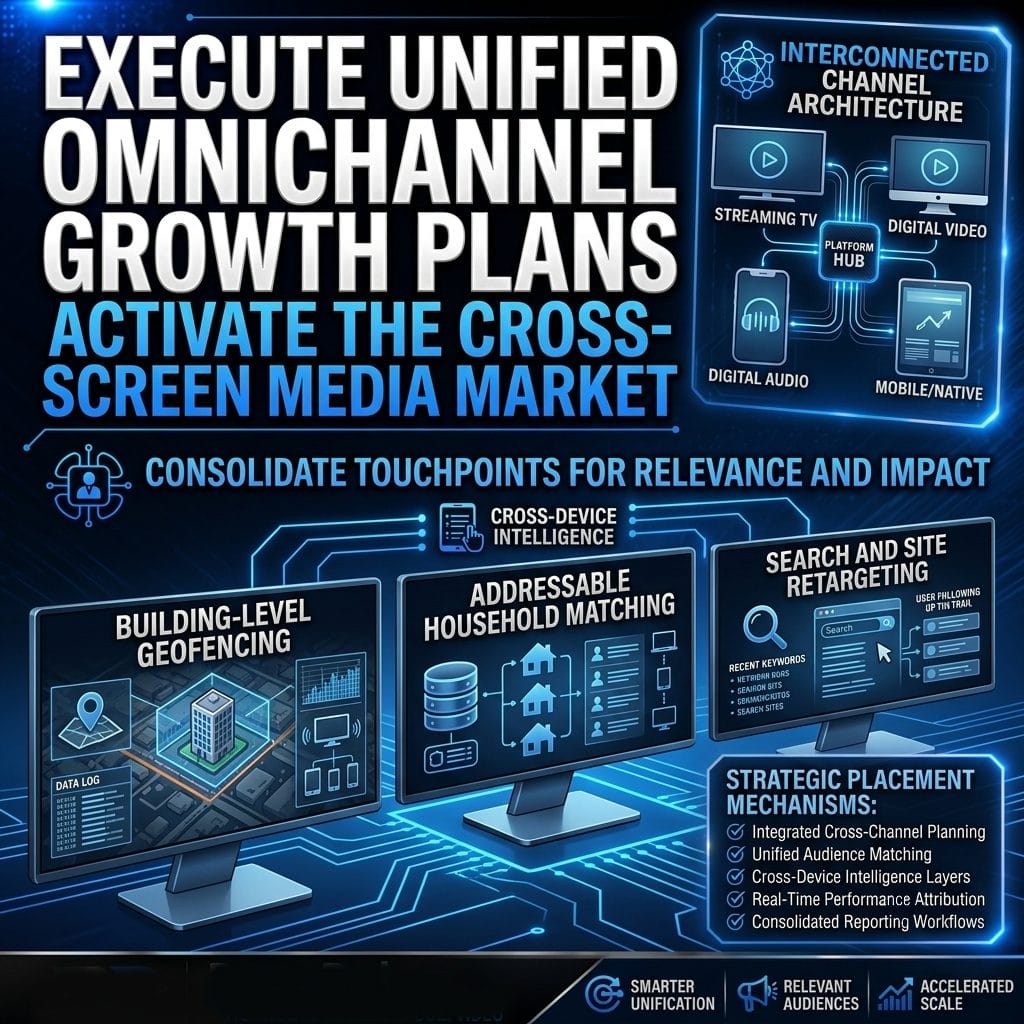
FullForceAds, based in Sandy, Utah, built its programmatic infrastructure around that reality. Streaming TV, video, audio, mobile, display, and contextual placements all run from one platform, so fragmented touchpoints turn into something an agency can actually plan around.
Relevance drives revenue. Most campaigns don't fail because of weak creative or a small budget. They fail because the ad shows up at the wrong time, on the wrong device, while the person's attention is somewhere else entirely.
Modern ad tech tries to fix that by matching ads to context using data and machine learning. When the ad fits what someone is already doing, it doesn't feel like an interruption.
Take a typical purchase path. Nobody sees an ad and buys immediately. It usually looks more like this: while watching a show on Roku or Fire TV, the viewer sees a polished, unskippable video ad that builds brand recall. The next morning, during a drive or a workout, a podcast ad on Spotify reinforces that same message, landing during one of the few screen-free moments in someone's day. Later that afternoon, while reading a local news article, a native ad that blends into the page's layout shows up with a direct call to action.
Spreading touchpoints across the whole media market (not just one social platform) means a brand isn't stuck at the mercy of one algorithm change. An omnichannel approach follows the consumer to wherever they actually spend time.
Hitting that multi-screen journey requires direct access to the full range of digital channels, unified under one partner instead of split across five vendors.
| Channel | Core Function |
|---|---|
| Streaming TV | The big screen, unskippable brand impact |
| Digital Video | Sight, sound, and motion via pre-roll and mid-roll |
| Digital Audio | Screen-free attention on Spotify, Pandora, and podcasts |
| Mobile & Native | In-app, location-based, in-feed action |
| Display Ads | Scalable foundation for broad retargeting |
Mobile advertising works because a phone tracks where someone goes, what they search, and how they browse, which makes it one of the most useful signals available. It reaches people through in-app placements, mobile web banners, and location-based notifications, and for brick-and-mortar retailers, it's the clearest link between a digital impression and an actual store visit. Contextual advertising takes a different approach, skipping personal tracking and targeting the environment instead: an outdoor apparel brand can run ads next to hiking and camping content, so the product shows up while the reader's mind is already on the topic.
Video and audio drive discovery, but display and native ads do the heavy lifting on conversion and retargeting. Standard banners across high-traffic sites keep a brand visible at low cost, while native ads match the look of the page they're on, which helps them get noticed instead of scrolled past. TV is still the screen people trust most, but traditional cable can't target the way digital can. Streaming TV, or connected TV, combines the visual scale of a TV commercial with targeting down to the household, and through Hulu, Roku, Fire TV, and YouTube TV, brands buy exact impressions to in-market households instead of a broad local cable slot and a guess.
People also watch billions of hours of video on phones, tablets, and desktops, and pre-roll, mid-roll, and outstream video keep the message consistent even as someone switches from the TV to their phone mid-evening. A campaign built only around visual screens misses the moments when people are driving, cooking, or working out with their phone in a pocket. Audio ads on Spotify, Pandora, and podcasts reach people then, and tend to post strong recall numbers because there's no visual clutter competing for attention.
Picking the right channel is only half the job. A beautiful streaming TV ad served to someone outside the delivery area, or with no interest in the product, is still wasted spend. Targeting is what makes the channel work.
Geofencing at the building level. A broad 3-mile radius around a store wastes money on people who were never going to buy. Geofencing draws a line around the actual shape of a building instead. That opens up a few tactics:
Addressable audience matching. For brands with CRM lists, email opt-ins, or direct-mail data, addressable targeting connects those offline records to the devices inside those homes. Upload a list of physical addresses, and the system can serve streaming TV, display, and video ads to the laptops, tablets, and smart TVs at those verified addresses, instead of mailing a catalog that might get thrown out.
Search and site retargeting. Someone who searches "ergonomic office chairs" but doesn't buy can still be reached with search retargeting as they browse other sites. Site retargeting works differently: it drops a pixel on visitors who left without buying, then follows them with product ads elsewhere on the web.
Enterprise programmatic tools have traditionally required big monthly minimums, long contracts, and management structures nobody outside the agency could see into. FullForceAds.app was built to work differently: a self-serve platform where the client controls the campaign directly.
Instead of waiting days for a manual order or emailing back and forth to adjust a bid, users upload creative, set targeting, assign budget, and launch a cross-channel campaign in an afternoon. A human team can only react to results after the fact, but the platform's algorithms evaluate impressions as they happen, factoring in time of day, device type, and the site or app the ad ran on. If display ads on home improvement blogs convert better on Tuesday afternoons, the system shifts budget toward those impressions automatically.
Building a dozen ad variations by hand takes real design time, so the platform's creative automation takes core product details, a landing page URL, and key visuals, then generates and tests combinations of headlines and imagery against different audience segments in real time.
Step 1: Discovery call. This is where the strategy team looks at the business as it stands: target customer, geography, and what success actually needs to look like. The goal is figuring out whether programmatic advertising is the right fit at all.
Step 2: Strategic mapping. From there, the team builds a media mix suited to the goal, not a template.
| Objective | Recommended Approach |
|---|---|
| Local brand awareness | Building-level geofencing + mobile web + local display |
| Conquesting competitors | Competitor geofencing + addressable targeting |
| Premium authority building | Streaming TV + pre-roll video + digital audio |
| High-volume web traffic | Native ads + display + search retargeting |
| Re-engaging lost browsers | Site retargeting + interactive video |
| Customer list activation | Addressable matching + household streaming TV |
Step 3: Launch. Creative gets formatted, targeting gets finalized in the platform, and campaigns go live across the selected networks within 5 to 7 business days, without the multi-week onboarding some vendors require.
Step 4: Reporting. Once a campaign is live, tracking starts immediately, and clients get a weekly breakdown of placements, engagement, and foot traffic attribution rather than a black-box summary. Those weekly numbers are what drive budget shifts, creative rotation, and targeting tweaks.
Programmatic advertising can feel out of reach for smaller businesses and regional agencies because of how the industry has traditionally gated access.
If an agency can't hand over an unedited list of exactly where your ads ran, some of that budget is probably going toward markup and low-quality inventory. Ask for the list.
Many programmatic vendors require $10,000 to $15,000 a month in spend and a six-month commitment, which shuts out mid-market brands. FullForceAds lets clients start at a comfortable budget, check the attribution data, and scale up once they see it working. Managing separate vendors for SEO, social, display, radio, and TV creates administrative drag and reporting that never quite lines up, whereas consolidating everything under one platform means one team handling strategy, buying, targeting, and reporting, and one consistent set of numbers to look at.
Consumer attention keeps splitting across more apps, devices, and streaming services, and a brand relying on a single ad network is exposed to whatever that network changes next. A multi-screen approach, streaming TV and video paired with building-level geofencing and addressable targeting, gives a business more than one way to reach the same customer.
Whether that means handing the whole roadmap to an agency team or running campaigns directly through the self-serve platform, FullForceAds provides the infrastructure and the reporting to back it up.
Ready to see what this looks like for your business? Visit FullForceAds to review case studies, run campaign projections, or schedule a platform demo.