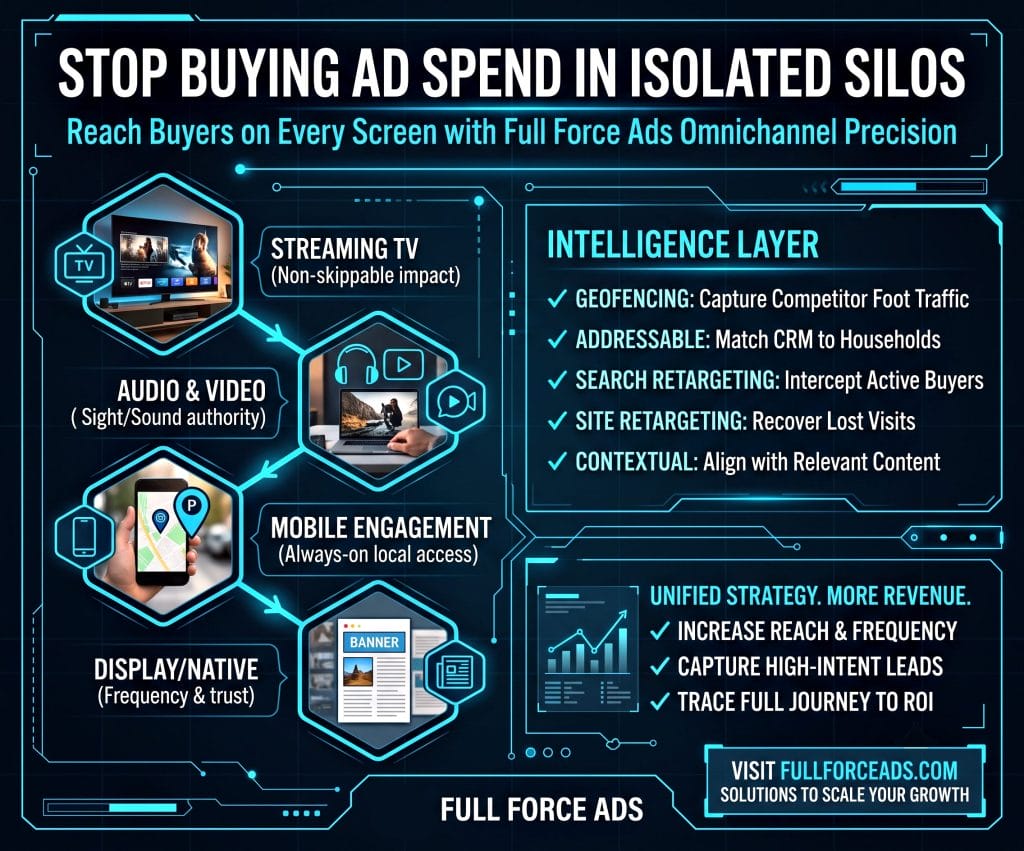
The old way of buying ads is mostly gone: manual negotiations, insertion orders, and a lot of guessing. If you run a business or a marketing team and you care about revenue, you need a way to put your message in front of people who are ready to buy, at the moment they're ready.
Here's how brands are using programmatic advertising to win in their category, get more back from ad spend, and grow on purpose instead of by luck.
Running everything through one channel, whether that's Meta, Google Search, or local print, puts your whole plan on one leg. People don't behave that way. A single buyer might listen to a podcast on the drive in, check the news on their phone at lunch, read industry articles on a desktop at work, and stream a show on the TV that night.
When you treat those moments as separate boxes run by separate teams or agencies, your message splinters. You lose control of frequency. You pay twice to reach the same person.
Full Force Ads is an omnichannel advertising agency based in Utah. Instead of signing separate contracts for streaming, mobile, and display and hoping they line up, you run every major digital channel from one place. Streaming TV, video, audio, mobile, display, and native all sit in one plan, so your story stays consistent on every screen a prospect uses.
To win attention you need formats that work across sight, sound, and motion. Each one does a different job.
| Channel | What it's for | Why it works |
|---|---|---|
| Streaming TV (CTV) | Brand awareness | Full-screen, unskippable ads on the biggest screen in the house |
| Online video | Storytelling and engagement | Pre-roll, mid-roll, and outstream placements that hold attention |
| Digital audio | Screen-free moments | Reaches active listeners on Spotify, Pandora, and podcasts |
| Mobile | Location-based reach | In-app and mobile web ads served where people actually are |
| Display | Volume and retargeting | Banner placements across millions of sites |
| Native | Low-friction trust | Ads that match the look of the article around them |
Streaming TV. Cable used to force local and regional advertisers to pay for a huge geographic footprint they didn't need. CTV fixes that. Through programmatic buys on Roku, Amazon Fire TV, and Hulu, you put a commercial in front of the specific audience you want, and they can't skip it.
Digital audio. Audio fills the gaps other formats miss: the commute, the workout, the time spent cooking. Someone driving or at the gym can't see a banner, but they can hear you, and audio ads tend to stick.
Native and display. CTV and video get you noticed. Native and display keep you there. Native ads take on the look of the site they run on, so they slip past the banner blindness most people have trained themselves into, which is usually why they earn more clicks.
Channels are the real estate. Targeting decides who walks in. Buying broad and hoping is the fastest way to burn a budget. Layer these onto a campaign so you're paying for people who might actually buy.
Full Force Ads is headquartered in Utah. The part that matters for a client isn't the location, it's how the team operates: fast, technically sharp, and straight with you about what's happening in your account.
Here's what working with Full Force Ads actually means. You run every channel through one partner, planning streaming TV, audio, video, mobile, and display from a single hub instead of stitching together vendors. The targeting pays off, because geofencing, addressable matching, and behavioral data point your spend at real buyers instead of filler impressions. The reporting is readable: weekly reports show where ads ran, the geography, what people did, and what converted, with no black box. Budgets stay flexible with no lock-in, so you start at a level you're comfortable with and scale when the numbers justify it, and there's no long-term contract. Launches are fast too, since most agencies take four to six weeks to onboard while Full Force Ads gets targeted campaigns live in five to seven business days.
Every business is at a different stage with different priorities. Here are mixes Full Force Ads runs for specific objectives.
| Goal | Channel mix | What it does |
|---|---|---|
| Local awareness | Geofencing, display, mobile | Build local presence and drive foot traffic in specific areas |
| Compete for a rival's customers | Geofencing, addressable | Reach people who visit competitor locations or sit on their customer lists |
| Brand building | Streaming TV, video, audio | Establish presence on premium screens and audio networks |
| High-intent web traffic | Display, native, search retargeting | Catch active searchers and contextual readers |
| Re-engage past visitors | Site retargeting, display, video | Bring warm leads back across publisher sites |
| Activate a CRM list | Addressable, streaming TV, display | Serve household-level ads to an existing address database |
Step 1: Discovery call. A working session to look at what you're running now, who you're trying to reach, your unit economics, and your growth targets. It's a diagnostic, not a pitch.
Step 2: The plan. Full Force Ads builds a media mix and targeting plan around your audience, goals, and starting budget.
Step 3: Launch. Creative gets mapped to inventory, and most campaigns go live across national publisher networks within five to seven business days.
Step 4: Optimize and report. Once live, budget shifts toward the channels, times, and locations that perform, with a weekly report showing exactly what's working.
Digital advertising doesn't wait around. While some companies keep spreading budget across disconnected channels and untargeted impressions, the ones taking share are running full-funnel programmatic with real targeting behind it.
Whether you want to take on local competitors, put an offline address list to work, or run your brand across Roku and Hulu, Full Force Ads has the technology and the team to make ad spend produce predictable growth.
Book a discovery call and we'll map out what full-funnel could look like for you.