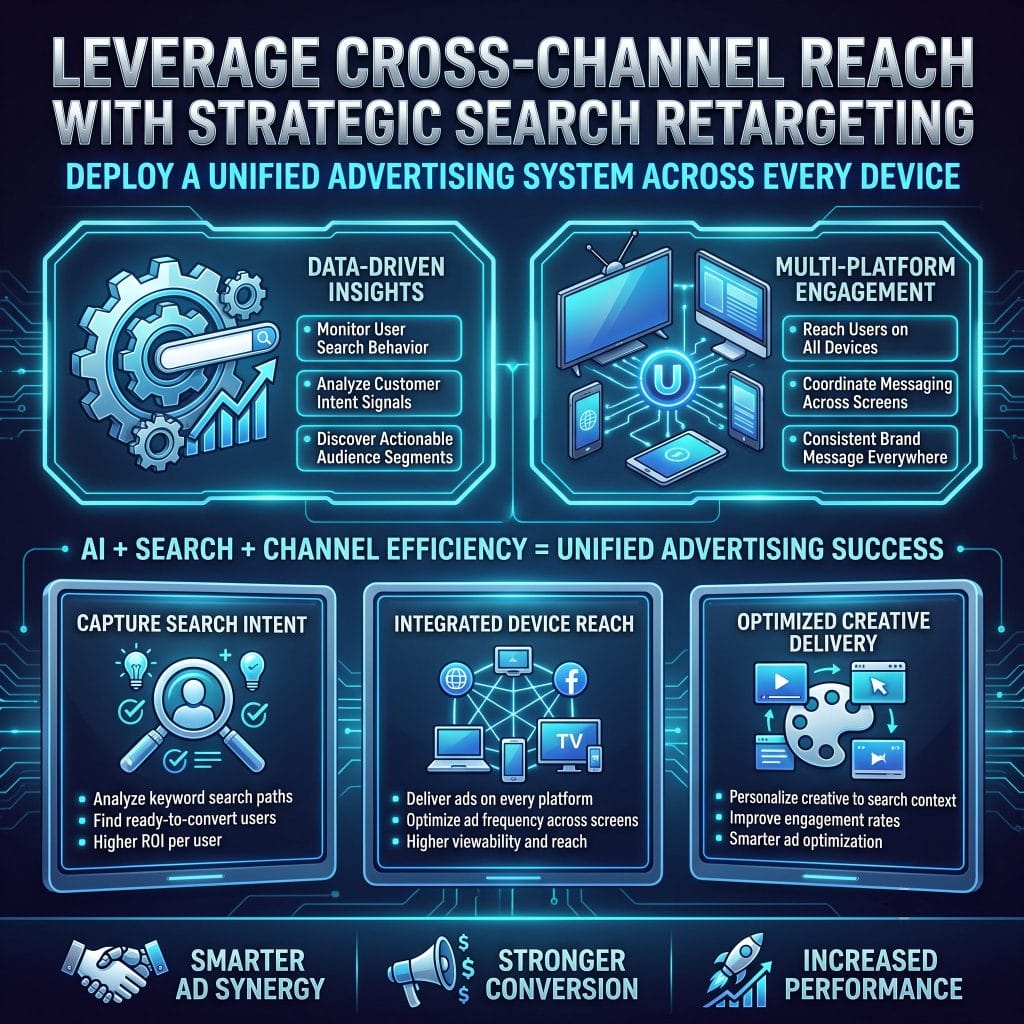
Search retargeting gets around the cost problem by pulling intent data away from the search engine itself.
Instead of paying $20 a click to sit as a text link on a results page, you buy the intent. When someone in the US searches across search engines, review portals, and shopping comparison sites for phrases like:
their device profile drops into an active intent segment.
Full Force Ads then puts video, display, and native ads in front of those same people while they read news sites, scroll lifestyle blogs, and stream shows. That happens well before your competitors have any idea those buyers are shopping.
Say an outdoor gear brand puts $10,000 a month behind high intent buyers.
With paid search at a $20 CPC, that budget buys 500 clicks. Run those against a 2% ecommerce conversion rate and you get 10 orders, which puts your cost per sale at $1,000.
With programmatic search retargeting at a $12 CPM, the same $10,000 buys roughly 833,000 impressions served to people who just searched your category. Between click traffic and return visits, that turns into thousands of qualified sessions instead of 500. You also get video and audio working on a buyer across hundreds of touchpoints during the days or weeks they spend deciding, which a single text link never does.
ROAS is revenue divided by ad spend. Search retargeting does not change that math, it changes what the denominator buys. The same dollar reaches an active searcher many more times than one click ever will.
| User search phrase | What it signals | What we serve |
|---|---|---|
| "heavy duty rooftop tent" | Ready to buy | 30 second CTV spot on weatherproofing and durability |
| "overland gear store near me" | Shopping a competitor | Native article comparing your racks against theirs |
| "best sub-zero sleeping bags" | Specific product need | Dynamic display banner with a free shipping offer |
A national search retargeting deployment comes together in four moves.
Cross-channel advertising and search retargeting
Most advertisers pick a channel and stay there. Search ads, maybe some banners on social, and for a while the numbers look fine. Then they stop looking fine, and the usual fix is to spend more on the same channel.
The problem isn't the channel. It's that nobody sits still anymore. One buyer reads the news on a laptop before work, has a podcast on during the drive, checks a feed at lunch, and puts something on the TV at nine. Treat those as four campaigns and you're bidding against yourself four times to reach one person.
Buy them together instead. One platform across every screen, with search retargeting running underneath the whole thing so the money follows people who have already shown they want what you sell.
Where the ads run
Programmatic buying opens up inventory across the open web and connected devices without a separate contract for each publisher.
Connected TV is the one people underestimate. It puts unskippable video on the living room screen through Roku, Hulu, and the rest, and you still pick households the way you would online. Pre-roll video runs on sites and inside apps. Digital audio catches people on Spotify and podcast networks mid-commute or mid-workout, which is attention nothing else can buy. In-app placements, display and native, run inside iOS and Android and can key off where that device has physically been. Plain display keeps you visible. Native takes the shape of whatever article it sits in, which is usually the difference between being read and being scrolled past.
Ways to target
Geofencing draws a line around a real place, a trade show hall or a competitor's parking lot, and picks up the devices that cross it. Addressable targeting takes street addresses out of your CRM and matches them to household IPs, which is as close to a mailing list as digital gets. Site retargeting goes after the people who visited and left. Contextual targeting drops the ad next to articles on a subject. And search retargeting works off what people have been typing into search engines, which is the closest thing to reading intent out loud.
Search retargeting vs. paid search
Search ads sit on the results page and charge you every time someone clicks. The terms worth owning are expensive, and they get more expensive every year.
Search retargeting takes the same signal and spends it differently. You collect query history from search engines and product pages, then serve display or video to those people for 30 days while they read, shop, and stream everywhere else. Same intent, cheaper inventory, more room to say something.
| Search ads (PPC) | Search retargeting | |
|---|---|---|
| Where it runs | Search results pages | Websites and streaming TV |
| Format | Text links | Display banners and video |
| Timing | The moment someone searches | A 30-day window after |
| Cost | High cost per click | Lower cost per thousand impressions |
Which keywords build the audience
Two buckets. The first is product terms: what you sell, and the clumsy way people describe the problem before they know the product name. The second is competitor terms, which means rival brand names, their product lines, and above all their pricing pages. Anyone reading a competitor's pricing page has finished deciding on the category.
For e-commerce
Target a demographic and you buy a lot of browsing. Traffic goes up, orders don't, and cost per acquisition quietly climbs.
Two things work better. Put video in front of people who have been searching your product terms in the last month. Then go take competitor searches, especially coupon and comparison queries, where the buyer has picked the category and is only picking a brand.
Matching the goal to the setup
| Goal | Who you're after | What to run |
|---|---|---|
| Foot traffic | Devices seen near your locations | Mobile and display |
| Competitor conquesting | Their locations, their search terms | Geofencing and search retargeting |
| Brand awareness | Households by demographic | Connected TV, video, audio |
| E-commerce sales | People searching your product terms | Search retargeting and display |
| Lead recovery | Visitors who didn't convert | Site retargeting and video |
Plenty of agencies can run ads. The trouble usually starts somewhere else: three vendors to manage, markups nobody will explain, contracts you cannot get out of, and reports that never quite answer where the money went.
The traditional setup means one agency for CTV, another for search, a third for display. Three invoices show up, none of the data lines up, and you are the one stuck reconciling it. Full Force Ads runs CTV, video, audio, display, native, and mobile out of one hub, so there is one invoice and one attribution picture.
That structure also means you are not hiring a CTV specialist, a display specialist, and someone else for geofencing and digital audio. Same team plans it, runs it, and optimizes it.
Targeting is part of the build rather than an upgrade you get sold later. Impressions without intent are wasted money, so geofencing, addressable list matching, site retargeting, search retargeting, and contextual placement go into the strategy from the start.
Reporting is where most agencies get quiet. Ours comes weekly and shows where the ads ran, who engaged with them, and what those impressions did for site conversions and revenue.
We also do not ask for an enterprise contract or a heavy spend minimum. Start at a number you are comfortable with, then scale once the results hold up.
Speed is the last piece. Legacy agencies take 4 to 6 weeks to get a campaign out the door. Ours go live in 5 to 7 business days.
| Goal | Channels | Targeting stack |
|---|---|---|
| Local awareness | Display, mobile | Geofencing, contextual |
| Competitor conquest | Display, native | Competitor geofencing, search retargeting |
| National brand building | Streaming TV, video, audio | Addressable household, contextual |
| High intent web traffic | Display, native | Search retargeting, contextual |
| Retargeting past visitors | Display, video | Site retargeting, dynamic product feeds |
| Customer list activation | Streaming TV, display | Addressable target match from a CRM upload |
Regional service businesses, luxury home goods, and multi location retailers are usually after foot traffic. Geofence competitor locations and the commercial centers your buyers already visit, then run local mobile and display against those devices. Addressable targeting handles the rest, putting video in front of households in the postal codes you want.
A D2C brand going national has the opposite problem: growth is easy, keeping acquisition cost sane is not. Search retargeting with native and display catches active searchers across the web. Site retargeting picks up the cart abandoners. Streaming TV runs underneath both so your brand looks established while people are still deciding.
Enterprise contracts need a decision maker who is never going to fill out your form. Take the target account list, upload headquarters and branch addresses into addressable household targeting, and serve video, native, and audio ads to those buildings across desktop and mobile.
Step 1 is a discovery call. We go through your offer, your margins, what your conversion data already shows, who your best customer is, and what is currently in the way. It is a working conversation, not a pitch.
Step 2 is the recommendation. Our team maps out the media mix (streaming TV, video, mobile, display, audio, native) and the targeting layers (geofencing, addressable, search retargeting, contextual, site retargeting) that fit your budget and your goal.
Step 3 is launch. Once creative and targeting are approved, our traffic managers deploy the campaign. Most go live within 5 to 7 business days.
Step 4 runs for as long as the campaign does. We watch performance daily and adjust bids, publishers, geography, and creative as the data comes in. Every week you get a report covering reach, clicks, cost efficiency, and conversions.
Advertising gets easier when you show up on every screen your buyer uses and the targeting knows why they are there. Search retargeting, geofencing, and household addressability all do the same job in different places. They cut the blind impressions and put your budget in front of people who were already looking for what you sell.
If you want to cut the vendor sprawl and run your media from one place, take a look at what Full Force Ads offers across channels, or book a discovery call and we will tell you exactly what we would do with your budget.