Search keywords and boosted posts catch people in one spot. The problem is that nobody stays in one spot. The same person streams a show on Roku while dinner is on the stove, listens to a podcast on the drive in, and scrolls the news on a phone during lunch. Three different screens, one buyer, and most ad budgets only show up for one of them.
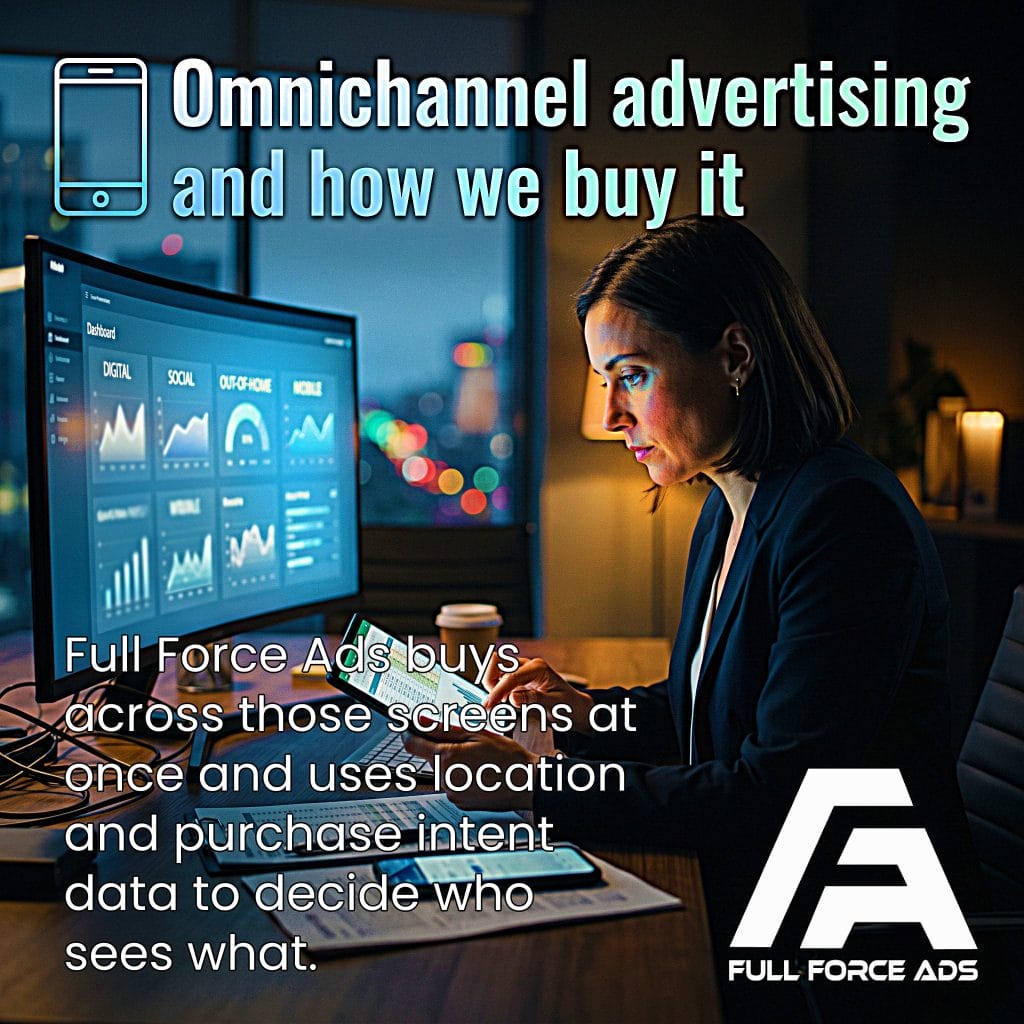
Full Force Ads buys across those screens at once and uses location and purchase intent data to decide who sees what.
Connected TV is the one most clients ask about first. Ads run inside Roku, Hulu, and similar apps, they cannot be skipped, and they can be bought down to a specific geography or household type. Pre-roll and mid-roll video does similar work on websites and inside mobile apps at a lower cost. Digital audio on Spotify and streaming radio is the quiet workhorse, because nothing else is competing for the listener's eyes during a commute or a workout.
Mobile in-app and mobile web ads follow people through the ordinary parts of the day, and that is where location data earns its keep, pointing impressions at phones near a storefront. Display banners handle general coverage. Native units match the look of the page they sit on and usually get better engagement than a standard banner, though they take more creative work to do well.
Geofencing is the piece that does the most for local businesses. You draw a boundary around a real place, a competitor's parking lot, a stadium, a trade show floor, and phones that cross that line can be served ads for the next 30 days.
Addressable targeting takes a mailing list and matches those addresses to home IP networks, so ads land on the TVs and phones inside specific houses. Search retargeting works off what people type into search engines and follows them onto other sites with video and display. Site retargeting brings back the people who already came to the site once and left. Contextual targeting places ads by subject matter, so an article about a failing water heater can carry an ad for a local plumber.
None of these do much alone. Stacked, they cover the same buyer at different points in the same week.
Running six platforms separately is a full time job, and most marketing teams already have one. We do the buying in one place, with no large minimum spend and no annual contract.
One team plans and runs the streaming TV, the audio, and the geofencing. Reports go out weekly with where the ads ran, how many people saw them, and what came of it. Budget moves between channels while the campaign is live, so a channel that is not producing does not keep spending for another quarter. Most campaigns go live within five to seven business days.
It starts with a call about the business, who it sells to, and who it is losing customers to. From there we put together the channel mix and the targeting plan, then get the creative live, usually inside that same five to seven day window.
After launch the work does not stop. Bids get adjusted, audiences get trimmed, and money moves toward whatever is actually producing appointments or foot traffic.
Wasatch Health Alliance runs clinics in Salt Lake City and St. George. Those are two very different markets, and that shaped the whole buy.
Utah's median age is 31 and the birth rate is high, so pediatrics and family medicine carry the volume up north. The tech workers around Lehi will not call a front desk; they expect to book online. St. George is the opposite end, older and retired, which means orthopedics and cardiology.
The calendar mattered as much as the geography. Winter inversions in the valley fill waiting rooms with coughs and respiratory complaints. Ski season brings knees and shoulders, and physical therapy behind them. Spring is allergies. Summer sports keep urgent care busy.
So the campaign moved with all of that. Geofences around competing urgent care clinics and the medical huts at the resorts served mobile ads about 15 minute waits and online check-in, aimed at people who were already sitting in someone else's lobby. Addressable targeting split the household list in two: families with children got streaming TV and audio for same day pediatrics, older households in St. George got display for joint replacement. During inversion weeks, ads ran alongside air quality coverage. Keyword targeting picked up people searching for specialists by name. Connected TV retargeting ran in the evenings, and site retargeting followed up with the people who opened the booking page and closed it.
| Metric | Result |
|---|---|
| Audience reach | 485,000 local households |
| Urgent care cost per acquisition | $28.50 per scheduled patient |
| Orthopedic cost per acquisition | $142.00 per surgery consultation |
| Retargeting conversion | 8.4% booking rate |
| Cost vs. linear TV | 42% lower cost per lead |
Most clients come in with one goal, not five. This is roughly how we map it.
| Goal | Channels | Targeting | What it does |
|---|---|---|---|
| Foot traffic | Geofencing, display | Location polygons | Reaches people already near the store |
| Taking share from a competitor | Geofencing, addressable | Competitor locations | Puts an offer in front of people who just walked into a competitor |
| Local brand awareness | Streaming TV, audio | Geographic and demographic | Gets the name onto the big screen in your market |
| Lead capture | Display, search retargeting | Search intent, contextual | Reaches people mid research |
| Converting past visitors | Site retargeting, display | Site pixel | Follows up with people who visited and did not book |