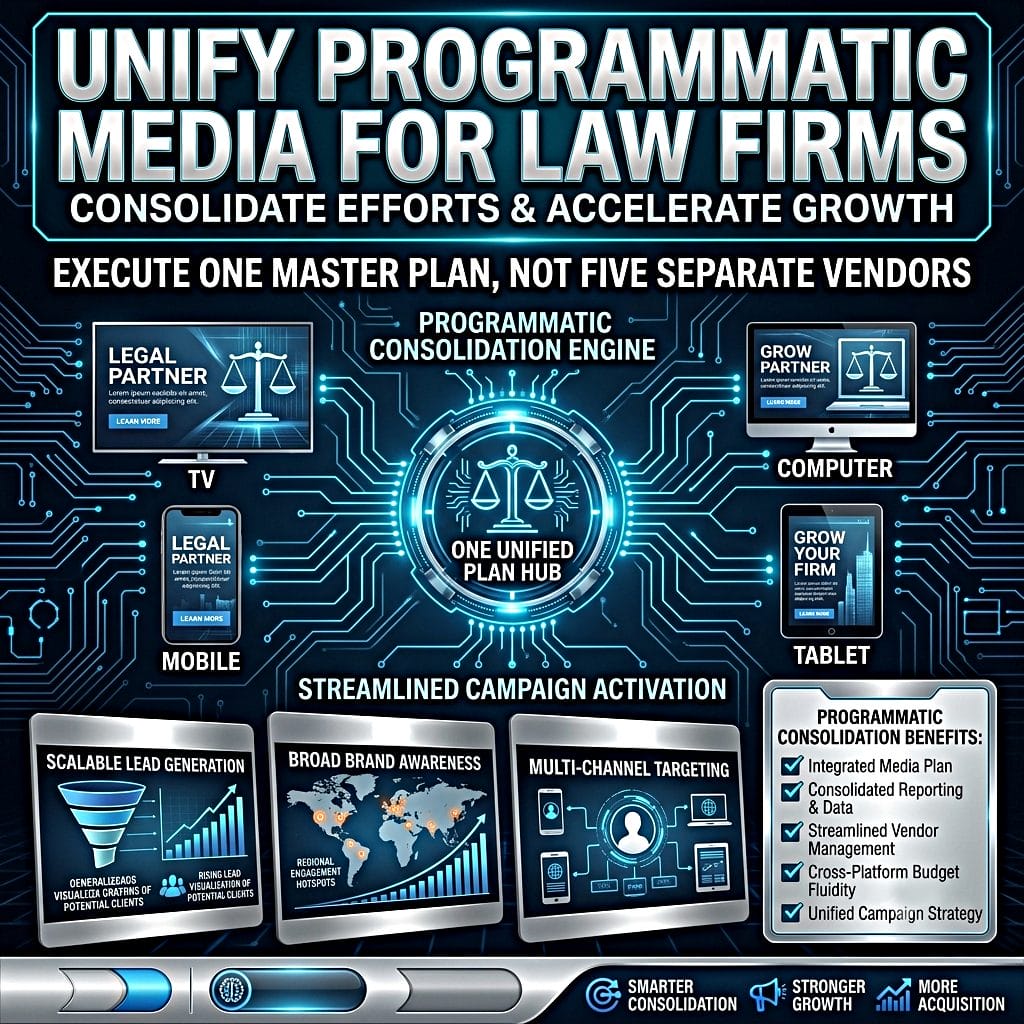
Most of the media budgets we audit have the same shape. Search sits with one agency. Social sits with a freelancer someone found two years ago. A radio rep sold them a package in January. And somewhere in there, a programmatic vendor is running display ads that nobody has opened a report on since the kickoff call.
Nobody plans it this way. It accumulates, one reasonable-sounding phone call at a time. The cost shows up later and never on a single invoice: the same prospect gets hit by three campaigns that have no idea the others exist, acquisition cost drifts up, and when you ask which channel produced the last ten clients, you get four dashboards and four different answers.
Buying media in one place fixes most of that. Not because programmatic is magic, but because the channels can finally see each other. Someone who watched your streaming TV spot on Tuesday should get a different display ad on Thursday than a total stranger does. That only happens when one system is running all of it.
Below is how we build those campaigns, with a long section on legal services in New York, Washington, and Chicago, because that is the market where the math is most brutal and the difference is easiest to see.
The TV in the living room is still the best place to be believed. Streaming inventory gives you the production value of broadcast with the targeting of digital, so you can run a spot in specific zip codes instead of buying an entire market.
Ads run on Roku, Amazon Fire TV, Hulu, Max, Paramount+, and Peacock, most of it unskippable. The point is recognition. When someone finally needs what you sell, you want to be a name they have already heard, not the fourth blue link on a results page.
Pre-roll and mid-roll across web and apps, plus outstream units that sit inside article text. Video does the explaining. If your offer takes more than a sentence to make sense, this is where that happens.
People listen while driving, cooking, at the gym, and mowing the lawn, with no screen involved. Spotify, Pandora, iHeartRadio, and the podcast networks sell that time. Completion rates run high because skipping audio takes more effort than scrolling past a banner, and a voice in someone's headphones lands differently than a rectangle on a webpage.
Depending on whose study you believe, people pick up their phones somewhere between 100 and 300 times a day. It is the one device they carry everywhere. In-app interstitials, mobile web banners, and location-triggered creative all run here, and mobile is also where geofenced audiences get delivered, so it does double duty.
Banner ads across millions of sites through the major supply-side platforms. Display is cheap per impression, which makes it the workhorse for frequency and the backbone of every retargeting pool you build.
Native units take on the fonts, layout, and feel of the site they run on, so they read as part of the page rather than an interruption. Click-through rates beat standard display, mostly because people have trained themselves to ignore anything shaped like an ad slot.
Channels decide where. Targeting decides who, and that is where a budget is won or lost.
Geofencing draws a boundary around a real place: a competitor's parking lot, a trade show floor, a hospital, an industrial park. Devices that enter get picked up, and you can serve those device IDs ads for weeks afterward across mobile, video, and display.
Addressable advertising takes a physical mailing list and matches those street addresses to household IP networks, so the people on your direct mail list see your streaming TV, display, and mobile ads. It is the closest thing programmatic has to direct mail with a delivery report attached.
Site retargeting follows the people who visited your site and left without calling or filling anything out. That is most of your traffic. Retargeting is how you get a second conversation with them.
Search retargeting reaches people who recently searched terms tied to your service, and reaches them off the search page. You get the intent without paying auction prices for the click.
Contextual targeting reads the page instead of the person. An engine scans article content and sentiment in real time and places your ad next to relevant material, an estate planning ad inside a piece on wealth transfer, for instance. It needs no third-party cookies, which is why it keeps getting more attention.
This is where the arithmetic gets ugly. In tier one legal markets, one click on a term like "personal injury lawyer NYC" or "commercial litigation attorney Chicago" can run anywhere from $150 to well past $400. Not a lead. A click. At $250 a click and a 5 percent form conversion rate, that is $5,000 per inquiry, before anyone at the firm has decided whether the case is worth taking.
Firms holding cost per case at a sane number in these markets are not winning that auction. They are getting in front of people earlier, before the search happens.
Dense, loud, and expensive. Personal injury, financial litigation, and corporate defense firms are all bidding for the same attention. Streaming TV at the zip code level does the heavy lifting, because it buys trust that a text ad cannot. Layer geofencing on the places that matter: the SDNY courthouse, major transit hubs, the financial district, hospitals.
A different audience. Highly educated, policy-adjacent, with real demand for regulatory, compliance, government contracting, and defense work. Addressable advertising fits because you can target curated lists: trade associations, contractors, and high net worth corridors in Bethesda, McLean, and Arlington. Pair it with contextual placement on political and regulatory publications so the firm shows up where its clients already read.
A dense core with a lot of industrial suburb around it, and heavy competition across personal injury, labor and employment, and commercial litigation. Commuters are the opening. Mobile and digital audio along I-90, I-94, and the Metra lines reach people during long trips, and search retargeting picks up anyone who recently looked for injury or employment terms.
Phase one, days 1 to 14, is authority. Fifteen and thirty second streaming TV spots plus fifteen second audio on Spotify and local news podcasts. Put the senior partners on camera, use real client outcomes, and stay on the households you actually want. When a legal problem shows up, people call a name they recognize.
Phase two, days 15 to 30, is interception. Geofence the places relevant to the practice area. Personal injury: trauma centers, urgent care, physical therapy clinics, body shops. Commercial and corporate: office towers, headquarters buildings, legal conferences. Labor and employment: industrial parks and corporate campuses, especially during restructuring. Devices captured inside those polygons get mobile and video ads within hours.
Phase three runs from then on. Search retargeting and site retargeting catch anyone who searched "best accident lawyer near me" or read a practice page without calling, and serve them a sequence of display, native, and video. Put case results and review counts in the creative. This is the stage where people who were nearly ready become people who called.
Phase four is the part most firms skip. Call tracking (CallRail or similar), form analytics, and the intake CRM (Clio, Salesforce) wire back into the ad platform, so a signed retainer can be traced to the impression, geofence, or CTV household that started it. Skip this and you are guessing, and you will keep funding whichever channel produces the friendliest report.
A Chicago personal injury firm moved 40 percent of its budget out of broad search keywords and into geofencing around hospitals and accident-heavy corridors, plus streaming TV aimed at local households. Ninety days later, cost per acquired case was down 38 percent and inbound calls were up 52 percent. The search budget still exists. It is smaller now and pointed at the terms that actually convert.
Bidding is algorithmic. Demand-side platforms adjust bids in milliseconds using device type, location, time of day, publisher quality, and past conversion likelihood. The practical effect is that you stop paying premium prices for impressions that were never going to do anything.
Identity works differently after cookies. Third-party cookies are on the way out, so targeting now leans on IP to household mapping, authenticated device IDs, and first-party graph data. That foundation is more durable than the cookie ever was, and it is part of why addressable and CTV have gotten better instead of worse.
Contextual engines read for meaning, not keywords. They scan full articles for topic and sentiment, so a family law ad can run next to a piece on asset division without landing beside a story about a custody tragedy.
CTV has started to convert directly. QR codes on screen, pause-screen creative, and second-screen push to the viewer's phone while the spot plays give streaming TV the response mechanism it spent years lacking.
Doing this in house means DSP contracts, minimum spends that start in the tens of thousands, data vendor relationships, and someone on payroll who knows creative specs for six ad formats. Most companies do not want that, and they should not have to build it.
One partner covers every channel. Video, audio, CTV, mobile, display, and native get planned and optimized together instead of by four vendors who have never spoken to each other.
Targeting is built for conversions, not impression counts. Cheap impressions are easy to buy and mostly worthless. Geofencing, addressable matching, search retargeting, and behavioral layers cost more per impression and return more per dollar.
Reporting is readable. You get weekly detail on where ads ran, who engaged, and what happened after. No black box, no "trust the algorithm."
Budgets stay flexible and contracts stay short. Start where you are comfortable, look at what came back, and scale from proof rather than a signature.
Campaigns go live in 5 to 7 business days. Onboarding at a traditional agency can eat a month. We can be running in a week.
| Goal | Channel and targeting mix | What it does |
|---|---|---|
| Local brand awareness | Geofencing, display, mobile | Catches people already moving through your service area and stays on their phone afterward |
| Competitor conquesting | Geofencing, addressable | Reaches people who visited a competitor, then follows them home |
| Mass market brand building | Streaming TV, video, digital audio | Buys recognition at scale across TV, web, and headphones |
| Website traffic and lead capture | Display, native, search retargeting | Picks up active search intent and routes it to your site |
| Re-engaging past visitors | Site retargeting, display, video | Gets a second shot at the traffic that left without calling |
| Activating a customer or mailing list | Addressable, streaming TV | Matches your address list to households and serves them TV and cross-screen ads |
A discovery call comes first, covering the business, the ideal client, service areas, and what growth needs to look like in numbers. From there we write a recommendation: the channel mix, the geofence parameters, the audience layers, all built around the budget you have rather than the one we wish you had. Creative gets finalized and tested, and the campaign goes live across streaming networks, apps, and publishers within 5 to 7 business days. After that it is ongoing optimization, with weekly reporting and budget moved toward whatever is producing.
If you run a firm in New York, Washington, or Chicago and your cost per case has been climbing, or you run a regional business paying four vendors to reach the same person, one programmatic plan is worth a conversation.
Book a media consultation and we will tell you what we would run and why, before you spend anything.