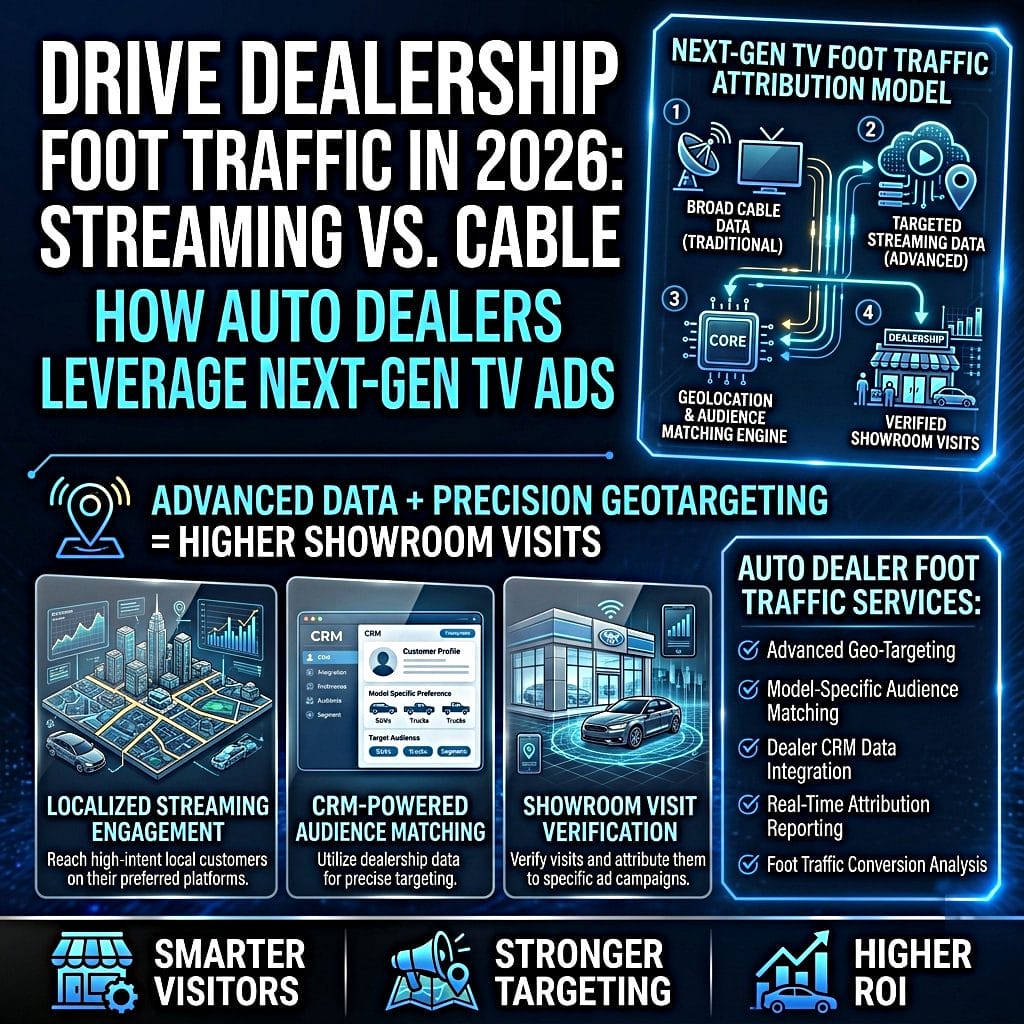
Connected TV has passed cable and broadcast as the main video buy, for national brands and for the single rooftop out on the highway. US CTV ad spend is close to $38 billion, and streaming upfront commitments came in ahead of primetime linear for the first time. For a dealer the choice comes down to this: keep paying cable rates for spots nobody can trace, or buy the same living room screens household by household.
Impressions were never the scoreboard at a store. Cars on the lot are. Cable scatters your spot across an entire market and hands you a ratings estimate at the end of the month. CTV paired with location data connects a 30-second spot on the big screen to a device that later parked in your customer lot.
Cable was the foundation of dealership marketing for thirty years, and for most of that run it worked. You bought Adults 25 to 54 inside a DMA, signed an annual contract, and accepted the spillover that came with it: truck spots landing in third floor apartments, luxury sedan spots landing an hour outside your trade area. Everyone knew the buy was leaky. There wasn't much else to buy.
Then the audience moved. More than 80 million US households now watch nothing but free or ad-supported streaming, and streaming accounts for close to half of all daily TV viewing. The ads reaching those households behave differently too. CTV video completion runs above 95 percent because the spot plays full screen, with sound, on a television, and there's no skip button. Cable viewability has gone the other way as people flip channels through every break.
The wider gap is targeting. Cable sells networks and dayparts. CTV sells households, filtered by in-market auto intent, lease expiration date, household income, and where those devices have physically been.
Cable still delivers local reach, and there are stores where the Sunday news block earns its keep. What it can't do is tell you which of those households is three payments from a lease turn in.
| Traditional cable | Full Force Ads CTV | |
|---|---|---|
| Targeting | Age and gender across cable zones, such as Adults 25 to 54 | Household address lists, in-market buyer intent, geofencing, behavioral data |
| Completion | Not measurable, with heavy channel flipping during breaks | Above 95 percent on unskippable living room screens |
| Inventory | Local cable blocks such as local news and cable sports feeds | Hulu, Roku, Peacock, Fire TV, YouTube TV, Paramount+, ESPN |
| Foot traffic | Nothing beyond brand awareness surveys | Conversion zone tracking on exposed devices entering your showroom |
| Retargeting | Not possible | Follow CTV viewers across mobile, display, audio, and native |
| Commitment | Annual or quarterly contracts with heavy minimums | Flexible budgets, campaigns live in 5 to 7 business days |
Most people watch television with a phone in their hand. More than 75 percent of streaming viewers have a phone or tablet going at the same time, which is either a distraction problem or a second ad slot depending on how you buy. We build campaigns assuming the second screen is there.
Instead of buying a zip code, addressable geofencing traces the property lines of individual homes at street level. Hand us a CRM list, whether that's customers 30 months into a 36 month lease or service customers you've never actually sold a car to, and those specific living rooms get your spot on Hulu, Roku, Peacock, and YouTube TV. The house next door doesn't see it.
Catching people while they are still shopping is how share moves. We put building-level fences on the dealerships you compete with and capture mobile device IDs from shoppers walking those lots. From that point, for anywhere from one day to a month, that shopper and their household see you across screens: a 30-second CTV spot about your trade-in bonus or APR while they watch TV that night, a banner with a test-drive incentive while they read reviews on their phone, audio on Spotify or Pandora during the commute.
Cable loses this argument outright. A store spends tens of thousands on a quarter of television and then argues internally about whether the floor got busier. Conversion zone tracking draws a boundary around your physical lot and counts the devices that walk into it after being served your ad on CTV, mobile, or display. Weekly reporting shows impressions by platform, video completion rates, and verified walk-ins matched back to exposure. If a channel isn't pulling its weight, you find out in week two rather than at renewal.
A store fighting a domestic competitor two exits away needs something different from a store spending co-op dollars on brand, so the mix changes by rooftop.
Geofencing, addressable CTV, and mobile. We draw building-level fences on nearby competitor lots, serve mobile banners while the shopper is still standing there, then follow the household with addressable CTV and mobile carrying your price match or trade offer.
Geofencing, display, mobile, and conversion zone attribution. For a holiday tent sale or a new inventory drop, we blanket high-traffic shopping centers, banks, and repair shops in your area, then re-engage those visitors across mobile apps and websites with a local test-drive offer, and count who shows up.
Streaming TV, pre-roll video, and streaming audio. This is the closest thing to the old cable buy, except it runs on Hulu, Roku, and Paramount+ across your whole metro, with pre-roll and audio on Spotify and Pandora carrying the same message between viewing sessions.
Site retargeting, search retargeting, CTV, and display. Somebody spent nine minutes on a used Tahoe listing and left. We put your ad back in front of that person on their television and their phone, along with anyone searching high-intent terms like best SUV deals near me.
Running programmatic through one vendor, geofencing through a second, cable through a rep, and reporting through a fourth login is how messaging drifts and budgets quietly inflate. We run every channel on one platform, so the CTV spot and the banner and the audio ad tell the same story.
Our fences trace the actual footprint of a building rather than a radius circle dropped on a pin, which matters when the competitor you're conquesting shares a parking lot with a strip mall. Reporting comes weekly and shows where your ads ran, how many people finished the video, and how many walked onto your lot. Campaigns launch in 5 to 7 business days, with no annual commitment or spend minimum holding you in past the point where you can judge the results.
Cable built automotive advertising, and in some markets it still earns a line in the budget. It just isn't the thing filling a showroom on a Saturday in 2026.
If you want your own market mapped out, competitor lots and household lists and conversion zones included, schedule a strategy call with Full Force Ads.