Most retargeting is a rerun.
Someone lands on your site, leaves without doing anything, and then your ad follows them around for a week. It works. It also runs out of road fast, because you can only retarget people who already found you. Your retargeting pool is capped by your traffic, and your traffic is capped by everything upstream of it.
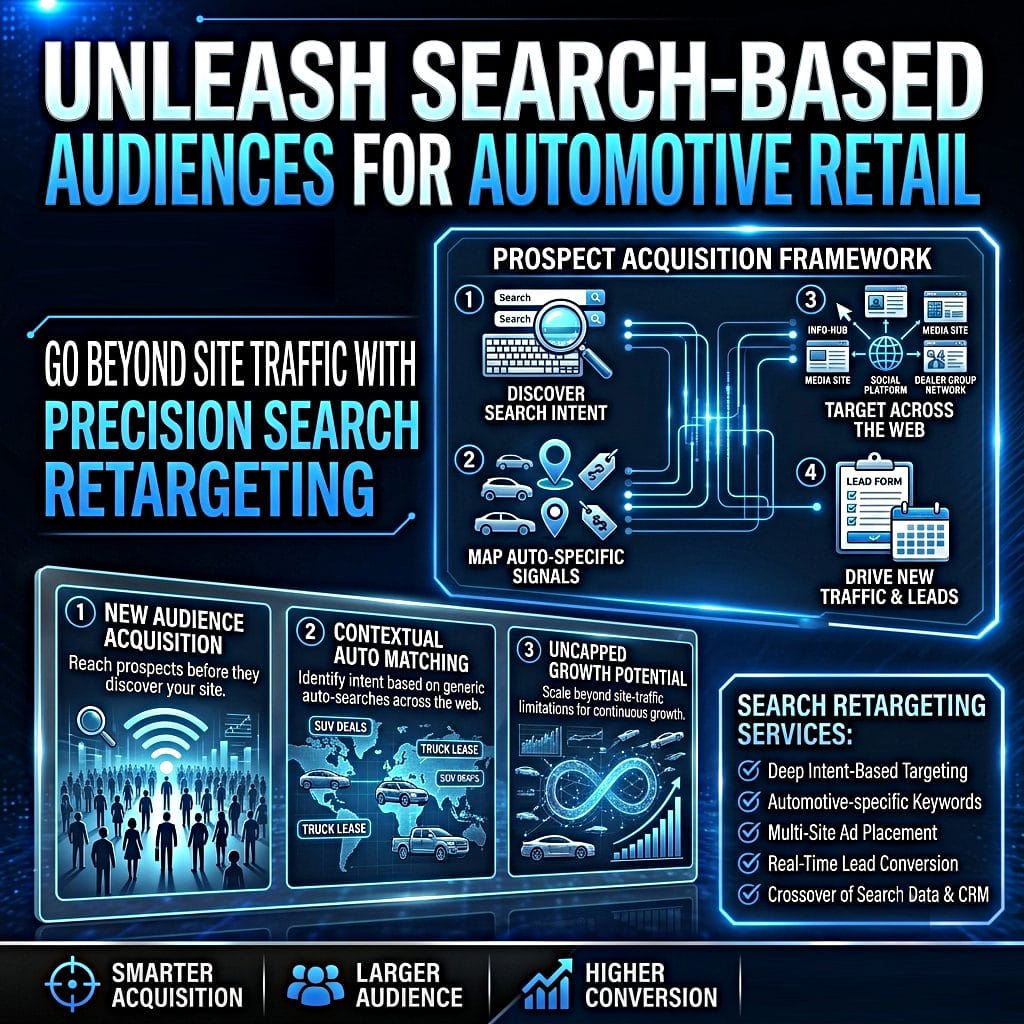
Search retargeting works differently. It reaches people based on what they are actually searching for across the web, whether or not they have ever touched your site.
I want to use car dealerships to explain this, because the buying behavior there is documented better than almost anywhere else. The thinking carries over to any business people research before they buy.
A car buyer runs somewhere between 14 and 20 online searches before walking into a showroom, and spreads them over 60 to 90 days. Towing capacity on a Tuesday. Trim comparisons two weeks later. Financing questions at 11pm on a phone, usually in bed.
Almost none of that happens on a dealership website. It happens on Kelley Blue Book, Edmunds, CarGurus, Google, YouTube reviews, and whatever forum comes up third. By the time someone finally lands on a dealer site, most of the decision is already made.
That is the problem with site retargeting on its own. It shows up at the end of a story it had no part in writing.
Search retargeting puts you in the middle of the research instead. Someone searches "best three row hybrid SUV" on an automotive research site, that query gets matched to an anonymous device profile, and now your ad can reach that person on a news site, a weather app, or a streaming TV break. They have never heard your name. They are also, right now, exactly who you want.
Here is where most campaigns quietly waste money. They run one creative against everyone.
The person searching "2026 GMC Sierra Denali for sale" is not the same person searching "best luxury crossover with a panoramic roof," and neither of them is the person searching "zero down lease deals." One is ready to buy a specific thing. One is still deciding what kind of thing they want. One only cares about the monthly payment.
The first group wants a real price, real availability, and no runaround. Show them the actual vehicle sitting on the lot, with the real photo and the real price.
The second group is shopping by need, not brand. Show them three or four options that fit the criteria and put the specs in the copy, because that is what they are comparing.
The third group is the conquest audience, researching your competitor while you have a comparable product in stock. That is a head to head argument, and it only works if you lead with the one thing you actually beat them on.
The fourth group is doing math. Show them the payment.
Same principle outside of cars. A roofing company has homeowners searching storm damage, homeowners collecting quotes, and homeowners who already got a scary number from someone else and want a second opinion. A dental group has people searching Invisalign cost, people searching emergency dentist, and people searching whether their insurance is accepted. Those are not the same ad.
Nothing kills this faster than bad data.
If your feed updates once a day, you will spend money sending people to cars that sold yesterday. Somebody clicks an ad for a specific truck, lands on a dead page, and that is the last time they trust you. Feeds need to refresh every few hours at minimum, and sold items need to drop out the moment they sell.
The reverse matters too. Once someone buys, they should stop seeing acquisition ads for the next three to six months. That means firing conversion signals on the pages that actually indicate a purchase, the finance application confirmation, the deposit page, the check-in kiosk, and feeding those back to the ad platforms. Otherwise you are paying to advertise a car to someone who is currently sitting in it.
Same idea applies to a med spa, a law firm, or a plumbing company. Whatever your version of "already bought" looks like, the ad platform needs to know about it.
Click through rate is the number everyone reports and the number that tells you the least.
What matters is whether people reached the page that counts. In a dealership that is the vehicle detail page. Everywhere else it is the service page, the pricing page, the booking form. Cost per one of those views is a real number.
After that: cost per lead, counting calls and form fills and chats, not just forms. Store visit lift, if you sell in a physical location. And at the bottom, the matchback, where you cross reference who actually bought against who saw your ads. That one takes work to set up. It is also the only number that answers the question the owner is actually asking.
Search retargeting is not a replacement for the campaigns you are already running. Your brand search, your manufacturer co-op, your existing site retargeting, all of that keeps doing its job.
What this adds is reach into the part of the buying process that used to be invisible. The weeks where somebody is deciding, on other people's websites, whether you are even in the running.
That is what Full Force Ads runs for dealerships, home service companies, healthcare groups, and the agencies that white label us. Search intent targeting, competitor conquesting, streaming TV, display, and dynamic creative that pulls in live inventory and pricing. Weekly reporting that shows what actually moved.
If you want to see what your competitors in your market are already running, that is a conversation worth having. Book a time here.