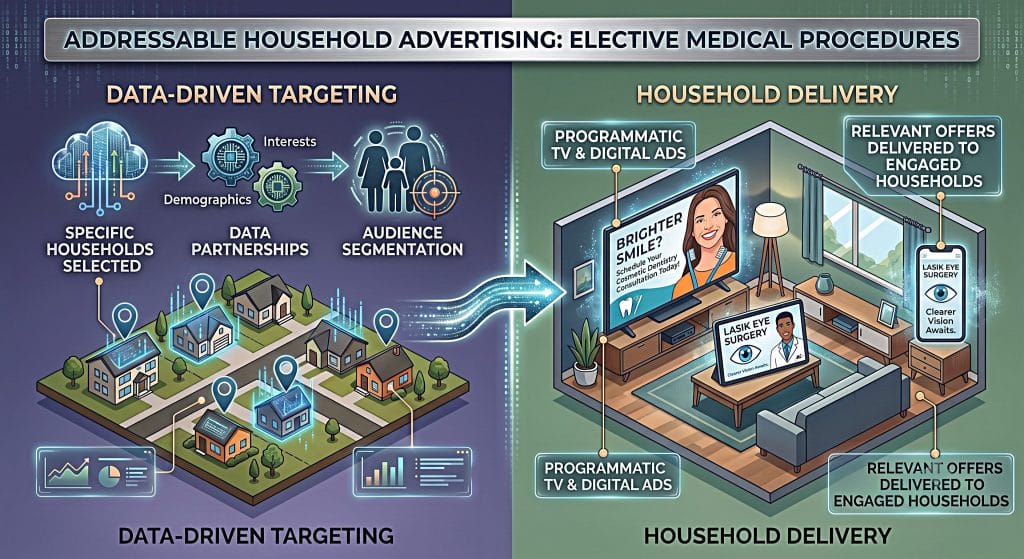
Addressable household advertising for elective medical procedures gives specialty practices a direct way to reach high-value patients without triggering privacy penalties. Elective medical procedures sit at a unique spot in healthcare. Unlike emergency visits driven by immediate health needs and insurance networks, elective services rely on discretionary consumer spending. Procedures like cosmetic surgery, fertility treatments, vision correction, cash-pay orthopedics, and full-mouth dental implants depend on patient choice, personal finances, and trust.
For years, specialty practices had to pick between two bad marketing strategies. They could buy broad broadcast media like billboards, radio, and linear TV, which wasted most of the budget on people who were not candidates. Or they could use narrow web tracking, which now brings heavy legal risks under federal health privacy rules.
Addressable household advertising resolves this dilemma. By matching verified residential addresses with household internet networks, practices deliver tailored video, mobile, and display ads to specific homes on Connected TV (CTV) and streaming networks. As a digital advertising agency based in Sandy, Utah, FullForceAds.com helps medical practices run these precise campaigns while keeping patient data secure.
Elective treatments often cost anywhere from $3,000 to over $50,000 out of pocket. That means the actual pool of qualified patients in any market is small. When practices buy regional broadcast TV or billboards, less than 5% of the audience has both the income and the clinical interest for the procedure. The remaining 95% of ad spend goes to waste.
To fix this, many practice marketers turned to website tracking pixels, third-party cookies, and search retargeting. However, recent regulatory enforcement from the U.S. Department of Health and Human Services (HHS) Office for Civil Rights (OCR) and the Federal Trade Commission (FTC) changed everything.
Website tracking tools that send IP addresses, device identifiers, or visit details to third-party ad networks without patient consent create immediate legal liabilities under HIPAA and state privacy laws. If a tracking tool reveals that a user viewed a specific procedure page, regulators can treat that interaction as protected health information.
Addressable targeting removes this risk. Instead of tracking an individual's sensitive web searches across the internet, addressable campaigns target verified residences using offline consumer attributes, home ownership records, and income modeling.
Want to stop wasting ad spend on broad channels? Contact our media team at FullForceAds.com to audit your current market reach.
Addressable advertising connects physical residential street addresses to the digital devices used inside that home. This setup lets healthcare marketers deliver CTV video, mobile advertising, and contextual display banners directly to selected households.
[ Direct Mail & Wealth Data ] ──► [ ZIP+4 Micro-Clusters ] ──► [ Household IP Match ]
                                                                      │
                                                                      ▼
[ Targeted CTV & Display Ads ] ◄── [ Digital Device Sync ] ◄── [ Connected Devices ]
Addressable engines compare physical direct-mail lists, property tax rolls, and census details with internet service provider billing records. Linking physical street addresses to household device groups creates a clean digital perimeter around targeted homes.
When individual household matching requires an extra buffer for privacy, practices use micro-neighborhood modeling. Grouping data at the ZIP+4 level isolates pockets of 10 to 20 neighboring homes. This delivers geographic and demographic precision without using personal health information or individual identifiers.
Because elective care correlates strongly with income, age, and lifestyle habits, practices build audience segments using non-clinical indicators:
By combining these factors, a practice offering cash-pay joint preservation can focus its budget on adults aged 50 to 70 with higher net worth within 15 miles of the facility, cutting out wasted impressions entirely.
Build your practice's custom addressable target list today with FullForceAds.com.
The main rule in healthcare marketing is simple: campaigns must never infer or use a patient's personal medical history or diagnosis to deliver targeted ads without explicit authorization. Targeting must rely on demographic, geographic, and lifestyle data.
Traditional retargeting relies on browser cookies and page tracking. If a site visitor reads a page about fertility care, standard retargeting tools broadcast that behavior across ad networks. Under current HHS guidance, this practice creates serious legal exposure.
Addressable household advertising protects practices through distinct operational safeguards:
| Campaign Approach | Data Engine Used | PHI Exposure Risk | Regulatory Status |
| Traditional Web Retargeting | Third-party cookies, tracking pixels, page URLs | High risk. Shares URLs, IP addresses, and search terms with open networks. | Heavily restricted by HHS OCR and FTC rules. |
| Addressable Household Advertising | Physical address data, household IP matching, ZIP+4 groups | Minimal risk. Uses non-clinical consumer data and geographic clusters. | Built for compliance with HIPAA and state privacy laws. |
Beyond federal regulations, elective practices must follow medical advertising guidelines. Ads should avoid making guaranteed outcome claims, using pressure tactics, or offering fake limited-time discounts. High-value household advertising works best when it focuses on patient education, physician credentials, treatment options, and facility safety.
Is your current digital setup compliant? Speak with the privacy-first media team at FullForceAds.com.
Different elective specialties need specific targeting criteria, ad formats, and call-to-action steps.
Launch specialized healthcare campaigns built for high-ticket procedures on our proprietary platform, FullForceAds.app.
Running an addressable household campaign requires a multi-stage approach that educates prospective patients over time.
       [ Phase 1: Addressable Connected TV (CTV) ]
       └── High-impact video served to targeted households
                         │
                         ▼
       [ Phase 2: Mobile & Contextual Display ]
       └── Follow-up ads on smartphones and tablets in the home
                         │
                         ▼
       [ Phase 3: Direct Mail Alignment ]
       └── Physical postcard delivered to matched physical addresses
                         │
                         ▼
       [ Phase 4: Intake & Patient Concierge ]
       └── Patient care team responds within 5 minutes
The campaign starts on the largest screen in the home. Using programmatic addressable networks through FullForceAds.app, non-skippable 15-second and 30-second video ads run exclusively in qualified target homes.
Once a household sees the CTV video a set number of times (for example, three views within seven days), our system triggers secondary ads across other household devices like smartphones, tablets, and laptops. These display and mobile ads include direct actions like "Take the 60-Second Vision Quiz" or "Download the Dental Implant Guide."
Physical touchpoints build trust for major medical decisions. When a household engages with digital ads, our platform triggers a personalized direct-mail postcard to that physical street address within 48 to 72 hours.
Marketing precision fails if intake staff handle inquiries slowly. When a prospect clicks an ad, they land on a streamlined landing page dedicated to that specific procedure. The clinic's response process should match the campaign quality:
Set up your practice's multi-touch campaign architecture directly through FullForceAds.com.
Measuring return on ad spend (ROAS) in elective healthcare can be tricky. Final consultations and treatments happen offline in a surgical suite weeks or months after an ad runs.
Addressable household advertising solves this tracking challenge using match-back attribution analysis.
[ Target Address List ] ──► [ Ad Exposure Records ]
                                   │
                                   ▼
[ Encrypted Practice EHR ] ──► [ Secure Clean Room Match ] ──► [ Verified ROAS & PAC ]
To track campaign health, use two core formulas:
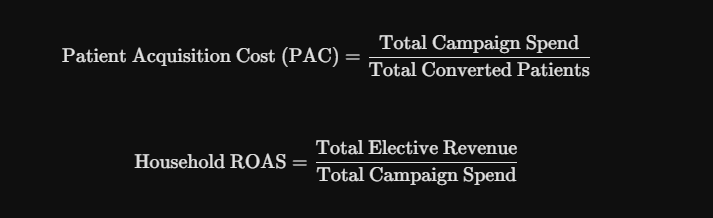
Use these benchmark targets to guide your optimizations:
| Metric | Target Benchmark Range | Optimization Step |
| Household Match Rate | 80% to 95% | Clean target address lists and refine ISP mapping. |
| Cost Per Household Reached | $0.08 to $0.25 | Adjust media mix between top streaming apps and programmatic networks. |
| Consultation Booking Rate | 3% to 8% of page visits | Simplify landing page forms and list financing options clearly. |
| Patient Acquisition Cost (PAC) | $300 to $1,500 depending on procedure | Improve front-desk response times and intake team call training. |
Connect with our analytics team at FullForceAds.com to calculate your practice's true return on ad spend.