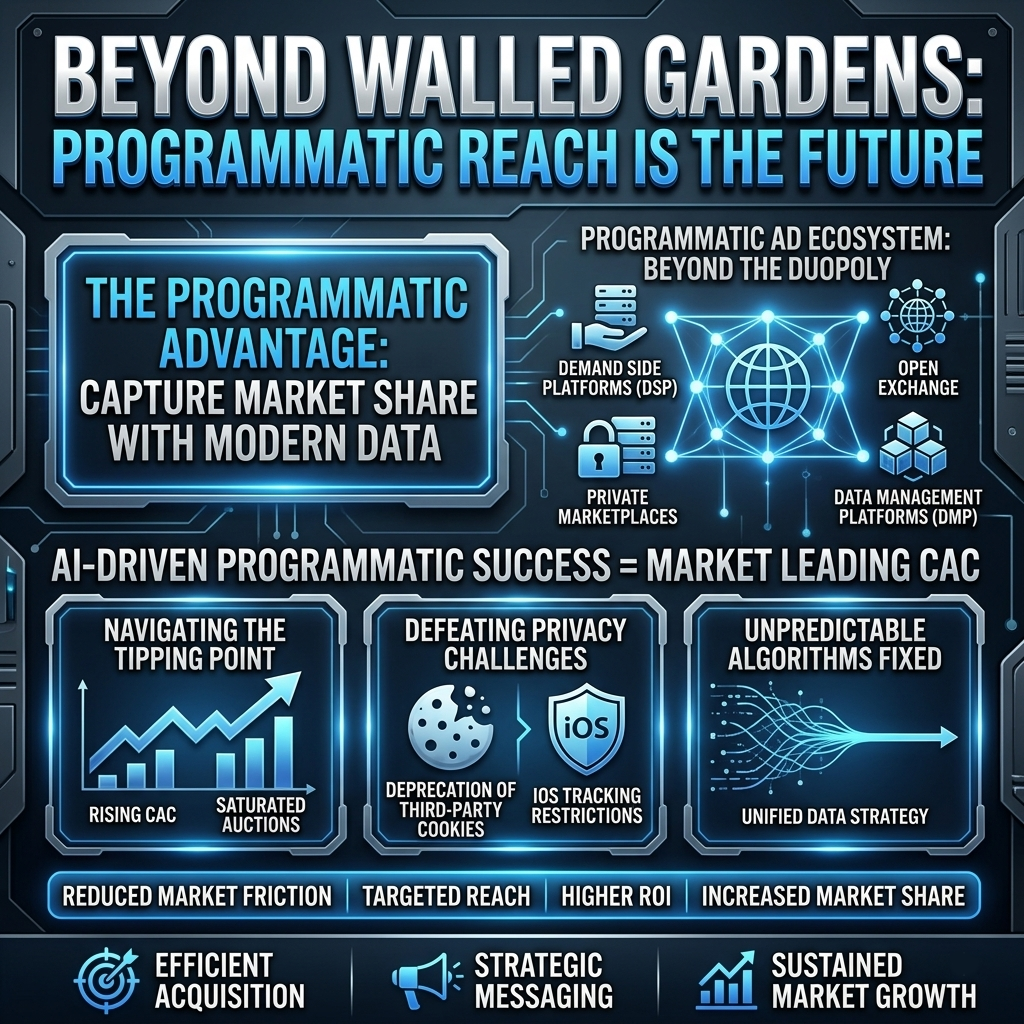
Marketers spent over a decade running the exact same digital playbook: dump 80% or more of your budget into Google and Meta, add a little SEO, and hope the algorithm spits out a decent return.
That strategy is dead.
Rising customer acquisition costs, privacy changes, opaque ad networks, and oversaturated feeds turned standard search and social channels into money pits. Brands pay more for worse impressions, competing in auctions where platforms mark up inventory while hiding where ads ran or who actually saw them.
To grow today, companies are walking away from walled gardens. Instead, they run independent programmatic campaigns driven by raw location data, building-level mapping, and direct audience targeting.
Based in Sandy, Utah, Full Force Ads offers a programmatic framework built for companies that need enterprise targeting without high spend minimums, hidden metrics, or long contracts.
Unlike agencies that resell Google management, Full Force Ads runs its own programmatic platform. This gives advertisers direct access to inventory across Connected TV, online video, audio, mobile, display, and native channels, combined with precise location and event targeting.
Here is how modern programmatic media works, why building-level geofencing and event targeting are replacing generic keyword campaigns, and how you can use these tools to build market share.
Buying ads on major search engines or social networks locks you inside a closed system. You buy inventory controlled by the platform, targeted using audience segments the platform invents, and evaluated by the platform's own reporting tools.
Search engines capture existing demand, but they cannot create it. If someone is not actively searching for your keyword, search ads miss them entirely. Social platforms offer broad interest targeting, but those interests come from passive scrolling habits rather than real-world actions or buying intent.
| Walled Gardens (Search/Social) | Independent Programmatic (Full Force Ads) |
| High minimums and rising CPMs | Flexible budgets and transparent CPM bidding |
| Inferred interest data | Direct physical intent data |
| Zip-code or radius proximity overlap | Building-level polygon geofencing |
| Siloed to single screens or apps | Single campaigns across CTV, Audio, and Display |
| Aggregated reporting | Log-level reporting and foot-traffic tracking |
Independent programmatic buying operates outside these boundaries. By connecting directly to real-time bidding exchanges, Full Force Ads links your business to over 100 streaming apps, publisher networks, digital audio channels, and mobile apps from one place.
Instead of relying on pre-packaged audience segments, Full Force Ads uses unstructured data. Campaigns evaluate raw data points, like exact GPS timestamps, visited venues, search history, and physical street addresses, to show targeted ads based on what people actually do.
Consumer attention shifts across multiple screens all day long. A single buyer might listen to a news podcast on their morning drive, check industry news on a tablet at work, stream a movie on a Smart TV that night, and check sports scores on their phone before bed.
If your strategy relies only on desktop banner ads, you miss most of your audience's daily touchpoints.
Full Force Ads combines six digital media channels into one campaign architecture:
Getting an ad onto a screen is only half the work. Audience accuracy determines actual returns. Full Force Ads layers targeting methods over these media channels to hit vetted prospects.
| Targeting Method | Mechanism |
| Geofencing | Polygon mapping around physical venues |
| Addressable | Mapping physical CRM lists to home devices |
| Site Retargeting | Re-engaging past site visitors across screens |
| Search Retargeting | Reaching users based on keyword search history |
| Contextual | Placing ads next to relevant online trade content |
| Event Targeting | Fencing venues during specific dates and hours |
Standard radius targeting draws a 1-mile or 3-mile circle around an address. This wastes money by capturing nearby houses, highways, strip malls, and unrelated businesses.
Full Force Ads uses polygon geofencing. Strategists map the exact perimeter of a building, parking lot, or facility, cutting out surrounding streets and neighboring businesses. When a mobile device enters that physical space, the system logs its Mobile Advertising ID (MAID).
Conversion Zone Tracking places a second geofence around your physical business location or showroom. This measures foot traffic directly, showing how many people walked into your building after seeing an ad.
Addressable targeting connects direct mail lists to digital media. You upload a list of physical street addresses, such as customer records or target accounts. The platform maps the physical boundary of each property using tax assessor plot data, linking smart devices associated with that address to serve targeted ads.
Search retargeting reaches people based on keywords they searched online, capturing buyers who are actively researching options. Site retargeting re-engages users who visited your website without filling out a form or making a purchase, serving sequential ads as they browse other sites.
Contextual targeting analyzes page text, video metadata, and topic structures in real time. This places your ads next to articles discussing specific industry tools or market conditions.
For B2B companies, industrial suppliers, and commercial service providers, industry trade shows bring decision-makers together in one venue.
Traditional trade show participation costs tens of thousands of dollars for booth space, custom exhibit construction, travel, and sponsorship fees. Physical booths also limit your team to attendees who happen to walk down your specific aisle.
Event targeting changes trade show marketing entirely.
Event targeting uses location mapping to draw virtual boundaries around event venues during specific dates and hours.
With event targeting, your business does not need a physical booth at the show. You can geofence an industry conference from your office and build an audience of attendees. While competitors pay $50,000 for floor space, you can run a targeted campaign that puts your message on the phones and hotel screens of executives in attendance, followed by retargeting ads when they return to work.