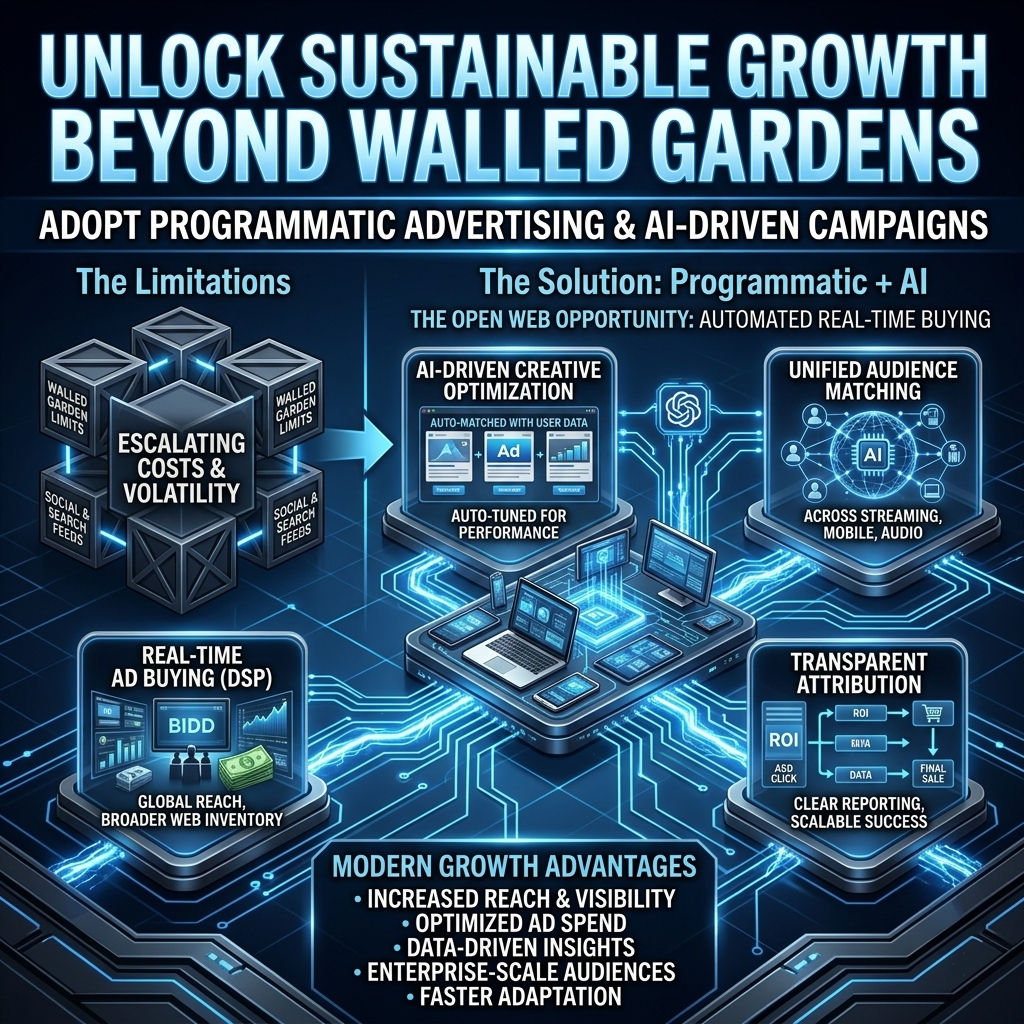
Google and Meta built modern digital advertising, but they also built a trap. Brands pay more every year for less control, higher CPMs, and reporting dashboards that ask you to trust black-box algorithms.
The alternative is the open web. Programmatic advertising lets you buy ad space across websites, streaming apps, podcasts, and mobile software in real time. Instead of waiting for someone to log into Instagram, you reach them on the news sites they read at breakfast, the podcasts they listen to on their commute, and the streaming apps they watch at night.
Full Force Ads, based in Sandy, Utah, is a programmatic agency and technology provider. Built on proprietary demand-side technology, the platform gives marketers enterprise-level targeting without the usual trade-offs: no $10,000 monthly spend minimums, no long-term contracts, and no hidden markups.
Programmatic media replaces manual insertion orders and direct publisher reps with automated software auctions. Through Real-Time Bidding, software evaluates individual ad impressions in under 100 milliseconds while a page loads.
When a user opens an app or website, the page sends an ad request containing context about their location, device type, and content category. A Supply-Side Platform packages that slot and offers it to open exchanges. From there, Demand-Side Platforms evaluate the incoming data, compare it against active advertiser parameters, and submit bids. The highest bidder's ad renders instantly before the page finishes loading.
Traditional ad networks lock buyers into pre-packaged, rigid audience segments. Full Force Ads uses unstructured data, which means you target specific data points instead: exact geo-coordinates, specific search terms, or tight recency windows. That precision cuts out wasted impressions.
People do not stick to a single app all day. Full Force Ads coordinates campaigns across six primary placements through one dashboard:
Connected TV puts non-skippable commercials on platforms like Roku, Hulu, Paramount+, Peacock, and YouTube TV, giving you television impact with digital measurement. Digital video places pre-roll, mid-roll, and outstream video inside online articles to build authority before asking for a click. Digital audio delivers commercial spots on Spotify, Pandora, iHeartRadio, and podcast networks during screen-free moments like driving or working out.
In-app mobile uses location-aware banners and interstitial placements served when prospects walk near specific storefronts, events, or points of interest. Standard banner display across news sites and niche publications maintains brand awareness and handles site retargeting. Finally, native display adapts to the layout and typography of the host publication, which keeps click-through rates higher and reduces banner fatigue.
Choosing where an ad appears is only half the job. Precision data determines who actually sees it.
| Strategy | How it works | Typical application |
| Building-level geofencing | Maps custom polygon borders around physical buildings or outdoor spaces down to the property line. | Conquesting competitor locations, capturing trade show attendees, or driving store visits. |
| Addressable household mapping | Matches physical CRM mailing addresses directly to household IP addresses and connected devices. | Digital direct mail, account-based marketing, and lapsed customer reactivation. |
| Search retargeting | Serves display or video ads to people based on the exact keywords they recently searched online. | Intercepting active buyers during their research phase. |
| Site retargeting | Tracks website visitors who left without buying and follows them across the open web. | Re-engaging warm leads to lower customer acquisition costs. |
| Contextual targeting | Places ads next to articles and videos directly related to specific industry topics. | Aligning brand messages with relevant content without using third-party cookies. |
Standard radius targeting draws a wide circle on a map, wasting budget on nearby highway traffic, residential neighborhoods, or unrelated businesses. Building-level geofencing traces the actual footprint of a target location, like a competitor's showroom or a convention hall.
When a mobile device enters that boundary, the system captures its anonymized device ID. You can then serve targeted ads to that phone, and to other connected screens in the same household, for up to 30 days. By drawing a separate Conversion Zone over your own location, you can track physical foot traffic to see how many people visited your store after seeing an ad.
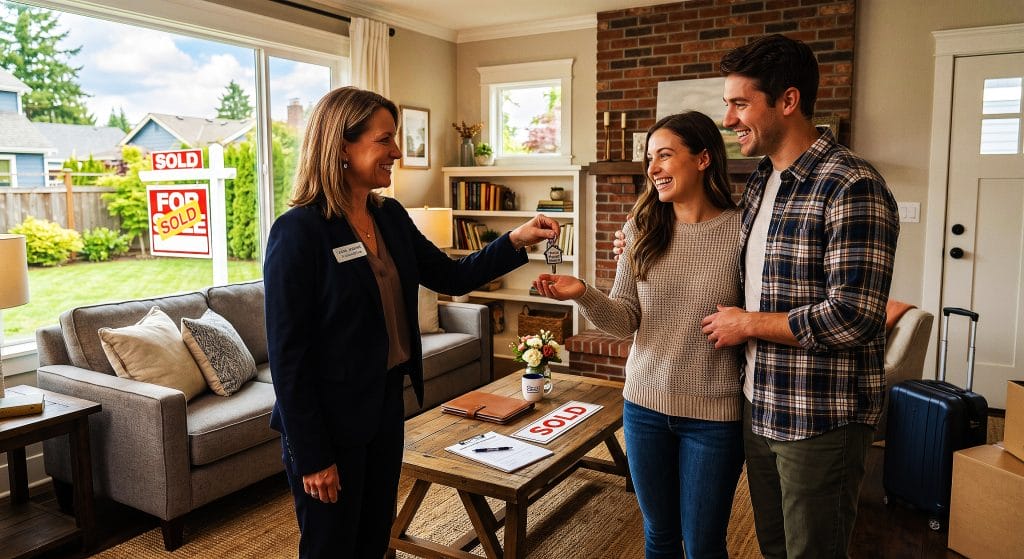
Real estate shows how programmatic media and dynamic creative work together. Property marketers face three constant pressure points: hyper-local target areas, tight listing timelines, and high visual expectations from buyers.
Using broad radio or print ads wastes money outside the target neighborhood. Real estate teams use search retargeting for terms like "homes for sale near me" instead, combined with geofences around competing developments or luxury venues.
Preparing display ads across standard sizes used to create a design bottleneck. Combining professional photography with generative AI speeds up the entire workflow. Clean architectural photography provides an authentic foundation that builds trust. AI tools can then virtually stage unfurnished or outdated properties in multiple design styles, showing minimal or transitional options to test which visuals yield higher click-through rates. From there, copy tools generate ad copy variants targeting different buyer personas, highlighting local school districts for families or investment yields for investors.
Combining dynamic asset creation with programmatic templates cuts creative production turnarounds from weeks to a few hours.
While many companies prefer fully managed services, in-house marketing teams and regional agencies often want direct control over their campaigns.
The FullForceAds.app platform gives teams hands-on access to their media buys. Media buyers can adjust daily pacing, CPM caps, and bid strategies in real time without waiting for an account manager to process a change order. Marketers can upload photography, copy, and display banners to launch geofenced or addressable campaigns immediately.
The platform shows exact site placements, app impressions, and geographic performance without masked publisher lists or hidden markups. Agencies can also manage multiple client accounts under their own brand while retaining healthy margins.
Different business goals demand different campaign setups. To drive local store visits, pair building-level geofencing with mobile and display ads, then set a Conversion Zone over your storefront to track physical foot traffic. To target a competitor's customers, geofence their physical locations and apply addressable targeting to surrounding street addresses.
To build regional authority, run unskippable Connected TV commercials alongside digital audio and video ads targeted by household demographics. If you want to capture active research traffic, combine display and native ads with search retargeting on high-intent industry keywords. To reactivate an existing customer list, upload physical direct mail lists to match household IP addresses for multi-screen display and CTV campaigns.
Getting started with programmatic media involves four simple steps: