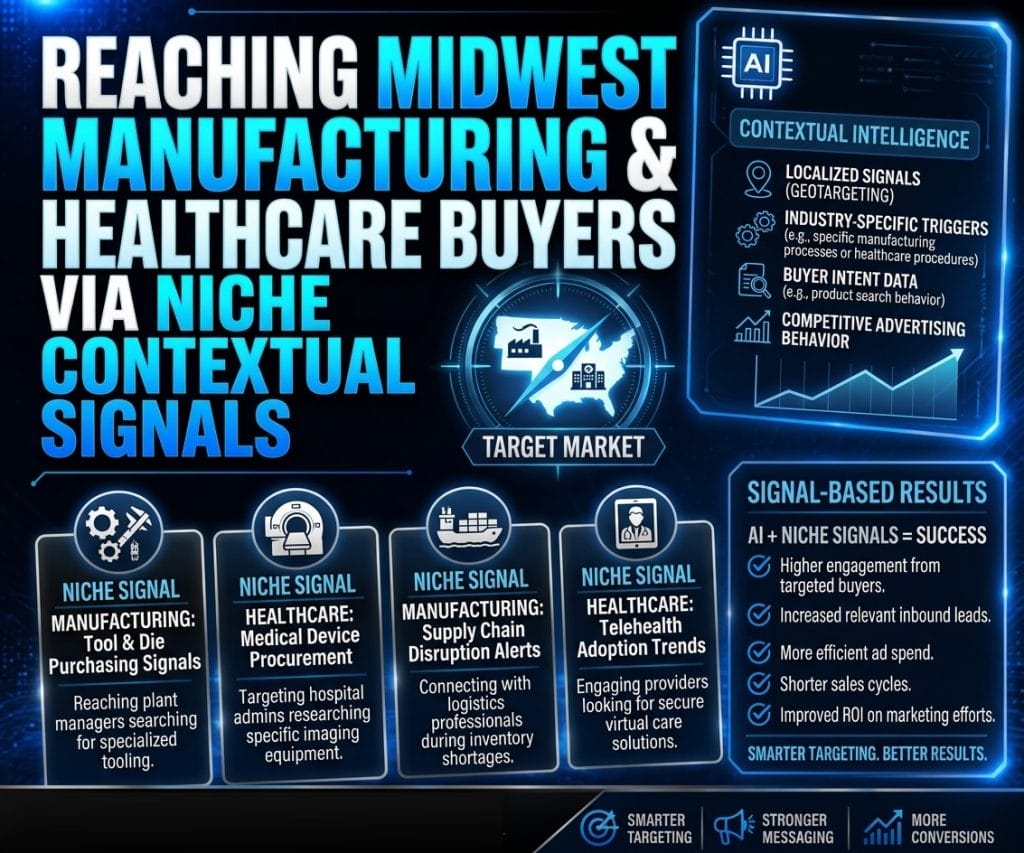
Reaching B2B decision-makers in specialized regional markets like Ohio industrial plants or Midwest healthcare networks has gotten noticeably harder. For years, digital growth teams relied on IP tracking databases, behavioral profiles, and third-party tracking cookies to follow buyers around the internet.
That strategy is mostly dead now. Privacy laws, browser restrictions, and ad blockers have wrecked cross-site tracking accuracy. On top of that, buyers in manufacturing plants and hospital procurement units sit behind strict corporate firewalls and VPNs that strip out tracking scripts by default.
To reach these accounts today, companies have to abandon old tracking habits. The practical alternative is intent-driven contextual advertising.
Instead of trying to trace a specific user from site to site, contextual placements look at what someone is actively reading right now. When you run those ads across streaming TV, digital audio, display, native, and mobile formats, you stay visible to the right people without needing invasive tracking data.
Our team at Full Force Ads, based out of Sandy, Utah, builds these campaigns for mid-market companies and agencies. Through our platform, FullForceAds.app, teams can run multi-screen placements with complete visibility into where their budget actually goes.
Why cookie tracking broke down
For years, programmatic advertising treated user profiles as the holy grail. If an operations manager in Columbus visited an industrial supply site, an ad network dropped a cookie and chased them across news blogs, sports sites, and social feeds for a month.
That setup fell apart for a few obvious reasons:
Contextual placement flips the model. It stops asking who the user is and starts looking at what they are doing right now.
When an operations director reads about supply chain fixes, assembly line maintenance, or medical device rules, their professional focus is active. Putting your display, video, or native ads directly inside that reading material hits them while they are actually thinking about work.
Reaching Midwest manufacturing buyers
The industrial corridor across Ohio, Michigan, Indiana, and Pennsylvania accounts for billions in enterprise purchasing. But the people buying factory equipment, raw materials, or metal fabrication services do not browse standard news portals to find vendors.
Modern contextual engines also go well beyond basic keyword lists. Older tools made clumsy mistakes, like dropping an airline ad into a story about a plane crash because both used the word aviation. Today's tools use natural language processing to read the full page, check the overall topic, evaluate sentiment, and confirm intent before placing a bid.
In manufacturing, that usually means matching ads to specific content types:
Placing native and display ads directly inside these trade pieces helps suppliers build credibility without touching personal data.
Navigating healthcare procurement without privacy risks
Marketing to healthcare decision-makers like hospital CFOs, medical directors, and procurement heads brings a different set of hurdles. Strict HIPAA regulations make user-level tracking a major compliance risk.
Because contextual ads target page content instead of user identity, they operate completely outside personal health data rules. Medical device makers and healthcare vendors can run targeted campaigns without running into privacy trouble.
Different roles need different contexts. Hospital CFOs usually read about healthcare finance and facility operations, where desktop native ads discussing cost reduction make sense. Chief medical officers read clinical studies and workflow updates, making short pre-roll video or native articles about clinical results a better fit. IT directors follow network security and EHR integrations, which align with mobile and display ads focused on system stability. Procurement officers track wholesale equipment sourcing, where simple search retargeting and banner ads can highlight pricing and stock availability.
Building a multi-screen campaign
A single banner ad rarely closes a complex B2B deal. Staying visible usually requires a consistent presence across the devices your prospect uses throughout their day.
A typical run might start with digital audio ads on podcasts or streaming radio during their morning commute. During the workday, native articles and display banners keep your product visible on trade websites. In the evening, non-skippable video spots on streaming TV platforms reach executives on their home screens. You can also draw hyper-local virtual borders around industrial parks, trade shows, or medical centers to deliver mobile ads to people inside those zones.
Layering intent and location signals
Contextual content matching carries most of the weight in cookieless media buying, but layering extra location and intent signals improves overall results.
Geofencing sets virtual borders around physical locations, like competitor plants or regional trade conventions. Devices inside those zones can then receive targeted ads during the event and over the following month.
Addressable targeting takes corporate contact lists or physical mail records and matches those street addresses to household IP addresses, letting you deliver streaming TV and display ads straight to specific decision-maker homes. Search retargeting catches buyers who searched for specific industrial or medical terms right before visiting trade sites, reaching them while they are actively searching for solutions.
A simpler path for growing brands
Many growth teams run into the same problem: standard self-serve platforms lock you inside their own closed networks, while massive programmatic agencies enforce high spend minimums and markup fees.
Full Force Ads gives mid-market businesses and regional agencies direct access to enterprise-grade programmatic tools without those hurdles. Our team in Sandy, Utah handles strategy, setup, and optimization directly, so you work with experienced media planners instead of junior account managers.
For teams that want direct control over execution, our self-serve platform at FullForceAds.app offers real-time bidding inventory, site-level domain transparency, and simple multi-channel management.
A practical deployment playbook
Setting up an intent-based contextual campaign generally follows four steps:
Ditching third-party cookies takes a shift in approach, but intent-driven contextual placements, precise location signals, and clear multi-screen planning give B2B brands a reliable way to reach real buyers across the Midwest.