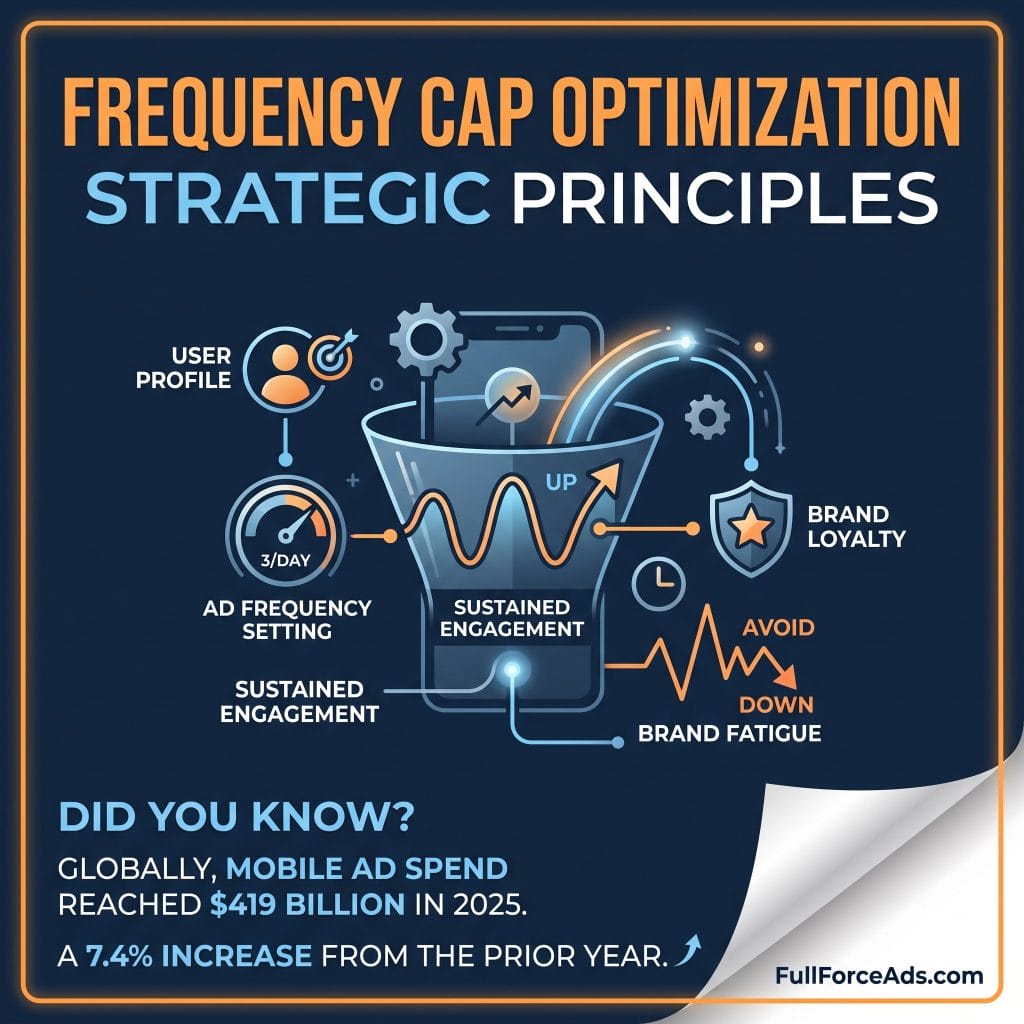
In digital marketing, finding your audience is rarely the hard part anymore. The actual challenge is knowing when to stop showing them the same ad. Media budgets keep rising, yet campaigns constantly lose efficiency because brands show their ads too many times to the same people.
If a buyer sees the same display ad twelve times in one afternoon across three different sites, they do not feel closer to buying. They go from noticing the brand to getting annoyed, and eventually to ignoring or actively avoiding it.
Marketing teams need to control how often their ads appear across different channels. Setting clean frequency caps keeps campaigns effective, protects your return on ad spend (ROAS), and ensures platforms like Full Force Ads deliver your creative at a sensible pace.
Understanding the economics of frequency: burnout vs. breakthrough
Frequency capping limits how many times a single user sees an ad within a set timeframe, such as 3 impressions in 24 hours. The concept is simple, but finding the exact balance between making an impression and annoying people takes deliberate testing.
[ Audience Engagement Lifecycle ]
High ^ Optimal Peak
| /--------------
| / (Effective)
| /
| /
Efficacy / \ Ad Fatigue &
| / \ Decay
| Threshold
Low +--------------------------------------------->
1 3 5 7 9 12 15+
Impressions per User / Day
The cost of over-exposure
People quickly tune out ads they see too often. Once someone reaches their limit, they either ignore the banner completely or install an ad blocker. Buying more impressions for someone who has already passed their point of interest wastes ad spend without generating extra sales. It also leaves a bad impression that hurts long-term customer relationships.
The cost of under-exposure
Showing an ad just once rarely leaves a lasting memory. Complex products and longer sales cycles need several touchpoints before a buyer takes action. Good media planning finds the middle ground: enough impressions to build clear recognition without annoying the user.
Cross-channel frequency capping matrix
Ideal frequency caps depend on the ad format, screen size, and how people interact with the content. Here is a practical baseline for setting caps across modern channels:
| Media channel | Typical engagement mode | Recommended frequency cap | Primary optimization goal |
| Streaming TV (CTV) | Lean-back, high-attention, unskippable | 2 to 3 impressions / household / day | Brand recall and premium impression impact |
| Video (Pre-roll/Mid-roll) | Active viewing, high sensory intake | 2 to 4 impressions / user / day | Message retention and click-through intent |
| Digital Audio | Screen-free, personal, immersive | 2 to 3 impressions / user / day | Audio recall and intimate connection |
| Mobile Web & In-App | Highly frequent, fast-scrolling | 4 to 6 impressions / user / day | Immediate engagement and click-throughs |
| Display Banners | Passive browsing, contextual ambient | 5 to 8 impressions / user / day | Ongoing visibility and brand presence |
| Native Advertising | Integrated reading experience | 3 to 5 impressions / user / day | In-depth content engagement and trust |
Core strategies for optimizing frequency caps
Keeping audience attention without causing ad fatigue requires a multi-layered approach to ad delivery, creative rotation, and audience segmentation.
              [ Strategic Framework ]
                        |
+-----------------------+-----------------------+
|                                               |
[ Tactical Layer ] [ Architecture Layer ]
• Dynamic Creative Rotation • Cross-Device Household Graph
• Cross-Channel Cadence Capping • Unified Omnichannel DSP
• Funnel-Based Decay Caps • Direct Inventory Pipelines
Unified omnichannel identity resolution
Buying media through separate platforms breaks frequency limits. If your display, streaming TV, and audio ads run in isolated systems, a single user might see 5 display ads, 4 TV spots, and 3 audio ads in one day. To that person, your brand just ran 12 ads in 24 hours.
A unified ad stack connects identity tracking across devices and inventory channels. Managing buys through a single engine applies impression rules across every screen and publisher source.
Creative sequencing and asset rotation
Ad fatigue usually comes from seeing the exact same image repeatedly rather than seeing the brand itself. Rotating creative variations keeps the message fresh while maintaining awareness:
Setting automated rules to rotate these assets after a set number of impressions guides prospects through a clear story without tiring them out.
Funnel-based decay rules
An ad's ideal frequency depends on where the user sits in your sales pipeline:
Strategic activation with Full Force Ads
Based in Utah, Full Force Ads builds programmatic ad technology that lets brands run multi-screen campaigns from one place. Instead of relying on disparate third-party networks, Full Force Ads uses its own media engine to enforce global frequency caps across all channels in real time.
            [ Full Force Ads Unified Engine ]
                           |
+-----------+-----------+------+------+-----------+-----------+
| | | | | |
Streaming TV Video Audio Mobile Display Native
(Roku, Hulu) (Pre/Mid) (Spotify, Pod) (In-App) (Web Banners) (In-Feed)
| | | | | |
+-----------+-----------+------+------+-----------+-----------+
|
[ Frequency Capping & DSP ]
Fully integrated media channels
Through one dashboard, Full Force Ads manages delivery across major digital formats:
High-precision targeting capabilities
Frequency capping only works if you target the right audience. Setting caps on unpromising leads still wastes budget. Full Force Ads combines multiple targeting layers before serving an impression:
The strategic advantage: enterprise media control
Full Force Ads gives buyers direct control over campaign settings, reporting, and execution:
Campaign frameworks for specific business goals
[ Objective-Based Campaign Mixes ]
Local Awareness Conquesting Brand Building
+-----------------+ +-----------------+ +-----------------+
| • Geofencing | | • Geofencing | | • Search Retar. |
| • Mobile | | • Addressable | | • Streaming TV |
| • Display | | • Search Retar. | | • Video |
+-----------------+ +-----------------+ +-----------------+
Campaign strategy matrix
| Primary objective | Recommended channel mix | Strategic targeting focus | Ideal frequency strategy |
| Local market awareness | Geofencing + Mobile + Display | Foot-traffic zones, neighborhood perimeters, local events | Broad distribution; capped at 4 to 6 display/mobile impressions daily |
| Competitor conquesting | Geofencing + Addressable + Search Retargeting | Competitor storefronts, target locations, active keyword searches | High immediate frequency (5 to 7 impressions daily) following a location or search trigger |
| National brand building | Streaming TV + Pre-Roll Video + Audio | In-market demographics, interest groups, contextual content | Household capping of 2 to 3 CTV or video views daily |
| Site traffic generation | Native + Search Retargeting + Display | Contextual editorial channels, active search categories | Moderate frequency of 3 to 5 native or display interactions daily |
| Re-engaging past visitors | Site Retargeting + Video + Display | High-intent site actions like abandoned carts or pricing views | Dynamic decay capping starting at 6 per day and tapering to 1 per day over two weeks |
| Customer list activation | Addressable + Streaming TV + Display | Verified household address lists, CRM syncs | Cross-screen household cap of 3 to 4 impressions daily |
Step-by-step implementation framework
Measuring campaign health and frequency efficiency
To verify that your frequency limits protect your budget without missing key buyers, track these performance metrics across your media mix:
[ Key Media Metrics ]
+-------------------+-------------------+
| | |
v v v
[ Cost Per Reach ] [ CTR Decay Curve ] [ Lift Analysis ]
Unique Reach vs. Performance drop Conversions vs.
Media Cost Ratio over impressions Impression Count
Transform your digital advertising strategy today
Frequency cap optimization is more than a technical setting in a demand-side platform. It is a core part of managing ad spend, respecting your audience, and building long-term brand equity. Setting smart limits across connected channels helps campaigns deliver higher returns without burning out potential customers.
Whether you need a fully managed team to build custom campaigns or want to run buys yourself through FullForceAds.app, Full Force Ads provides the tools, inventory access, and reporting clarity to scale efficiently.
Take control of your media strategy across streaming TV, video, audio, display, mobile, and native channels. Schedule a discovery call with Full Force Ads to build a tailored media plan for your growth goals.