For a Chief Marketing Officer, business owner, or agency executive, modern digital advertising feels like a trap. We have better tools than ever to find and convert buyers. Yet the actual ad tech ecosystem is a fragmented, opaque, overpriced mess.
Look at how most enterprise ad ops run today. To cover basic ground, marketing teams end up juggling half a dozen ad platforms, vendor accounts, and agency contacts.
Search and display live in one silo. Social media inventory sits in another. You negotiate separate deals with connected TV vendors, write individual checks for streaming audio, and bring in specialized vendors for mobile geofencing or direct-mail matching.
It is operational chaos. Disconnected tools mean you end up bidding against yourself across channels. Your campaign hits the same audience twenty times with the same banner while completely missing fresh prospects. You get stuck deciphering conflicting conversion reports where three different ad networks take 100% credit for the exact same sale. Meanwhile, six-figure annual vendor contracts lock up your capital whether the ads work or not.
If you want to scale today, single-channel thinking has to go. High-performing marketing needs a unified cross-channel setup: one system that places your brand on every screen and speaker your buyers use, backed by real physical and digital behavior.
Here is the strategic plan for cross-channel advertising, built around the approach used by Full Force Ads—a digital advertising agency in Sandy, Utah, focused on omnichannel execution and precision programmatic media buying.
The shift: Why unified omnichannel buying wins
Before getting into execution, we need to draw a clear line between multichannel and omnichannel advertising.
In a multichannel setup, every channel operates in the dark. Your CTV vendor buys impressions on smart TVs with zero idea if that viewer saw a mobile banner ten minutes ago or heard a podcast ad on Spotify this morning. You pay full price across every silo, double-count your audience, and guess at attribution.
Unified omnichannel buying changes that. Your media buyer manages a single programmatic engine. Every channel, from 65-inch living room screens to smartphones, podcasts, and news feeds, draws from one pool of data. When a prospect interacts with your brand on one device, that touchpoint immediately adjusts how and where they see you next.
Cutting out middleman bloat
Most agencies do not own their media tools. They broker them. They mark up third-party tech, white-label underlying platforms, and pass the bill to you alongside monthly spend minimums of $10,000 to $50,000 just to keep the lights on.
Full Force Ads skips that whole setup. Based in Utah, Full Force Ads runs its own ad platform. Your ad spend goes straight into real-time bids, placement, and targeting, not agency markups.
By stepping around platform walled gardens, you get enterprise-level reach across channels without getting locked into annual contracts or inflated minimums.
Take a look at the Full Force Ads Advertising Solutions to see how unified media buying works in practice.
Part 1: Media channels - Reaching your audience across every screen
Influencing buyers requires a consistent story across the media they use every day. Full Force Ads manages six core media channels from one platform, eliminating vendor clutter.
Streaming TV (Connected TV / CTV)
The TV in the living room is still prime real estate, but traditional cable is dying fast. Viewers have moved to Hulu, Roku, Fire TV, Peacock, and YouTube TV.
Full Force Ads brings precise targeting to big-screen television. Instead of buying broad, expensive cable slots based on soft demographics, Streaming TV lets you deliver non-skippable, high-definition ads directly to specific households.
Impact: 100% completion rates on unskippable HD ads, backed by household-level targeting so you do not waste ad spend on the wrong viewers.
Digital Video
Video holds attention like nothing else. Beyond CTV, Full Force Ads places video assets across pre-roll, mid-roll, and outstream slots on millions of websites and mobile apps.
Impact: Engages desktop and mobile users as they read news, watch web content, or check industry publications, driving strong recall and clicks.
Streaming Audio
People spend hours in screen-free modes: driving, working out, or cooking dinner. Streaming audio gives you direct, quiet access to them during those hours.
Through Full Force Ads, you can run targeted audio spots across Spotify, Pandora, podcast networks, and digital radio.
Impact: Reaches listeners when their eyes are elsewhere, delivering clear 15- to 30-second messages without competing visual noise.
Mobile Advertising
Smartphones are the main entry point to the web. Full Force Ads puts your message on the devices your audience checks all day long.
Using targeted in-app and mobile web placements, mobile campaigns meet buyers in real time, whether they are checking sports scores, reading news, or walking past a storefront.
Impact: Forms the backbone for location-based marketing, real-time foot traffic tracking, and quick local response.
Display Ads
Banner ads remain the workhorse of online presence and retargeting. Running across millions of premium sites and apps, display ads give you steady, cost-effective visual reminders.
Impact: Keeps your brand front of mind, reinforces your visual identity, and drives steady site retargeting.
Native Advertising
Banner fatigue is real. Native advertising gets around it by matching the design, typography, and structure of the site host.
Impact: Generates higher click-through rates by fitting naturally alongside editorial content, news feeds, and articles.
Part 2: Precision targeting solutions - Hitting the mark every time
Putting ads on good channels is only half the work. Strategic success comes down to targeting: ensuring your money buys impressions from real prospects, not web bots or random traffic.
Full Force Ads layers these targeting methods onto any channel mix:
Building-level geofencing
Drawing a standard 1-mile radius around a store is wasteful. You end up capturing highway traffic, nearby apartments, and people who will never buy from you.
Full Force Ads uses precise building-level geofencing. We trace the exact physical outline of a building, like a competitor's location, a trade show center, or a specific auto lot.
When a phone steps inside that virtual outline, its device ID logs in a privacy-compliant way. You can then run targeted ads to that user across their devices for up to 30 days, and track whether they walked into your store using Conversion Zone tracking.
Addressable household targeting
Physical direct mail is slow, expensive, and tough to track. Addressable targeting converts direct mail lists into precise digital delivery.
Upload your customer CRM data, prospect mailing lists, or local sales addresses. Full Force Ads matches those exact street addresses to home IP networks and household devices.
Your ads land directly on the laptops, phones, and smart TVs inside those homes. You get digital efficiency backed by direct mail accuracy.
Search retargeting
Standard search ads capture people only when they visit a search engine and click a sponsored link. Search retargeting broadens that reach.
By tracking real-time keyword searches across partner sites, Full Force Ads finds people active in your market. We serve them display, native, or video ads while they read news or browse the web, reaching them long before they click a competitor's link.
Site retargeting
Over 95% of first-time website visitors leave without taking action. Site retargeting makes sure that traffic spend is not wasted.
When a prospect leaves your site, Full Force Ads places quiet, consistent touchpoints across their daily browsing. They might see a native ad on a news site, catch a video in an app, or hear your brand mentioned on Spotify.
Privacy-first contextual targeting
As tracking cookies disappear and privacy laws tighten, old tracking methods are breaking down.
Contextual targeting avoids user tracking altogether. It matches your ads directly to page topics, videos, and articles. If someone is reading an article about kitchen remodeling, your custom cabinetry ad appears right next to it, keeping things relevant while respecting user privacy.
Part 3: The structure of ad persuasion - Aligning intent with conversion
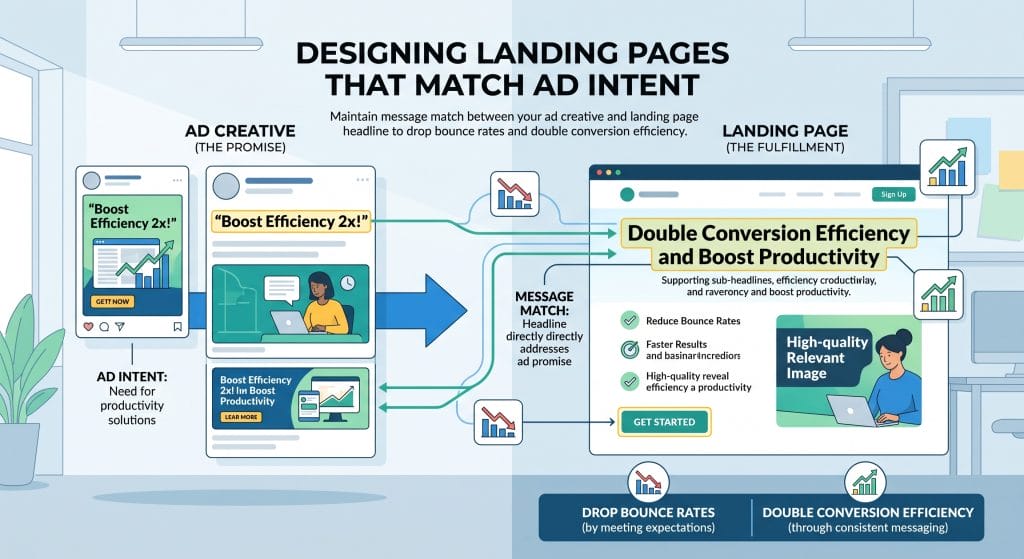
A programmatic campaign can place your brand in front of millions of buyers, but closing the deal takes matching messaging. To get solid returns, you need a tight bridge between your ad hook and your landing page.
The issue with intent disconnect
The biggest waste in digital advertising is driving hyper-targeted ad traffic to a generic homepage.
If a prospect clicks a geofenced ad for "20% Off Commercial Roof Inspections" and lands on a page reading "Welcome to Apex Construction – Quality Craftsmanship Since 1998," they freeze. They have to pause and figure out if they are in the right spot. Bounce rates soar, conversion rates drop, and your acquisition costs go through the roof.
The message-match approach for conversion
To turn ad views into revenue, landing pages must mirror the core offer of your ad:
Match the headline: The top headline on your page should state the main hook, offer, or search term used in the ad.
Keep visual cues consistent: Use matching images, colors, tone, and branding between the ad and the page.
Deliver on the offer right away: If your ad promises a pricing guide, put the download form right at the top of the page. Do not force people to look through menu bars.
Cut friction: Keep forms brief, make mobile load times fast, and show trust markers like reviews, trade badges, and local addresses.
When your creative and landing page align, bounce rates fall, trust goes up, and ROI improves.
Part 4: Strategic playbooks - Channel mixes by business goal
Every business operates on different goals, budgets, and sales timelines. A single template strategy does not work.
Full Force Ads designs channel strategies around specific goals. Here are six field-tested playbooks:
Scenario 1: Local retailer or restaurant chain Goal: Drive foot traffic and pull customers away from nearby competitors.
Strategy: Set up Geofencing around rival stores, entertainment hubs, and local event centers. Pair this with location-based Mobile and Display ads showing immediate promotions. Track actual store visits with Conversion Zone tracking.
Scenario 2: High-value B2B or specialized services (law firms, healthcare, home services) Goal: Capture serious leads and establish market presence locally.
Strategy: Use Search Retargeting on display and native channels to catch active searchers. Build trust with non-skippable Streaming TV ads delivered to targeted households, and run Addressable Targeting to hit verified high-value addresses.
Scenario 3: E-commerce and national growth brands Goal: Lower acquisition costs and raise customer lifetime value.
Strategy: Pair Contextual Targeting on niche blogs and industry sites with clean Video ads. Run Site Retargeting across display and native channels to bring back interested visitors without burning ad budget.
Part 5: FullForceAds.app - Platform control with self-serve agility
In advertising, execution speed and transparency make a real difference.
While Full Force Ads handles full-service agency management, marketing teams and agencies often want direct control over their daily campaigns.
That is why we built FullForceAds.app, our self-serve advertising platform.
It gives brands and agency partners direct access to enterprise-grade media tools without the bloated cost or complexity:
Self-serve media buying: Launch, pause, and scale campaigns across Streaming TV, Video, Audio, Mobile, Display, and Native inventory from a single dashboard.
Audience builder: Set up geofences, upload address lists, and set keyword retargeting rules in minutes.
Clear analytics: Track impressions, clicks, video completion, domain placements, and foot traffic live. No black-box reporting or hidden markups.
White-label agency features: Agencies can brand the dashboard, generating custom reports and client portals without managing five different ad tools.
Whether you choose full management from our media team or self-serve control on FullForceAds.app, you get the same inventory access and targeting accuracy.
Part 6: Choosing Full Force Ads as your digital advertising partner
When picking an agency partner, you have two options: keep juggling fragmented vendors, or unify your buying under one clear programmatic engine.
Based in Sandy, Utah, Full Force Ads works differently than traditional marketing agencies:
All channels in one place: We manage your media presence across TV, audio, mobile, web, and native platforms inside one system, cutting out vendor mess and simplifying campaign checks.
Targeting based on real actions: From custom geofence outlines to addressable household matching and search retargeting, we reach prospects based on real-world behavior.
Transparent reporting: Clear metrics show where your ads ran, who saw them, and how they drove results, including foot traffic tracking.
No long-term contracts or arbitrary minimums: We hold onto your business through campaign performance, not legal lock-ins.
Fast campaign launches: While traditional agencies spend weeks onboarding, Full Force Ads gets your campaigns running in 5 to 7 business days.
Fixing your digital ad strategy
You do not need to waste ad budget on vendor fragmentation, middleman fees, and outdated targeting. You can run your digital marketing through a single, transparent system that reaches your audience on every screen they use.
Whether you are a local business building foot traffic, an enterprise team expanding cross-device reach, or an agency looking for a programmatic partner, Full Force Ads has the platform and execution to deliver.
Check out our full capabilities at Full Force Ads Advertising Solutions or get in touch today to schedule a strategy call. Let's build a practical, profitable advertising engine for your business.