
Self-Serve →
Full Force Ads
Programmatic Advertising Blog >>
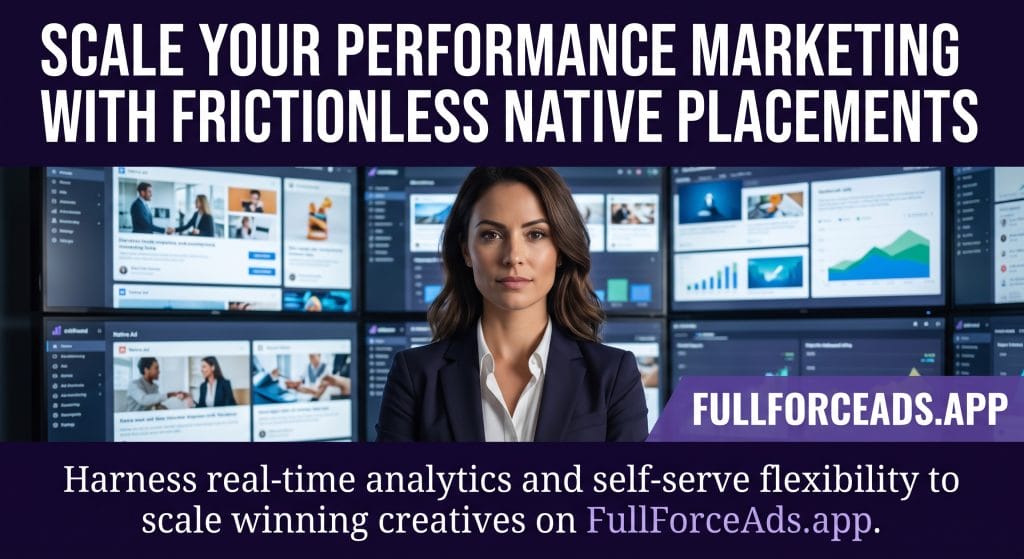
Scale Your Performance Marketing with Frictionless Native Placements

Scale Your Performance Marketing with Frictionless Native Placements

Posted on September 18, 2026

Native placements match the layout, tone, and visual style of publisher feeds, giving performance marketers a direct way to expand beyond crowded search and social platforms. By blending into organic content, these ads sidestep standard banner blindness, driving up to 8.8 times higher click-through rates than standard display units while building real interest before the user ever lands on a site.

The mechanics behind scaling native

People click these ads because the headline promises an insight or a fix rather than a quick pitch. That dynamic screens traffic early, yielding better conversion rates after the click. Scale matters here too. Networks like Taboola and Outbrain reach over 1 billion monthly users across mainstream news sites, providing immense top-of-funnel reach. Ad creative also lasts longer; because these placements look like standard articles, they suffer far less audience fatigue than aggressive social ads.

Core native placement formats

FormatStrategic valueTypical benchmark
In-feed nativeSits directly in news and article feeds to feel like surrounding content.0.40% to 0.60% CTR
Recommendation widgetsSits at the bottom of articles ("You Might Like") to catch readers after a piece.$0.20 to $0.50 CPC
In-article video / interactiveRuns video mid-article to boost dwell time without interrupting the reading flow.+180% to +530% video dwell

Scaling native campaigns

  • Match content to the placement: Do not send clicks straight to a hard-sell checkout page. Use bridge pages like advertorials, listicles, or quick quizzes that mirror the host site's editorial feel.
  • Lead with curiosity and value: Write headlines around a relatable issue or unexpected discovery. Focus on angles like "Why 80% of Homeowners Are Switching" instead of pushing a direct discount.
  • Test image and headline combinations: Run at least 5 to 10 pairs per target segment. Use candid, realistic images over generic stock photos to keep the native feel believable.
  • Refine publisher targets early: Launch campaigns on broader targeting to collect data fast, then move high-performing publisher IDs onto an approved list while blocking low-converting domains.

Most digital advertising strategies run on a predictable loop: dump money into search keywords or social feeds, watch costs per click climb, and hope the margins survive. But people moved on from scrolling a single feed years ago.

On any given day, an actual customer listens to a podcast on their morning commute, reads an article over lunch, looks up a local service, and spends the evening streaming a show on Fire TV or Roku. If your ads only live in search results or social feeds, you miss most of the places where people make decisions.

Based in Utah, Full Force Ads builds campaigns across those non-social channels. Whether you want an agency team to run media buying or prefer to manage ads directly through FullForceAds.app, scaling modern performance marketing means going where the rest of the web's attention sits.

Full Force Ads: Omnichannel Reach

  • StreamingTV (Roku, Fire)
  • Video/Audio (Pre-roll)
  • Mobile (In-App)
  • Display (Banners)
  • Native (In-Feed)

Why Search and Social Cap Your Growth

Keyword auctions and social feeds are crowded, expensive, and volatile. An algorithm shift can wipe out account performance overnight, while bidding wars against thousands of competitors drive up acquisition costs for small slices of screen time.

Unifying streaming TV, digital audio, video, native, display, and mobile under one system keeps messaging consistent across screens. It also keeps effective CPMs lower than fighting for feed space.

Matching Creative Formats to the Environment

Different media environments require different formats:

  • Streaming TV (CTV/OTT): Unskippable ads on living room screens through Roku, Fire TV, and smart TV apps. You get the impact of broadcast television without upfront network commitments or massive minimum spends.
  • Digital video: Pre-roll, mid-roll, and outstream placements embedded in articles. Best for quick product demos and short hooks.
  • Digital audio: Ads on Spotify, Pandora, and podcast networks that reach people while driving, working, or cooking with their eyes off their screens.
  • Mobile in-app and web: Banners and interstitial placements on phones that drive direct clicks, local visits, and app installs.
  • Display advertising: Standard web banner placement across news sites and blogs. Low cost per thousand, useful for baseline brand recognition and retargeting.
  • Native advertising: In-feed ads that match the visual layout of the publication hosting them. People read them as content instead of tuning them out like banner ads, making them effective for long-form landing pages and direct response offers.

Reaching Specific Buyers

Where an ad runs matters, but who sees it matters more. Setting precise targeting cuts out wasted impressions on people who will never buy.

Targeting MethodologyBest Strategic Use CaseHow It Works
GeofencingConquesting competitors, trade shows, local foot traffic.Draws GPS boundaries around physical locations to capture device IDs.
Addressable targetingAccount-based marketing, matching direct mail to digital.Maps street addresses to household IP networks for multi-device delivery.
Site retargetingRecovering lost site traffic, shortening sales cycles.Tracks non-converting site visitors and serves follow-up ads across the web.
Search retargetingCapturing active search intent outside search engines.Targets users who recently searched for specific keywords related to your product.
Contextual targetingPrivacy-first targeting, relevant article placement.Matches ads to web page context, article content, and topic categories.
  • Geofencing sets perimeters around real-world places. You can draw perimeters around direct competitors' locations to serve reason-to-switch ads, target trade show arenas during events, or cover high-income commercial zones.
  • Addressable targeting bridges offline physical address lists with digital devices. The system maps customer or prospect street addresses to household network routers, serving targeted streaming TV or display ads directly into specific homes.
  • Search retargeting tracks keyword searches across general web networks, avoiding high search-engine cost-per-click rates.
  • Site retargeting serves tailored follow-up copy to the 95% of site visitors who leave without converting.
  • Contextual targeting scans web content to place ads alongside relevant articles without relying on third-party cookie tracking.

Strategic Playbooks for Common Goals

  • Local Foot Traffic: Geofencing + Display + Mobile
  • Conquesting Competitors: Geofencing + Addressable + Native Ads
  • Enterprise Brand Scale: Streaming TV + Digital Video + Audio Ads
  • B2B Account Targeting: Addressable + Display + Search Retg
  1. Local foot traffic: Draw geofences around local commercial hubs and pair them with mobile and display ads to bring foot traffic into physical stores.
  2. Conquesting market share: Geofence rival storefronts, apply addressable targeting to known prospect lists, and run native and video ads that highlight your advantages.
  3. Enterprise brand scale: Use streaming TV and digital audio at the top of the funnel, run video and native ads in the middle, and close conversions with site retargeting.
  4. B2B account targeting: Match corporate HQ street addresses with addressable targeting, add search retargeting for intent keywords, and run contextual ads across industry trade publications.

FullForceAds.app and Agency Services

Some companies want a team to handle campaign planning, tracking setup, and ongoing optimization end to end. Others prefer hands-on control over their programmatic spend.

FullForceAds.app provides a self-serve platform for running native and display campaigns directly:

  • Launch Ads in Minutes
  • Real-Time Analytics
  • Scale Native Creatives

The self-serve app lets teams launch native variations, track performance metrics live, and shift budgets or bid amounts without long platform setup times.

Whether managed or self-serve, Full Force Ads avoids dark-box reporting. You get weekly performance breakdowns by channel, location, and device. Most managed campaigns set up and go live in five to seven business days.

Campaign Launch Process
  1. Discovery: Review target audiences, business model details, and conversion goals.
  2. Custom Plan (Strategy & Channels): Build a channel mix and targeting plan based on existing buyer data.
  3. Rapid Launch (Live in 5–7 Days): Handle technical tracking, perimeter setup, and creative validation to launch within five to seven business days.
  4. Optimization (Reporting & Scale): Reallocate budget to strong channels, cut non-converting placements, and send clear weekly performance reports.
Scale Your Performance Marketing with Frictionless Native Placements
FULL FORCE ADS
Our team is made up of seasoned members of the digital media community devoted to supporting our clients.
Sandy, UT
800-685-5776
cross linkedin facebook pinterest youtube rss twitter instagram facebook-blank rss-blank linkedin-blank pinterest youtube twitter instagram