The Digital Advertising Market Has Hit a Strange Wall
Companies in the US are pouring more money into digital media than ever before, but customer acquisition costs keep climbing, ad fatigue is everywhere, and standard tracking metrics are becoming harder to trust.
For years, the standard playbook for growing a company was simple: put your money into walled gardens, run search and social ads, and trust the platform algorithms to handle the rest. But privacy updates have cut into second-party tracking, ad blockers are common, and auction costs are eating up margins. Relying entirely on traditional search and social platforms has become risky.
The brands making progress right now are stepping outside those limits. They use sovereign, cross-channel ad technology to reach specific audiences on whatever screen they happen to be using, from streaming TV in the living room to audio streams on a commute, alongside location geofencing.
Based in Utah, Full Force Ads gives businesses a cross-channel setup designed to handle targeted delivery, clear reporting, and scale across screens without relying on traditional search or social networks.
To see why standard ad campaigns stall out, it helps to look at how people split their attention.
Most American households have several connected devices. Media consumption is no longer a single-stream event. It spans multiple screens and formats throughout the day:
When a campaign relies only on search intent or social feeds, it misses major steps in the buying process.
Connected TV puts video on the largest screen in the house, building recall that static feeds cannot match. Screen-free audio reaches people during commutes, workouts, or work hours when visual ads never get seen.
Physical behavior matters just as much. Digital activity is only a fraction of what people do every day. Physical visits to competitor stores, industry events, and specific neighborhoods offer clear offline intent data.
A resilient digital setup connects these channels under one roof. Instead of running separate campaigns on different platforms, brands can use programmatic reach to link these touchpoints through a single system.
Getting real traction means matching the message to the medium. Rather than forcing every audience into one format, effective campaigns fit the channel to where the audience is.
| Channel | Platform Reach & Formats |
| Streaming TV | Roku, Hulu, Fire TV (targeted CTV) |
| Video | Pre-roll, mid-roll, and outstream placements |
| Audio | Spotify, Pandora, podcasts, digital radio |
| Mobile | In-app, mobile web, location-triggered impressions |
| Display | Banner networks across news and editorial sites |
| Native | Sponsored content styled to match surrounding web pages |
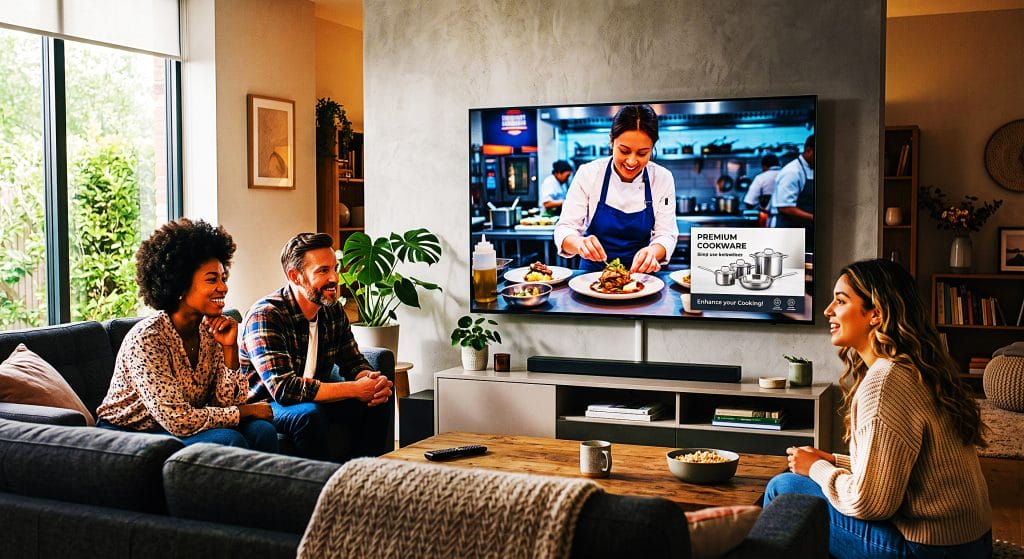
Connected TV brings the reach of traditional television into programmatic advertising. By placing video ads on platforms like Roku, Hulu, Amazon Fire TV, and top streaming apps, companies reach people on home screens. Unlike traditional broadcast TV, CTV campaigns target specific demographic groups, direct-mail lists, or geographic boundaries.
Digital video extends TV-style storytelling across web pages and mobile apps. Using pre-roll, mid-roll, and outstream placements, video ads capture attention while people read articles or watch clips. Video acts as a bridge between initial awareness and actual consideration.
Audio ads reach listeners when they are not looking at screens. Platforms like Spotify and Pandora, along with podcast networks and digital radio, let brands deliver conversational messages directly into a listener's daily soundtrack.
Mobile phones sit at the center of daily routines. Through in-app placements, mobile web banners, and location triggers, mobile ads reach people based on where they are and what they are doing right then.
Display banners cover the fundamentals of retargeting. Running across news sites and mobile apps, display ads maintain brand presence, reinforce messages seen on CTV or audio, and offer a simple way for interested readers to click through.
Native ads blend into the layout, fonts, and style of the surrounding page. By dropping the hard-sell look of traditional banners, native ads tend to get higher click-through rates, making them useful for technical products, professional services, and complex sales.
Media channels determine where an ad appears; targeting determines who sees it. Broad filters like "adults 25 to 54" waste money. Modern ad setups layer location, address, and intent data so budget goes toward real prospects.
Online browsing only tells half the story. Geofencing draws virtual boundaries around real places, like competitor storefronts, trade shows, auto dealerships, or specific commercial districts.
When someone enters these zones with a mobile device, their location signal enters a target audience pool. Ads can then run on that device while the person is at the location or for up to 30 days after they leave.
Addressable advertising maps physical addresses directly to digital networks. You can upload a list of physical street addresses, such as a direct-mail customer file, a target prospect list, or a neighborhood list, and match those locations to household IP networks and devices.
This helps deliver matching Streaming TV, display, and video ads directly to those households, reinforcing direct mail or print campaigns.
You do not need to buy search ads to capture search intent. Search retargeting tracks people who have recently searched for industry terms across the web, then shows them visual or video ads on other sites.
Once a prospect visits your site, site retargeting keeps your brand in front of them across display, native, and CTV channels until they convert.
On Connected TV, showing ads next to relevant content improves response. CTV targeting analyzes show genres, rating categories, and scene metadata to match the ad to the program. An auto insurance company, for instance, can choose to run ads during car shows, action movies, or financial news segments.
Companies usually choose between two working models depending on internal team size, technical skills, and speed.
| Feature | Full Force Ads Managed | FullForceAds.app Self-Serve |
| Execution | Fully managed media planning | Direct platform access |
| Strategy | Custom strategy build | In-house campaign setup |
| Management | Dedicated account manager | Self-directed workflow |
| Optimization | Hands-off optimization | Real-time budget & bid adjustments |
For teams wanting end-to-end management, Full Force Ads acts as an external media desk. The team handles strategy, channel allocation, setup, creative tweaks, and reporting.
For internal marketing teams and agencies that prefer direct control, FullForceAds.app offers a self-serve platform. Teams can upload creative assets, draw geofences, upload address lists, and track results from a single dashboard.
Channel allocations work best when built around specific goals rather than generic templates.
A regional business wants to take market share from local rivals.
An enterprise software firm or specialty contractor wants to reach specific decision-makers.
A consolidated approach offers a few simple structural benefits over piecemeal ad buying:
Setting up campaigns with Full Force Ads follows a straightforward four-step process:
Geofencing draws a virtual boundary around physical locations, like stores, event halls, or competitor spots, to capture mobile signals while people are there. Addressable Targeting takes a physical mailing list or customer address database and maps it to household IP networks, running ads across connected devices inside those homes.
Yes. CTV advertising is programmatic and precise. You can run video ads on home TV screens targeted down to ZIP codes, TV markets (DMAs), mile radii, or specific street address lists.
Search retargeting tracks search queries across a network of websites and publishing portals. When someone searches for relevant terms across participating sites, they enter an intent segment. You can then show them visual, video, or native ads across the rest of the web.
Relying entirely on search and social ads leaves businesses vulnerable to rising costs and shrinking reach. Expanding into Streaming TV, video, digital audio, and location geofencing creates a broader setup that reaches customers wherever they spend time online.
To see how a structured media plan can help your business grow, look into Full Force Ads or schedule a discovery call with their team.