Every marketing lead hits the same wall eventually.
You scale your ad spend, tweak the copy, raise bids, and swap in fresh creative. But customer acquisition costs keep climbing while returns drop off. You end up stuck in crowded channels, fighting the same bidding wars against the exact same competitors for the same small slice of digital space.
The problem usually is not your product, your design, or your timing. It is the wall around the platform you are using.
When you put all your budget into mainstream social platforms or standard search, you operate inside walled gardens. Those networks lock your audience inside their own ecosystems, force you to adapt to whatever algorithmic changes they make overnight, and make it almost impossible to follow a high-value customer across the rest of the web.
Real growth happens when you stop relying on single platforms and build a cross-screen strategy instead.
Based in Sandy, Utah, Full Force Ads helps businesses break through those platform limits. By using specialized programmatic infrastructure, Full Force Ads lets brands reach their ideal buyers across every screen, device, and channel from one central hub.
To see why single-channel marketing stalls, look at how people actually spend their day online.
Your target customer does not sit on one app for eight hours. They check local news over coffee, stream a podcast on the drive to work, read industry blogs on a desktop browser during the day, watch connected TV (CTV) in the evening, and scroll through mobile apps on the couch before bed.
| Time of Day | Channel / Touchpoint | Platform Examples |
| Morning | Audio & News | Podcasts, Digital Audio Streaming |
| Mid-Day | Desktop Browsing | Trade Articles, Web Search |
| Afternoon | Mobile & Apps | In-App Content, Geofenced Zones |
| Evening | Connected TV (CTV) | Hulu, Roku, Peacock, Paramount+ |
If you buy ads on just one or two traditional networks, you catch a tiny fraction of that routine. The rest of their digital life remains completely invisible to your brand.
Relying entirely on big platform algorithms creates three main bottlenecks:
A strong digital campaign reaches people everywhere they spend time. That is where targeted programmatic media buying comes in.
Omnichannel programmatic buying swaps isolated ad placements for global inventory access. Instead of buying space on one app at a time, programmatic tools connect directly to major ad exchanges and publisher networks in real time.
This lets brands launch synchronized, multi-channel campaigns that surround target prospects throughout their normal routines.
| Channel Category | Channels Included | Core Advantage |
| Sight | Streaming TV (CTV), Video (Pre/Mid-roll) | Delivers high-definition, non-skippable visual impact on premium big-screen apps like Roku, Hulu, and Peacock. |
| Sound | Spotify, Digital Radio, Top Podcasts | Reaches audiences screen-free during commutes, workouts, and daily routines with unskippable audio spots. |
| Screen | Geofencing, Mobile Web, Native & Display | Maintains consistent, high-impact visibility across thousands of websites and location-targeted mobile apps. |
Getting creative assets onto multiple channels is only part of the job. The real secret to keeping ad costs down is targeting, which ensures every dollar goes toward actual, high-intent prospects.
Instead of guessing based on vague interest categories, programmatic technology uses location intelligence, recent search history, and physical address matching to build tight target groups.
| Targeting Methodology | How It Works | Ideal Strategic Application |
| Location Geofencing | Draws virtual boundaries around physical sites (like competitor locations, industry expos, or office parks) to collect device IDs. | Competitive positioning, event outreach, and local market capture. |
| Addressable Targeting | Matches physical street addresses (from CRM or mailing lists) to individual household IP networks across all connected devices. | Account-based marketing (ABM), direct-to-household pushes, and CRM enrichment. |
| Site Retargeting | Shows follow-up ad sequences to people who visited your site but left without buying or filling out a form. | Bringing high-intent visitors back to lower acquisition costs. |
| Search Retargeting | Serves ads to people who recently searched for specific industry terms across the web, before they ever reach your site. | Intercepting buyers while they are still in the research phase. |
| Contextual Targeting | Reads page text in real time to place your ads next to relevant articles and discussions. | Placing ads alongside current industry news and safe, relevant context. |
Here are three common ways growth teams use programmatic media to drive measurable revenue:
A regional B2B vendor wants to pull clients away from established competitors in the area.
Instead of paying high prices for broad search terms, the brand outlines precise virtual fences around competitor offices, local industry expos, and trade hubs. When prospective clients walk into those zones, their mobile device IDs enter a target list. Over the next month, those specific people see video, display, and native ads across their phones, laptops, and living room TVs.
When any of those prospects later walk into the advertiser's local showroom, the system logs the visit inside a "Conversion Zone," showing clear foot-traffic results from the campaign.
A corporate sales team holds a target list of 5,000 specific accounts. Standard ad platforms struggle to isolate those exact buyers without wasting impressions on people outside the target companies.
With Addressable Targeting, the company matches physical office and home addresses directly to local household IP networks.
Those decision-makers then see a steady, unified campaign across every device: non-skippable streaming TV ads in the evening, native articles on desktop browsers during the workday, and mobile display ads in between. That gives the sales team deep account coverage with minimal wasted spend.
A buyer is researching software tools online. They type target search terms into engines and read comparison articles, but have not stumbled on your company yet.
Using Search Retargeting, programmatic tools spot those search signals as they happen across the web. Before that buyer commits to a competitor, your ads appear across news sites, mobile apps, and video platforms, stepping into the buying process while the decision is still open.
Running programmatic campaigns requires specialized platform access, media-buying experience, and ongoing adjustment. Based in Sandy, Utah, Full Force Ads operates as a direct partner for local businesses, corporate marketing leaders, and agencies looking to scale their ad reach.
| Campaign Phase | Action Item | Core Focus |
| 1. Discovery Call | Strategy Alignment | Align on core business goals and target profiles. |
| 2. Custom Strategy | Blueprinting | Build a synchronized channel and targeting plan. |
| 3. Rapid Launch | Deployment | Go live in 5 to 7 business days. |
| 4. Weekly Tuning | Optimization | Analyze clear reports and optimize active bids continuously. |
A few things set the Full Force Ads team apart from standard agency vendors:
While many companies prefer a fully managed partnership, some internal marketing teams and agencies want direct, hands-on control over their campaigns. For those teams, Full Force Ads offers FullForceAds.app, a self-serve media buying platform.
| Platform Feature | Functional Benefit |
| Fast Setup | Draft, review, and launch cross-channel ad campaigns in minutes. |
| Precise Mapping | Draw custom, building-level geofence boundaries directly on interactive maps. |
| Real-Time Analytics | Track impressions, clicks, and conversion signals live to adjust targeting on the fly. |
Whether you want managed service support or direct access through FullForceAds.app, you get the exact level of control your team needs.
Every company needs an ad mix built around its specific goals. The matrix below shows common starting combinations based on what you want to achieve:
| Core Business Objective | Recommended Channel Mix | Strategic Focus |
| Local Market Awareness | Geofencing + Display + Mobile | Build local brand recognition and pull in nearby foot traffic. |
| Competitive Positioning | Geofencing + Addressable Targeting | Target competitor locations and known buyer addresses to win market share. |
| High-Impact Brand Building | Streaming TV + Video + Audio | Reach target buyers on big screens and audio feeds with high-res creative. |
| Driving Qualified Site Traffic | Display + Native + Search Retargeting | Catch active intent online and direct interested readers back to your site. |
| Retargeting Past Visitors | Site Retargeting + Display + Video | Keep your brand top of mind and bring back visitors who left without buying. |
| Nurturing Customer Lists | Addressable + Streaming TV + Display | Match CRM lists directly to household devices to warm up sales leads. |
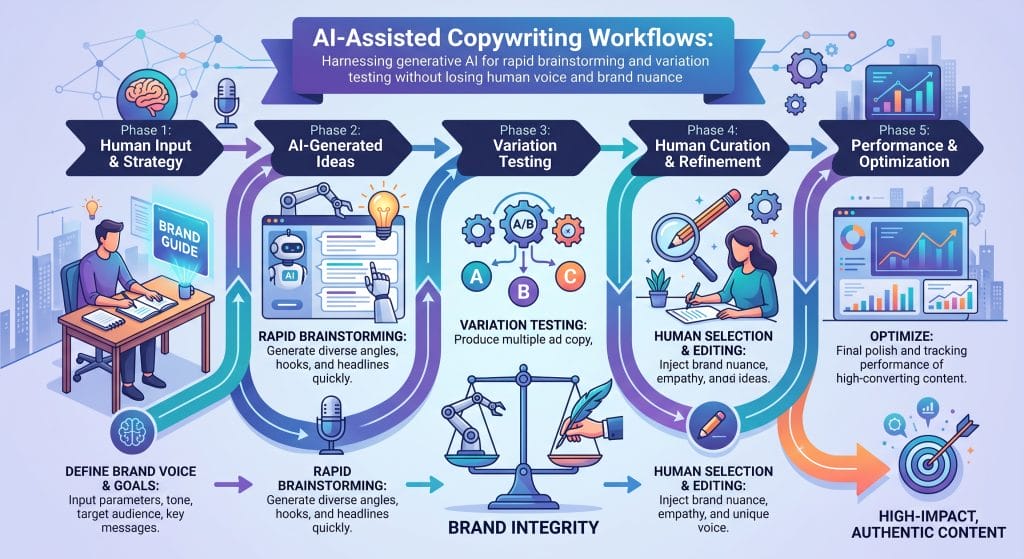
Running cross-channel campaigns means creating copy for dozens of different ad sizes, placements, and audience groups. To produce all that copy without ballooning costs, marketing teams often use generative AI to speed up drafting and variation.
| Workflow Step | Action Required | Strategic Value |
| 1. Briefing | Define Parameters | Outline target audiences, offer points, and messaging guardrails. |
| 2. AI Drafting | Generate Variations | Speed up early output of messaging angles, hooks, and formats. |
| 3. Human Review | Refine Voice | Edit tone, check factual accuracy, and polish final language. |
| 4. Multi-Screen Launch | Deploy Assets | Distribute formatted creative across target programmatic channels. |
Here is how growth teams use AI tools productively:
Pairing programmatic distribution with smart copy workflows gives growth brands an efficient way to test, learn, and scale campaigns over time.
How is programmatic buying different from standard platform ads?
Single-platform networks restrict your ads to their own apps and partner sites. Programmatic buying connects directly to global ad exchanges, letting you buy space across thousands of websites, mobile apps, podcasts, and streaming TV services through one setup.
How does physical Geofencing work?
Geofencing uses location data to draw virtual boundaries around real-world places, like competitor offices, convention halls, or commercial districts. Mobile device IDs that pass through those spaces enter a custom audience list, letting you serve targeted ads across their devices later on.
Can I run programmatic ads if I already have a CRM list?
Yes. With Addressable Targeting, your customer address list matches directly to physical household IP networks. That lets you show streaming TV, display, and video ads straight to those specific homes across all their connected devices.
How long does it take to launch a campaign?
While traditional agencies can take weeks to complete onboarding, Full Force Ads gets new campaigns live in 5 to 7 business days after your initial strategy call and creative review.
Sticking to one or two saturated ad platforms caps your growth potential and leaves valuable audience segments untouched. To build a reliable acquisition system, your brand needs an omnichannel media setup that meets prospects wherever they go online.
Whether you prefer a managed team to handle strategy and execution, or direct self-serve access through FullForceAds.app to run things in-house, Full Force Ads gives you the targeting tools and reach you need to scale cleanly.
If you are ready to cut wasted ad spend and reach your target buyers across every screen, schedule a free strategy call with Full Force Ads today.