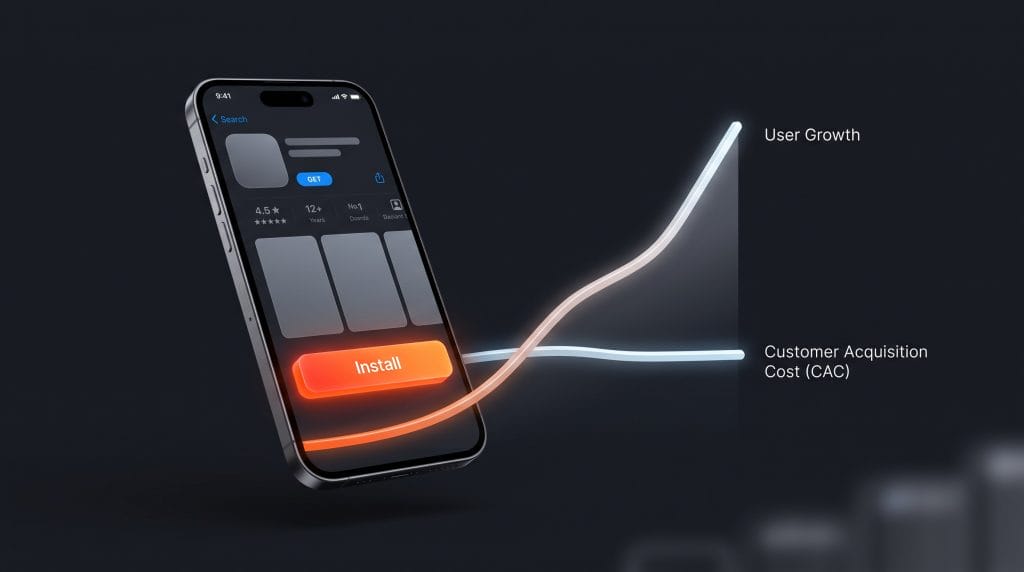
App store ad costs keep climbing, which puts mobile growth teams in a tough spot. If your main plan for scaling user acquisition is throwing more money at paid channels, you are going to burn through your margins fast.
To scale without wrecking unit economics, stop treating organic growth and paid campaigns like two different departments. The best acquisition strategies run as a single system. App Store Optimization, channel selection, creative refreshes, and early retention all have to pull together to keep acquisition costs down while protecting lifetime value.
Paid ads and app store optimization feed directly into each other. Every ad on Meta, Google, or Apple Search Ads ultimately dumps users onto your store page.
When that page converts better, your effective cost per install drops across every paid campaign at once.
Paid Impressions -> Optimized Store Page -> Higher Conversion Rate
|
v
Organic Rank Boost <- Increased Install Velocity <- Lower Effective Cost Per Install
Bumping a store listing's conversion rate from 25% to 35% cuts effective cost per install by nearly 28% without touching your ad bids or spending another dollar on media. On top of that, Apple and Google notice when an app picks up download speed and converts well, rewarding it with better search placement and higher category ranks. Those extra organic installs pull down your total blended acquisition cost even further.
Relying on a single acquisition channel is a gamble. The moment ad costs spike or an algorithm shifts, your CAC goes through the roof. A resilient mix balances high-intent search traffic with top-of-funnel discovery.
| Channel | Main Role | Intent | Optimization Focus |
| Apple Search Ads | High-intent capture | Very high | Exact-match brand defense and competitor terms. |
| Google App Campaigns | Automated scale | Moderate to high | In-app event targets (tCPA/tROAS) with deep event mapping. |
| Meta Ads | Visual discovery | Moderate | Broad creative testing, lookalike audiences, and broad targeting. |
| Programmatic & Ad Networks | Incremental scale | Variable | Fraud checks, network exclusions, and strict publisher blocklists. |
A simple rule here: do not scale top-of-funnel networks like Meta until your search campaigns are fully dialed in. High-intent channels on Apple and Google capture the demand generated when social ads prompt people to search for your brand or category.
Ad fatigue is the quiet killer of performance campaigns. When people see the same video three times in a week, click-through and install rates plummet. Ad networks treat dropping engagement as a signal that your ad lacks relevance, so they bump up your impression costs.
A three-step creative loop keeps fatigue from taking over:
Pumping ad dollars into an app users abandon after day one is just expensive vanity. If users churn during their first week, your real acquisition cost per active user shoots through the ceiling:
$$\text{Effective Cost per Active User} = \frac{\text{Blended Acquisition Cost}}{\text{Retention Rate}}$$
Three retention checkpoints show whether paid scale will actually work:
Before doubling or tripling ad budgets, check that the D1 to D7 retention curve flattens out into a stable line rather than sloping toward zero. A flat retention curve is the single clearest sign that you can scale paid acquisition without blowing up unit economics.
Track payback windows: Measure effective cost per install against day-30 and day-90 value targets to guard campaign payback periods.
The Playbook for Growing a Mobile App is Broken
Match store listings to ads: Align store screenshots and copy directly with top-performing ad concepts.
Audit store conversion monthly: Run regular A/B tests on icons, screenshots, and custom product pages.
Diversify channel spend: Keep any single ad network under 50% of your performance budget.
Maintain a creative pipeline: Build a steady process to test and deploy new ad variations every 10 to 14 days.
For years, you could buy users on Meta and Google, optimize your cost per install, and call it a day. That ended when Apple introduced App Tracking Transparency, ad costs jumped, and privacy changes made targeting harder.
Now, everyone bids on the exact same keywords and targets the exact same feeds. Costs go up, downloads go down, and your margin disappears.
If you want to keep acquisition costs reasonable, you have to look outside social feeds and search result pages. That means buying ad placements across streaming TV, podcast apps, mobile games, news sites, and location-based media where attention is cheaper.
Relying on one or two ad networks is a bad plan. When prices jump on Meta or Google, your cost per install jumps with them. You are left with two choices:
People do not spend their whole day scrolling one feed. They listen to podcasts on their morning commute, read articles on a laptop at work, watch streaming TV in the evening, and use half a dozen apps in between. Reaching them means showing up in those places instead of waiting for them to open Instagram.
Spreading your ad spend across multiple platforms cuts your reliance on expensive auctions. It also lets you buy attention on channels your competitors are skipping entirely.
                  THE OMNICHANNEL UA FLYWHEEL
                               │
     ┌─────────────────────────┴─────────────────────────┐
     ▼                                                   ▼
┌───────────────────┐                               ┌───────────────────┐
│ UPPER FUNNEL      │                               │ LOWER FUNNEL      │
│  • Streaming TV   │ ───────── High-Intent ──────► │  • Geofencing     │
│  • Digital Audio  │          Retargeting          │  • Addressable    │
│  • High-Impact    │                               │  • Site & Search  │
│    Native & Video │                               │    Retargeting    │
└───────────────────┘                               └───────────────────┘
│                                                   │
└───────────────┬───────────────────────────────────┘
                ▼
┌───────────────────────┐
│ HIGH-VALUE APP INSTALL │
└───────────────────────┘
Different ad formats solve different parts of the user acquisition problem:
Where you place the ad matters, but who sees it keeps your budget intact.
| Goal | Suggested Channels and Targeting |
| Local expansion | Geofencing, mobile in-app ads, display |
| Competitor conquesting | Geofencing, search retargeting |
| Brand awareness | Streaming TV, digital video, audio |
| Landing page traffic | Native ads, contextual targeting, display |
| Retargeting CRM lists | Addressable ads, streaming TV, mobile |
| Recovering dropped traffic | Site retargeting, display, video |
Managing five different ad platforms, negotiating separate contracts, and piecing together disparate reports is messy and inefficient.
Full Force Ads, a Utah-based ad firm, handles cross-channel campaigns under one roof. They set up, target, and optimize campaigns across streaming TV, audio, mobile, display, and native ads. They provide weekly performance reports, require no long-term contracts, and usually launch within a week of creative approval.
If you want direct control over your ad spend, you can use their self-serve platform at FullForceAds.app. It gives app teams access to media inventory, targeting parameters, and live reporting dashboards to build and manage campaigns on their own schedule.