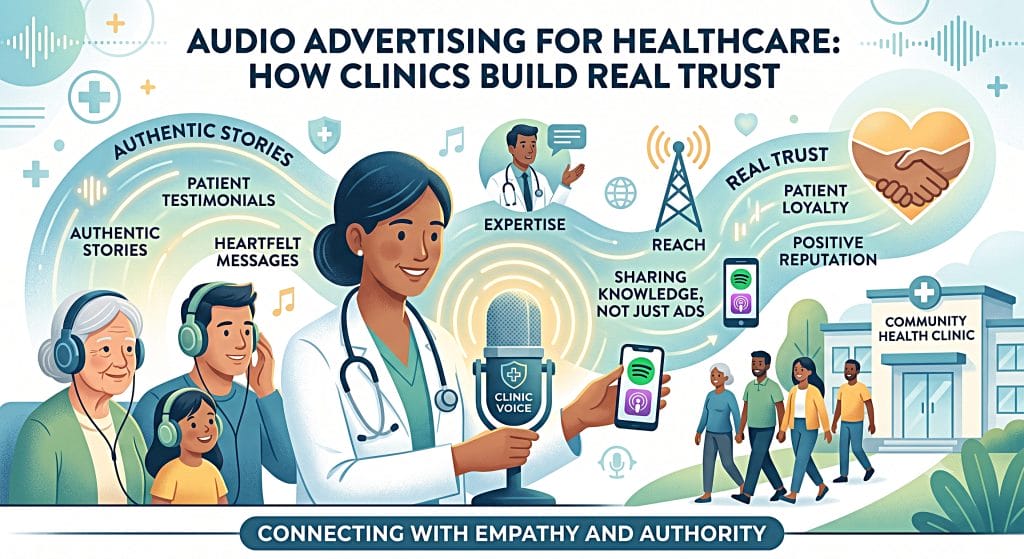
Audio advertising for healthcare gives medical providers a direct line to local patients when they are most attentive. Choosing a new dentist, a family doctor, or a surgical specialist is rarely a snap decision driven by a flash sale. It is a high-anxiety choice tied to physical health, personal finances, and emotional comfort. Patients do not simply purchase a service; they put their well-being in your hands. Because of that, trust is the primary currency in modern medical marketing.
At FullForceAds, a digital advertising agency in Sandy, Utah, we regularly help regional healthcare systems and independent dental practices move past static visual ads. In recent years, standard web banners and sponsored social posts have hit a wall. Consumers tune out visual noise, install ad blockers, or scroll past promotional posts without reading them. For a local clinic trying to establish a warm connection with neighbors across the Salt Lake Valley or anywhere in the US, visual ad fatigue makes patient acquisition harder every quarter.
Audio channels—including local radio, digital streaming services, regional podcasts, and smart speakers—offer a direct path to the listener. By using the natural nuance of the human voice, audio campaign strategies help healthcare providers build long-term familiarity long before a patient picks up the phone to book an appointment.
To understand why audio works so well for medical practices, you have to look at how people consume sound compared to visual graphics. Visual display ads hit a logical filter almost immediately. When someone sees a banner ad offering a discount on dental implants, their brain registers it as a sales pitch.
Audio ads operate differently. Sound reaches people in private, low-distraction environments: while driving to work on I-15, running on a treadmill with headphones, or cooking dinner at home. These settings create a personal, one-on-one atmosphere. When a physician or dentist speaks directly to a listener, the format creates proximity that static text cannot match.
Visual Display Ad        -> Logical Filter / Screen Fatigue -> High Skimming / Low Emotional Connection
Audio Ad (Voice & Sound) -> Auditory Processing             -> High Retention / Personal Trust
There are three clear reasons audio builds trust faster than visual media:
Not every audio format serves the same purpose. A balanced campaign uses a combination of local broadcast, targeted digital streaming, and podcast placements to reach different patient demographics.
| Audio Channel | Reach Type | Primary Targeting Method | Best Healthcare Application |
| Broadcast Radio | Broad local community | Geographic region & station format | Mass practice awareness, hospital ER wait times, seasonal health drives |
| Digital Streaming Audio | Targeted mobile listeners | Zip code radius, age bracket, lifestyle traits | Specific dental procedures (Invisalign, implants), pediatric clinics |
| Local Podcasts | Highly engaged niche audience | Show topic, regional focus, listener interest | Complex medical specialties, holistic care, practice founder stories |
| Smart Speakers | In-home families | Household location & device activity | Quick clinic searches, seasonal health tips, appointment reminders |
Digital streaming platforms give practices precise control over who hears their message. Instead of paying to reach an entire media market, a pediatric dental clinic in Sandy can target parents aged 25 to 40 within a five-mile radius.
Through our ad management platform, FullForceAds.app, agencies can deploy programmatic audio ads across major streaming networks and podcasts without relying on high-margin third-party networks. You select exact zip codes, set schedule frequency, and deliver contextually relevant messages straight to your target audience.
Broadcast radio remains effective for reaching older demographics who account for a large portion of medical appointments. Radio stations are deeply tied to local culture. When a long-time local radio host shares a personal positive experience about a regional hospital network or a local dental group, that credibility transfers straight to the practice.
While both dental clinics and regional health networks want to build community trust, their campaign scales, buyer journeys, and messaging strategies differ.
Dental Practices                Regional Health Networks
- Main barrier: Anxiety & cost  - Main barrier: Multi-specialty awareness
- Voice: Lead dentist           - Voice: Diverse specialists & announcers
- Goal: Reduce fear, book calls - Goal: Institutional authority & ER reach
For dentists, the primary obstacle is not lack of local competition; it is patient anxiety and fear of unexpected costs. Audio ads for dentists should focus on comfort, modern gentle care, transparent options, and friendly staff.
Sample 30-Second Dental Audio Script
[Music: Soft, warm acoustic guitar bed]
Dr. Marcus (Voiceover): "Hi, I am Dr. Marcus from Oak Valley Dental. I know that for many people, booking a dental appointment comes with real anxiety. Maybe it has been a while since your last checkup, or you are worried about discomfort. I want you to know our office is a completely judgment-free space. From comfortable amenities to gentle sedation options, we focus on the person behind the smile. Visit OakValleyDental.com today, or give us a call. Let us make your dental health comfortable again."
Large regional hospital networks need to demonstrate surgical capabilities, advanced research, fast emergency care, and broad specialty options. Their campaigns demand scale and consistent audio branding across multiple service lines like cardiology, orthopedics, and oncology.
Sample 30-Second Health System Audio Script
[Music: Uplifting orchestral music bed]
Announcer: "When it comes to your heart, experience matters. At Metro Health Heart Institute, our surgical teams perform advanced procedures using the latest technology in the region. But more than that, we walk alongside you through recovery."
Dr. Elena Vance (Physician Voiceover): "We treat every heart like it belongs to our own family."
Announcer: "Trust your heart to the team local families count on. Find a cardiology specialist today at MetroHealth.org/Heart. Metro Health: Care that moves you forward."
[Sonic Logo: Short three-note musical chime]
Visual branding relies on logos, color palettes, and typography. Sonic branding is the audio equivalent: using voice tone, custom music, and sound signatures to build instant recognition.
Historically, measuring offline audio campaigns was difficult. Today, programmatic audio tools available through FullForceAds give agencies clear attribution tracking to evaluate business impact.
Programmatic Audio Impression -> Attributed Web Visit (Pixel Tracked) -> Appointment Form Submitted
By placing tracking pixels on a clinic's website, ad operators can track when a user who listened to a programmatic audio spot on Spotify or Pandora later visits the site and fills out an appointment form.
Direct listeners to short, memorable URLs mentioned only in your audio spots (for example, [YourCityDental.com/relax](https://YourCityDental.com/relax) or MetroHealth.org/heart). This isolates web traffic driven directly by auditory channels.
Assign unique local phone numbers exclusively to broadcast and streaming ad spots. This tracks exact call volume generated by each audio flight in real time.
Compare baseline website traffic against traffic surges during weeks when audio campaigns run. Local practices usually notice a steady rise in direct domain visits and organic brand name searches shortly after audio ad flights begin.
Marketing medical services requires careful compliance and clear communications. A single mistake can erode the trust your campaign set out to build.
In a crowded digital landscape where visual screens are packed with banners, audio advertising gives healthcare providers a direct line to local patients. By reaching people in private, low-distraction environments with authentic voices and clear messages, clinics build long-term trust across their community.
When someone experiences a medical issue or a dental emergency, they rarely click on a random banner ad. They turn to the practice they feel they already know.
If you are ready to expand your agency's digital offerings with targeted programmatic audio, display, and contextual campaigns, get in touch with our team at FullForceAds today to explore our self-serve platform at FullForceAds.app.