Modern digital advertising is no longer about buying attention. It is about engineering precision.
Every day, millions of decisions are influenced, modified, or driven by digital messages on television screens, phones, desktop monitors, and connected audio devices. Yet, for many business owners and marketing directors, navigating the universe of media channels feels like stepping onto a crowded battlefield without a map. Most organizations spend heavily on ad placements only to discover that their messages reached the wrong demographics, sat in unviewable placements, or got lost in the noise of overcrowded ad networks.
If your organization relies on traditional channels or self-serve walled gardens that offer little real cross-channel intelligence, you are likely burning capital on empty impressions. Real growth requires a unified approach to digital advertising, combining expansive cross-screen distribution with granular, real-world data targeting.
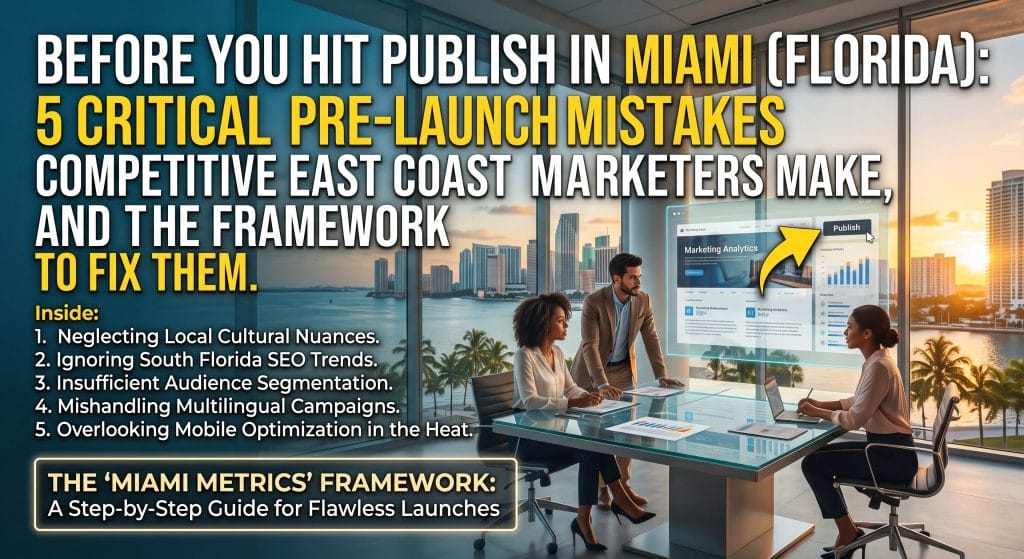
If you are a competitive East Coast marketer getting ready to launch in Miami, pump the brakes before you hit publish. Rolling out a campaign in South Florida without hyper-local context can quickly turn into a money pit that kills your ROI.
Here are the five biggest pre-launch mistakes East Coast marketers make when expanding into Miami, plus a straightforward framework to help you pull off a successful rollout.
The 5 Pre-Launch Mistakes Marketers Make in Miami
Even experienced marketers from New York, Boston, or Philly routinely run into trouble in Miami because they do not adjust for the region's specific demographics, pace, and search habits.
Mistake 1: Treating Miami like a single cultural block
Miami is made up of distinct, highly specific communities, not a general Hispanic monolith. Treating Venezuelan, Colombian, Brazilian, and Cuban demographics as interchangeable leads to tone-deaf messaging. The messaging strategy that converts in the Northeast rarelylands here without real local context.
Mistake 2: Missing local search intent
Search behavior in Miami relies heavily on hyper-local terms. Running broad geo-targeting instead of building landing pages around specific neighborhoods like Brickell, Wynwood, or Coral Gables burns budget on low-intent traffic.
Mistake 3: Broad, unsegmented audience targeting
Lumping all Miami residents into one audience profile causes low conversion rates. The luxury buyer in Coral Gables has almost nothing in common with the creative crowd in Wynwood or the long-standing community in Calle Ocho. One message sent to everyone means nobody converts.
Mistake 4: Running machine-translated Spanish ads
Over 60% of Miami-Dade County speaks Spanish at home. Running copy through Google Translate misses regional idioms, local tone, and proper phrasing. Beyond translation, Spanish-language messaging requires its own demographic segmentation, using the right tone for distinct national backgrounds.
Mistake 5: Ignoring mobile UX for on-the-go users
Miami is a heavily mobile-dependent market. People look for immediate recommendations while out, traveling, or commuting. A slow mobile landing page or a complex checkout flow loses leads instantly.
A Simple Solution: The 'Miami Metrics' Approach
To avoid these standard launch issues, structure your pre-launch planning around local metrics that matter. Move past vanity engagement like likes and clicks, and track the core data points that prove your positioning works: neighborhood-level conversion rates, qualified lead intake, and true language match.
If you want to review your rollout strategy before launching, reach out for a consultation and a launch review.
If you are an East Coast marketer getting ready to launch a campaign in Miami, hold off on hitting publish. Rolling out a campaign in South Florida using the same playbook that works in New York or Boston is a quick way to burn through budget with very little to show for it.
Miami is not just a warmer version of the Northeast. Here are the five mistakes that trip up outside marketing teams, and how to avoid them.
Treating the city as a monolith
Miami is a collection of distinct communities, not a single demographic group. A Cuban family in Hialeah, a Venezuelan professional in Doral, and an executive in Coral Gables do not share the same references, slang, or purchasing triggers. Pushing a generic "Miami vibe" campaign usually lands as lazy to the people who live here.
Ignoring hyper-local search behavior
Search intent in South Florida is tied heavily to specific neighborhoods. Targeting a general city term instead of building dedicated pages for Brickell, Wynwood, or Coconut Grove means paying for low-intent clicks that rarely convert.
Broad, unsegmented targeting
Trying to hit "all Miamians" with one message guarantees low conversion rates. The creative scene in Wynwood has almost no overlap with the residential, luxury market in Coral Gables. Tailor the message to the neighborhood rather than running one blanket campaign across the whole zip code.
Running automated translation for Spanish ads
Over 60% of Miami-Dade County speaks Spanish at home. Running your English copy through automated translation software usually yields awkward phrasing that misses local idioms entirely. Proper transcreation matters, as does knowing when to use formal versus informal phrasing depending on who you are talking to.
Neglecting mobile page speed and layout
Miami runs on mobile. People search while out, commuting, or looking for immediate options on the go. If a landing page takes more than two seconds to load on a phone or makes users jump through a clunky lead form, those visitors leave instantly.
The alternative: The Miami Metrics framework
Instead of watching basic engagement metrics like likes and general site impressions, focus on numbers that reveal real traction. Track neighborhood-level conversion rates, Spanish-to-English lead quality, and phone-driven form completions.
Get in touch for a quick pre-launch review, and we will help you audit your setup before you spend your budget.
Headquartered in Sandy, Utah, Full Force Ads is a digital advertising agency built to solve this structural problem. By unifying multi-channel media buying, location intelligence, physical-world attribution, and audience modeling under one roof, Full Force Ads helps brands transition from hopeful spending to predictable acquisition engines.
Part 1: The modern ad spectrum: reaching audiences across every screen
To build a complete brand presence, your business must meet prospects wherever they consume content throughout their day. Rather than relying on a single format, successful growth strategies layer multiple sensory touchpoints: sight, sound, motion, and context.
Full Force Ads provides direct access to advertising solutions spanning all premier digital channels.
Streaming TV (CTV / OTT) The living room television remains the focal point of domestic attention, but traditional cable is rapidly fading. Streaming TV lets you put your brand on the biggest screen in the house with the targeted precision of digital media. Through non-skippable ads on major streaming environments like Roku, Fire TV, Hulu, Peacock, and YouTube TV, brands can project authority and capture captive audiences with high-definition commercial spots. Unlike linear broadcast TV, streaming advertising with Full Force Ads lets you restrict delivery strictly to target households, eliminating wasted coverage.
High-impact video Video content captures human attention faster than any other format by combining visual storytelling with motion and sound. Delivering pre-roll, mid-roll, and outstream video across high-traffic digital publications, niche media outlets, and mobile applications ensures your message is absorbed when engagement is highest. With 100% viewability standards and targeted delivery, video campaigns establish brand voice and drive immediate response metrics.
Streaming digital audio Visual fatigue is real, but brand engagement does not have to pause when eyes leave the screen. Audio advertising connects with consumers during screen-free moments, like while driving, exercising, working, or cooking. By distributing localized audio commercials across Spotify, Pandora, podcast networks, and digital radio platforms, Full Force Ads reaches listeners directly through their headphones and smart speakers, creating an intimate connection with high brand recall.
Mobile and in-app inventory The average adult checks their smartphone over 140 times a day. Mobile advertising allows you to intercept audiences on the device they carry continuously. Through deep in-app integrations, mobile web inventory, and location-aware ad exchanges, Full Force Ads places interactive ad units right into the palm of your prospect's hand, sparking instant click-throughs and real-time store visits.
High-frequency display Display banners remain the fundamental backbone of web-wide reach and retargeting strategies. By deploying dynamic display creative across millions of indexed, high-authority websites and mobile apps, brands maintain market share, build steady front-of-mind awareness, and capture lost web traffic.
Native advertising Banner blindness can occasionally limit standard ad performance. Native advertising circumvents this by automatically adapting ad aesthetics to match the look, feel, and context of the surrounding editorial content. Because native placements read like organic articles or recommended feeds, they generate higher engagement rates and build immediate trust with readers.
Part 2: Precision targeting solutions: reaching the right people, not just impressions
Publishing an ad across top channels is only half the battle. Delivering that ad to someone who has zero interest in your product is an expensive mistake. Channels dictate where your message appears; targeting strategies dictate who receives it. Full Force Ads layers multi-dimensional targeting capabilities onto every media channel to guarantee that ad spend yields actual business outcomes.
Building-level geofencing precision Most digital agencies rely on radius-based geotargeting, drawing a loose 1-mile or 5-mile circle around a map pin. The flaw is that a 1-mile radius captures non-prospects, residential neighborhoods, highway traffic, and irrelevant businesses. Full Force Ads utilizes custom, micro-targeted building-level geofencing by drawing virtual boundaries around the exact physical contours of specific locations. These include competitor storefronts to conquest active shoppers, industry trade shows and conventions, or commercial zones, auto lots, and medical facilities. When a consumer steps inside that custom boundary with a location-enabled device, their unique Mobile Advertising ID is logged. This allows you to serve them targeted ads across Streaming TV, video, display, and mobile apps while on-site or for up to 30 days after they leave.
Addressable targeting (digital direct mail) Traditional direct mail is slow, costly, and difficult to measure. Addressable targeting transforms static address lists into a dynamic, cross-screen digital campaign. You simply upload a CSV list of physical customer addresses, prospect records, or target account lists. Full Force Ads matches those street addresses against household device graphs with over 90% accuracy. Every connected device inside those specific homes, including smart TVs, tablets, smartphones, and laptops, is then targeted with your ads.
Site and search retargeting Conversion rarely happens on the first interaction. Over 95% of website visitors leave without taking action. Site retargeting follows previous website visitors across the web, displaying tailored creative that brings them back to complete a transaction or inquiry. Search retargeting intercepts high-intent shoppers based on the exact keywords they have searched across major engines, showing display and video ads to them as they browse other digital properties.
Contextual targeting By evaluating the exact text, sentiment, and metadata of web pages in real time, contextual targeting ensures your ad appears alongside closely related, brand-safe editorial content. A legal firm's ads can automatically populate on news articles discussing personal injury updates, or a home services company can run ads on articles covering seasonal home maintenance.
Part 3: The Full Force Ads advantage: why Utah's leading agency wins
Businesses searching for digital advertising solutions are often forced to choose between two undesirable extremes: complex enterprise platforms with massive budget minimums, or boutique local vendors who outsource campaign management and charge opaque markups.
Full Force Ads was founded in Sandy, Utah in 2015 to eliminate this exact trade-off. Built on the core principle that every business deserves access to enterprise-tier media technology without enterprise-level barriers, Full Force Ads serves local businesses, corporate marketing directors, and white-label agency partners nationwide.
Regional market leaders and national growth brands partner with Full Force Ads for clear structural reasons:
You no longer need to coordinate media buys across dozens of separate ad vendors, platforms, and account managers. Full Force Ads plans, executes, measures, and optimizes your campaigns across CTV, video, audio, display, mobile, and native from a single centralized operation.
Clicks and impressions are helpful, but real foot traffic pays the bills. Through Conversion Zone tracking, Full Force Ads places a virtual boundary around your physical store or office location. The system tracks when an individual who saw your geofenced or addressable ad physically walks into your establishment, giving you definitive ROI metrics on store visits.
Trust is earned through month-over-month performance, not predatory multi-year legal agreements. Full Force Ads operates on flexible terms, allowing brands to scale budgets up or down based on real-world revenue outcomes.
You can say goodbye to cryptic, delayed monthly summary decks filled with vanity metrics. Full Force Ads provides clear weekly reporting detailing exactly where your ads served, which creative variations performed best, total video completion rates, and conversion actions taken.
While traditional agencies spend 4 to 6 weeks onboarding and configuring ad accounts, Full Force Ads launches multi-channel campaigns in just 5 to 7 business days.
Part 4: Agency managed vs. enterprise self-serve platform (FullForceAds.app)
Every company's internal team structure is different. Some organizations require a fully managed, hands-off media team, while tech-enabled agencies and in-house growth teams prefer direct execution control. Full Force Ads accommodates both models seamlessly.
Fully managed agency services For organizations seeking complete execution, the dedicated team at Full Force Ads acts as an extension of your internal marketing department. From initial discovery and strategy formulation to audience building, creative sizing, campaign setup, bid optimization, and reporting, the Utah-based team handles all heavy lifting.
Self-serve advertising platform via FullForceAds.app For digital marketing agencies, media brokers, and enterprise teams looking to run programmatic campaigns in-house, FullForceAds.app delivers direct access to an enterprise programmatic ad platform.
Through FullForceAds.app, users can build custom building-level geofences on interactive mapping tools, upload CRM residential address lists directly for immediate addressable matching, procure real-time inventory across top CTV apps, video networks, and web exchanges from one interface, and access complete white-label reporting suites branded specifically for your agency's client portfolio.
Whether managed directly by veteran media buyers or operated in-house through FullForceAds.app, your business gets the same industry-leading infrastructure, precision targeting, and massive media reach.
Part 5: How it works: the strategic campaign lifecycle
Launching a high-performing digital advertising campaign should not feel like solving a complex puzzle. Full Force Ads follows a four-step framework engineered for maximum speed and clarity.
Step 1: Discovery call Every successful campaign starts with a transparent, pressure-free strategy session. The Full Force Ads team evaluates your current customer acquisition channels, target demographics, historical sales data, local or national expansion targets, and key growth goals.
Step 2: Custom recommendation Instead of forcing your brand into a cookie-cutter ad package, Full Force Ads builds a custom channel mix and targeting roadmap tailored specifically to your objectives. Whether your goal is conquesting local competitor traffic or building a multi-state streaming brand presence, every dollar is allocated for maximum ROI.
Step 3: Fast-track launch Once strategy and creative assets are finalized, your campaign moves into production. Assets are deployed across selected streaming networks, apps, and web properties, with campaigns going live within 5 to 7 business days.
Step 4: Optimization and weekly reporting Launching the ad is just the beginning. Full Force Ads continuously monitors bid prices, placement quality, device performance, geographic clusters, and creative engagement. Budget is dynamically shifted toward top-performing channels, while detailed weekly reports keep you informed on every key metric.
Part 6: Playbook solutions: matching strategic goals to ad tactics
If you are not sure where to start, alignment begins by matching your core business objective to proven campaign tactics:
To build local brand awareness, combine geofencing, mobile, and display to drive high-frequency local visibility and physical store visits.
To conquest competitors, combine building-level geofencing with addressable targeting to intercept competitor shoppers and turn them into your customers.
To build regional brand authority, use Streaming TV, high-impact video, and streaming audio to establish an unskippable presence on living room screens.
To accelerate high-intent traffic, use search retargeting, native, and display ads to capture active shoppers searching your keywords.
To maximize website conversions, use site retargeting, video, and display to re-engage bounce visitors across every site they visit later.
To activate customer lists, deploy addressable targeting with Streaming TV and mobile to turn physical client address files into active digital ads.
Strategic Appendix: Before you hit publish in Miami (Florida)
5 critical pre-launch mistakes competitive East Coast marketers make: and the framework to fix them
To demonstrate how these strategies perform in highly competitive metros, let us examine a real-world regional landscape: Miami, Florida. The East Coast market is dense, fast moving, and expensive. Marketers running campaigns in South Florida frequently burn thousands of dollars due to small structural launch mistakes.
By learning how to spot and fix these five critical errors before pressing publish, market leaders can protect their media budgets and outpace regional competitors.
Error 1: Relying on broad zip-code over-spray across diverse neighborhoods The mistake: Miami is a patchwork of wildly different micro-markets separated by just a few blocks. Setting a broad 10-mile radius around Downtown Miami or target zip codes like 33131 or 33139 treats Brickell finance professionals, Wynwood creatives, Little Havana residents, and South Beach tourists as the exact same audience. This creates massive budget waste on irrelevance.
The fix: Ditch broad radius boundaries for micro-targeted, building-level geofencing. Trace exact polygon maps around specific high-value targets, such as luxury condo towers along Brickell Avenue, specific marine centers, or commercial districts in Coral Gables. Deliver tailored messaging that reflects the exact venue or district where the prospect is standing.
Error 2: Ignoring multi-lingual and cultural audience customization The mistake: South Florida is a global gateway where a huge percentage of the population consumes digital media in Spanish or is fully bilingual. Running a single, generic English-language campaign across video, audio, and display ignores cultural nuances, drastically lowering click-through rates and brand trust.
The fix: Deploy multi-creative ad sets with bilingual variant mapping. Utilizing contextual targeting and language-specific programmatic inventory ensures Spanish-language creative is served across Spanish editorial sites, radio streaming networks, and local podcasts, while English versions run alongside complementary placements. Matching context and culture instantly multiplies ad resonance.
Error 3: Neglecting high event density and seasonal tourist cycles The mistake: Millions of high-net-worth visitors flood Miami every year for massive events like Art Basel, the Miami International Boat Show, Miami Music Week, and major sports tournaments. Standard digital campaigns fail to capture this high-spending transitory population because they rely on static home-address demographics.
The fix: Build event-driven geofencing campaigns. Map out the exact boundaries of event venues like the Miami Beach Convention Center, Bayfront Park, or local stadium complexes during event hours. Capture mobile device IDs on-site and serve retargeting ads across Streaming TV, video, and display while attendees are in town and long after they return home.
Error 4: Failing to deploy conversion zone foot-traffic tracking The mistake: Brick-and-mortar retailers, auto dealerships, medical practices, and hospitality venues in South Florida often judge campaign success purely by digital clicks. However, high-value foot traffic rarely clicks on display or TV ads. They simply view the ad and physically visit the store. Without physical tracking, business owners mistakenly cut budgets on ads that are driving foot traffic.
The fix: Always establish Conversion Zone physical tracking prior to launch. By mapping your showroom, clinic, or storefront, Full Force Ads tracks when an ad-exposed device enters your physical location. This delivers exact cost-per-walk-in analytics, proving the true revenue impact of your ad spend.
Error 5: Siloing media channels instead of orchestrating cross-screen journeys The mistake: Running mobile ads through one vendor, streaming ads through another, and retargeting through a third creates a fragmented customer experience. A prospect might see your TV ad five times in an hour, but never receive a follow-up mobile ad or display banner when they pick up their phone.
The fix: Unify media buys under a single multi-channel engine like Full Force Ads. When a prospect sees your unskippable ad on their Roku TV in the living room, the platform automatically triggers follow-up display banners on their smartphone and native ads on their desktop laptop. This creates a seamless multi-screen brand journey that systematically guides prospects from initial awareness to final sale.
Frequently asked questions (FAQ)
What is programmatic advertising, and how is it different from social media ads? Programmatic advertising automates the real-time buying and selling of ad inventory across millions of websites, mobile apps, connected TVs, and streaming audio platforms. Unlike closed social media platforms that restrict your ads to their own social feeds, programmatic advertising gives you access to the open web and living room televisions, using real-world location data, address lists, and browsing behavior to target audiences everywhere they go online.
How does geofencing targeting differ from regular geotargeting? Standard geotargeting relies on broad zip codes, city limits, or wide radial circles that capture thousands of irrelevant people. Geofencing uses micro-precision mapping technology to trace the exact physical footprints of specific buildings, such as a competitor's store, an event venue, or an auto lot. Ads are served only to devices that physically enter those custom boundaries.
What is addressable advertising? Addressable targeting allows you to upload a list of physical street addresses, such as a customer CRM list or target mailing file. Full Force Ads matches those addresses to the specific internet-connected devices in those households, serving targeted ads across Streaming TV, desktop, and mobile devices in those exact homes.
How fast can a digital advertising campaign go live with Full Force Ads? While many legacy agencies require 4 to 6 weeks for onboarding, most campaigns with Full Force Ads go live within 5 to 7 business days following strategy approval and creative receipt.
Is there a self-serve platform available for agencies who want to run their own campaigns? Yes. In addition to fully managed agency services, Full Force Ads offers FullForceAds.app, a self-serve advertising platform that gives digital marketing agencies, media brokers, and in-house teams direct access to enterprise programmatic targeting tools, building-level geofencing, and white-label reporting.
Transform your digital advertising ROI today
In a marketplace crowded with noise, winning requires more than generic ad strategies. It demands enterprise-grade precision, multi-screen omnipresence, physical-world attribution, and a partner who treats your ad budget like their own revenue.
Whether you are a local Utah business driving nearby foot traffic, a national brand expanding market share, or an agency seeking white-label programmatic tools, Full Force Ads provides the technology, execution, and transparency needed to dominate your industry.
Stop guessing where your ad dollars go. Schedule your discovery call and demo with Full Force Ads today, and experience how intelligent, cross-channel digital advertising turns media spend into measurable business growth.