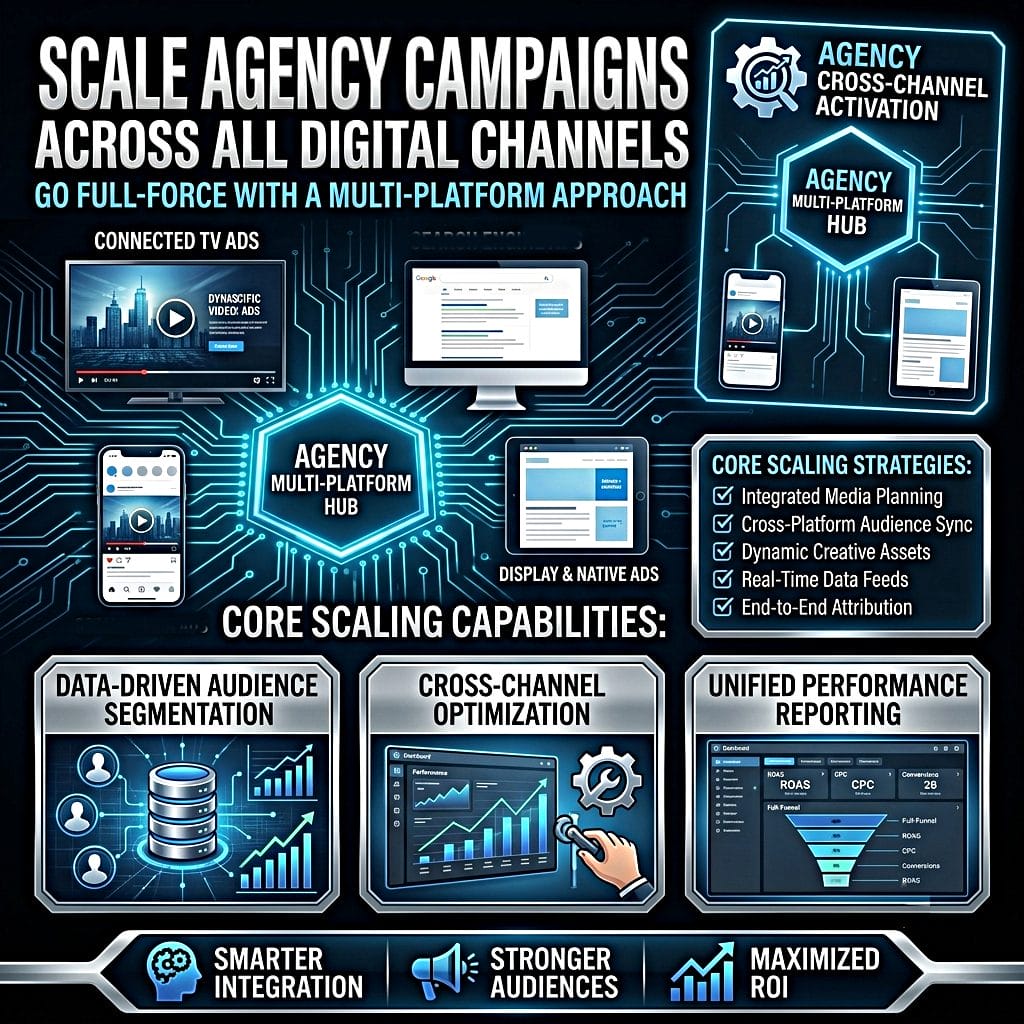
Most of the companies that call us are not underspending. They are spending in pieces. A display banner in one quarter, a two-week streaming audio buy in the next, and then a lot of confusion about why store traffic and online orders have not moved.
Nobody spends the day inside one app. Your customer checks a phone at breakfast, works on a laptop, streams a show after dinner, and listens to audio on the drive home. Reaching that person takes one plan that covers every screen, not six plans that ignore each other.
Full Force Ads is a digital advertising agency in Sandy, Utah. We build cross-channel campaigns against revenue targets, whether you run ten retail locations or sell entirely online.
A multi-screen advertising strategy coordinates one message across streaming TV, online video, digital audio, mobile, display, and native placements. Instead of treating each channel as its own project with its own report, you reach the same buyer at different points in the day, in whatever format fits the moment.
Your ad runs on Roku, Fire TV, Hulu, and similar devices. You get the visual weight of television with digital audience targeting behind it. This is the channel to use when you need households in a defined area to know your name quickly.
Pre-roll, mid-roll, and outstream placements run while people watch news, sports, and entertainment on sites and apps. Video buys you enough room to show the product working or walk through an offer that will not fit in a headline.
Spots on Spotify, Pandora, and podcast networks catch people when no screen is in front of them. Someone driving to work or making dinner cannot scroll past you, which is the whole advantage.
In-app placements, mobile web, and location triggers reach people on their phones. The phone goes where the buyer goes, so mobile is usually the shortest path from a first impression to a store visit or a checkout. Good mobile advertising strategies keep you visible while someone is out searching and browsing, not just when they sit down at a desk.
Banners on high-traffic sites keep your name in circulation at a low cost per impression. Display also carries most of the load in retargeting, since it is the cheapest way to stay in front of someone who already visited your site.
Native ads take on the layout and typeface of the page around them. Because they read like the article or feed they sit in, people click them more often than standard banners.
Targeted strategies use location data, browsing behavior, and your own customer records to put ads in front of specific people instead of a broad audience. Geofencing, addressable mapping, search retargeting, and contextual placement all exist to keep budget pointed at prospects who actually fit your customer profile.
We draw virtual boundaries around real places: competitor storefronts, convention halls, stadiums, shopping centers. When someone crosses into that boundary with location services on, their device becomes eligible for your ads during the visit and for up to 30 days after they leave. Geofencing ad campaigns work well for local businesses because they catch people at the moment intent is highest, standing in a parking lot rather than sitting at home.
Addressable matches street addresses to the device IDs inside those homes and offices. Hand us a mailing list or a CRM export and we can serve ads to those specific households on streaming TV, phones, and laptops.
Most first-time visitors leave without buying. Site retargeting follows them and delivers the next message while they read the news, watch video, or check scores somewhere else.
Search retargeting reaches people based on the terms they typed into a search engine. They may have never heard of your company, but their search history says they want what you sell.
A contextual advertising platform places your ads inside articles and pages that match your category. A hiking gear retailer can run ads in trail reviews and gear roundups without touching personal tracking data at all.
The right mix depends on whether you want local foot traffic, market share taken from a competitor, broad brand awareness, or direct online sales. Picking tactics against a stated goal is what keeps spend from leaking.
| Business goal | Channel mix | Core targeting tactic | Primary outcome |
|---|---|---|---|
| Local store traffic | Geofencing, mobile, display | Spatial radius around store locations | More foot traffic and local walk-ins |
| Conquesting competitors | Geofencing, addressable | Polygons around competitor storefronts | Market share taken from active shoppers |
| Brand building | Streaming TV, video, audio | Household income and geographic filters | Wider awareness and recall |
| Direct web sales | Site retargeting, native, search retargeting | Search history and site visitor tracking | Recovered visitors and completed orders |
| CRM list matching | Addressable, streaming TV, display | Street address matched to device ID | Repeat sales from existing customers |
The channels connect differently depending on the account, so here is a full rollout for a luxury clothing boutique in downtown San Francisco.
Brand: Aura and Oak, a retail boutique selling apparel and lifestyle goods Location: Downtown San Francisco, near Union Square Goal: more store walk-ins, more shoppers pulled away from nearby luxury retailers, and more online orders across the Bay Area
1. Channel setup
We launched a coordinated mix across downtown San Francisco rather than leaning on one channel:
2. Ad creative
Each placement got its own copy:
Streaming TV, 15 seconds: "New season, new collection. Aura and Oak, on Geary Street, two minutes off Union Square. Come see it, or tap to shop online."
Digital audio, 30 seconds: "Time to upgrade the wardrobe. If you are walking down Market Street or coming up from the Powell Street station, stop into Aura and Oak just off Union Square. Mention this ad and take 15 percent off your first purchase."
Mobile display banner: "Luxury apparel near Union Square. Visit our Geary Street boutique. Get directions."
3. Spatial mapping around San Francisco hubs
We drew tight boundaries around the highest foot-traffic zones:
4. Data layering
Then we narrowed the audience with filters inside the platform. Delivery was limited to households in the top 20 percent income bracket across San Francisco and Marin County. We loaded search intent keywords such as "designer boutique San Francisco" and "custom tailoring Union Square." The client's VIP address list went in as an addressable audience so those customers saw streaming TV ads on Thursday and Friday nights, ahead of weekend shopping.
5. Optimization and tracking
Days 1 to 3 went to delivery checks: pacing, geographic accuracy, and whether the Union Square fences were firing where they should. By days 4 through 7 we moved budget toward the creative and mobile placements pulling the best click rates. On day 14 we measured foot-traffic lift by counting exposed devices that later walked into the Geary Street store. From day 30 on, we expanded the winning search terms and served returning visitors dynamic ads featuring the products they had already looked at.
Separate vendors, separate demand-side platforms, and four different report formats cost you time and margin. We consolidate media buying onto our own platform, FullForceAds.app.
Streaming TV, digital video, digital audio, mobile, display, and native all run through a single interface. You can see the whole media spend on one screen instead of logging into six vendor accounts to piece it together.
Geofencing, addressable list matching, contextual placement, and search retargeting are part of the system, not add-ons we buy from someone else. Every impression goes toward an audience that fits your customer profile.
You get a weekly report showing where your ads ran, who saw them, and what those people did next. We do not hide margin inside the media cost or invent metrics that only look good on a slide.
There is no multi-year lock-in. Scale spend up for a busy season and pull it back when you need to.
Campaigns go from strategy to live delivery in 5 to 7 business days.
Ready to see what one coordinated plan does to your numbers? Talk to Full Force Ads and we will show you where your budget is currently going to waste.
What makes FullForceAds.app different from standard advertising platforms?
FullForceAds.app runs streaming TV, video, audio, mobile, display, and native placements from one interface, with geofencing and addressable CRM matching built in. You get one login, one report, and one team instead of a vendor for each channel.
How long does it take to launch a multi-screen campaign?
Most campaigns are live within 5 to 7 business days once creative and targeting parameters are approved.
Can geofencing track actual store visits?
Yes. We compare the devices exposed to your ads against the devices that later enter your storefront, which gives you a measured foot-traffic lift rather than an estimate.
Do I need to sign a long-term contract?
No. Budgets and terms stay flexible, and there is no multi-year commitment.