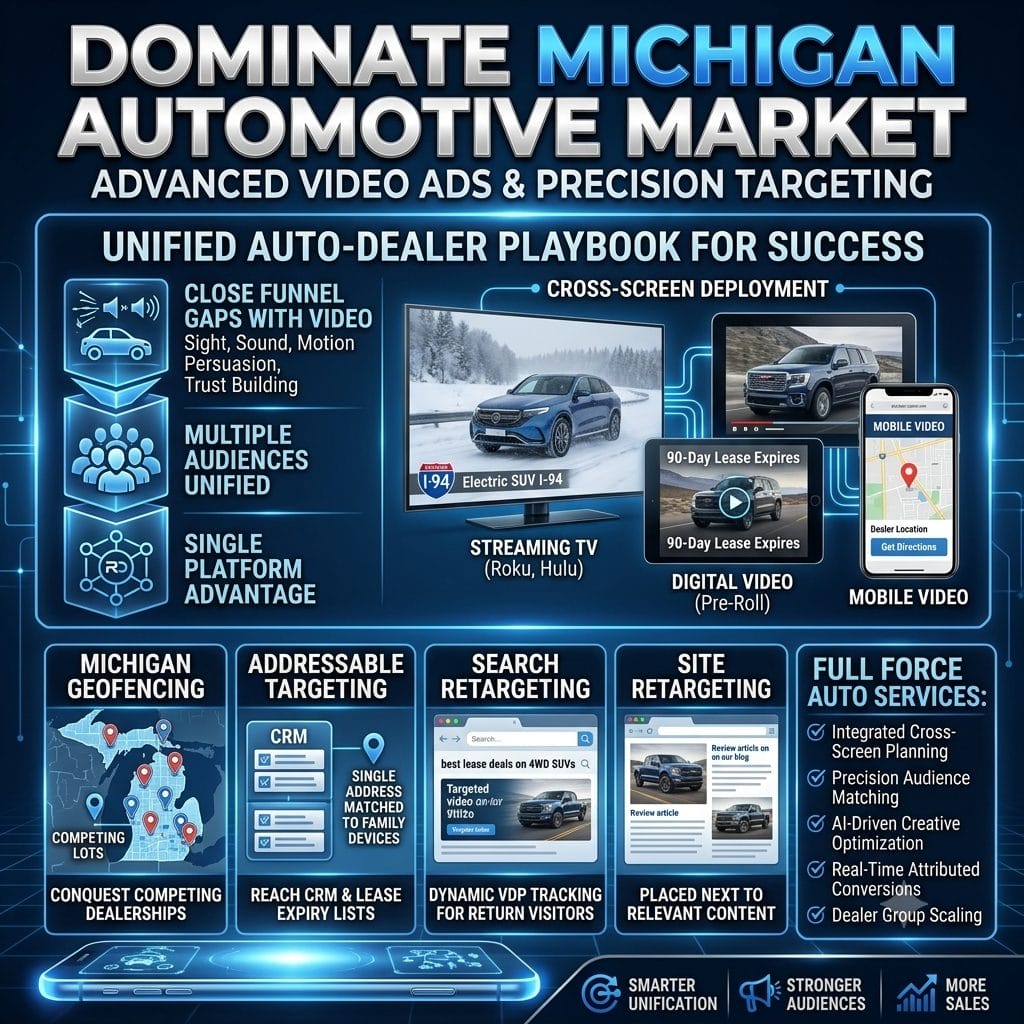
Michigan's automotive retail market is one of the toughest in the country. Dealerships here aren't just competing with the store down the road. They're selling to a customer base that grew up around the auto industry, knows the product inside and out, and expects a straightforward, low-friction buying process. From Metro Detroit down to Grand Rapids, Flint, and the Upper Peninsula, dealers face the same two problems: getting in front of people who are just starting to look, and closing the ones who are already close to buying before a competitor gets to them first.
Radio spots, print ads, and broad local TV buys don't move enough metal anymore to justify the spend. Car buyers now do almost all of their research online, and video is where most of that research happens. Industry surveys consistently find that a large majority of shoppers, often cited north of 75%, say online video played a role in choosing their next vehicle and where they bought it.
But producing video is only the first half of the problem. Getting it in front of the right person is the harder part. Dealers who want to move inventory need their video reaching the specific household, device, or individual who is actually in the market right now.
This playbook walks through how dealer groups are using multi-screen video, paired with location and behavioral targeting, to get more out of their ad spend and build a lasting edge in their market.
Buying a car is not a casual purchase. It's expensive, it's a long-term commitment, and for a lot of people it says something about who they are. That complexity is exactly why static images and text ads fall short: they can tell you the price, but they can't show you what it's actually like to drive the thing.
Video closes that gap. A local dealership can show a truck handling a Michigan winter, the quiet cabin of an electric SUV, or the safety features that matter to a parent driving on I-94 in the snow. Sight, sound, and motion do the persuading that a banner ad can't.
Video also solves some practical problems in the buying process. It's a better way to explain a complicated lease structure or a regional manufacturer incentive than a wall of text, and buyers trust it more. Roughly two-thirds of shoppers who watch a vehicle walkaround video say it gets them comfortable enough to move straight into financing. And beyond what the manufacturer's brand already communicates, video lets a local dealer answer the question that actually decides where someone buys: why buy from us instead of the dealership three exits away? Community ties, a family-run history, or something as simple as free winterization can be the deciding factor, and video is the format that gets that across.
To capture that value, dealers need one partner running everything from a single platform, rather than piecing campaigns together across vendors who don't talk to each other.
Reaching a Michigan car buyer means showing up across every screen they use in a normal day, whether that's a TV in the living room, a laptop at work, or a phone during the commute.
Streaming has changed how people watch television more than anything else in a generation. Running ads on Roku, Fire TV, Hulu, and live sports streaming puts a dealership on the biggest screen in the house, without the cost and waste of a traditional broadcast buy.
For a dealer in Grand Rapids or Lansing, this is a real shift. Instead of buying a spot that airs across the entire DMA during the evening news, a dealer can target only the households within fifteen miles of the showroom whose lease is set to expire in the next 90 days. That turns TV from a blunt awareness tool into something you can actually measure.
While streaming owns the living room, digital video reaches people actively browsing the web or using apps. Pre-roll ads run before a video starts, mid-roll ads run during a break in the content, and both are a good fit for inventory highlights or a time-sensitive promotion.
If someone is reading a truck review on an enthusiast blog, watching a walkaround video, or catching up on local news, a pre-roll spot fits naturally into what they're already doing. Outstream video extends this further by playing inside article pages that don't have a video player at all, opening up placements a standard video buy would miss.
Phones go everywhere the buyer goes, which makes mobile video the channel for staying visible between the moments someone actively thinks about your dealership. It's also the easiest channel to turn into an action: tap to call, get directions, or book a test drive straight from the ad.
Running these three channels together, instead of managing them separately, keeps the message consistent and cuts out the friction of dealing with multiple vendors.
A great video ad reaching the wrong person is wasted money. In automotive, precise targeting is what turns an ad impression into someone walking onto your lot. Dealers who move past basic age and gender targeting and start targeting real behavior and location see the difference in showroom traffic.
Geofencing lets a dealer draw a digital boundary around a real-world location and reach people based on where they physically are. For conquest campaigns, this is one of the most direct tools available.
Draw a fence around every competing dealership within twenty miles, and when a shopper's phone enters that lot in Macomb County, they become part of your audience. While they're waiting on a salesperson and checking the weather or the score of last night's game, your ad can show up with a better warranty, a more aggressive lease payment, or a reason to walk over to your lot instead.
The same idea works around events. A truck-heavy dealer can fence off agricultural expos, construction supply yards, or hunting shows across the state and put their inventory in front of people who actually use a truck for work.
Most dealerships are sitting on a database of past customers, old leads, and expiring leases that never gets fully used. Addressable targeting matches those home addresses to the household's connected devices, so you can advertise directly to that list.
If 5,000 past customers have leases expiring in the next six months, you can skip the direct mail piece entirely and put a tailored ad on their living room TV or tablet, speaking to their loyalty status, without spending a cent on anyone outside that list.
Car shopping takes weeks. Search and site retargeting keep your dealership visible during that stretch.
Search retargeting serves ads based on what someone recently searched. A shopper in Troy who searches "best lease deals on 4WD SUVs" can see your video the next time they land on a news site or a streaming app, while the search is still fresh in their mind.
Site retargeting handles the people who already visited your vehicle detail pages and left without filling out a form. As they browse other sites, they see an ad for the exact vehicle and trim they were already looking at, with an updated call to action.
Contextual targeting places your ad next to content that's already relevant to what you're selling. An EV ad next to an article about regional charging infrastructure lands better than the same ad running on an unrelated page, because the reader's mindset already matches the message.
Video does the heavy lifting, but a full campaign needs other channels working alongside it.
Digital audio reaches people during the parts of the day when they're not looking at a screen at all: commuting on the Lodge Freeway, driving across the state, or working out. Platforms like Spotify, Pandora, and podcasts let a dealer run a more conversational, direct-address spot. Something like "driving through this sleet? might be time for a vehicle with real all-wheel drive" lands differently in someone's ear than it would in a banner ad. Pairing the same targeting layers used for video with an audio buy reinforces the message when eyes are off the screen.
Display banners are cheap, wide-reaching, and form the backbone of any retargeting setup. Where video builds interest, a display ad keeps pricing, incentives, and your address in front of someone who's already shopping. Native ads, which are built to match the look of the page they're on, tend to get better click-through rates than standard banners because people don't immediately tune them out, and they work well for driving traffic to a landing page or a customer story.
| Goal | Channels | Targeting | Focus |
|---|---|---|---|
| Local awareness | Geofencing, display, mobile | Neighborhood filtering | Build recognition in your immediate market |
| Conquest | Geofencing, addressable | Competitor lots and service centers | Reach buyers while they're on a competitor's lot |
| Long-term brand building | Streaming TV, video, audio | In-market intenders, credit tiers | Build preference and answer "why buy from us" |
| Website traffic | Display, native, search retargeting | Keyword intent, contextual placement | Drive qualified traffic to vehicle detail pages |
| Retarget site visitors | Site retargeting, display, video | Dynamic VDP tracking | Re-engage people who didn't fill out a form |
| Activate CRM lists | Addressable, streaming TV, display | First-party address lists | Reach past customers with upgrade offers |
Running all of this well requires a partner that isn't juggling five different vendors and five different sets of reporting. That's the problem Full Force Ads was built to solve.
One partner, all channels. The biggest source of waste in dealership marketing is fragmentation. When search runs through one vendor, social through another, and traditional media through a third, you end up paying multiple markups, getting reports that don't agree with each other, and sometimes bidding against your own campaigns in the open market. We run streaming TV, pre-roll video, audio, mobile, display, and native from one platform, so budget can move in real time to whatever channel is actually performing.
Targeting built for real intent. We're not optimizing for impressions or clicks that don't lead anywhere. Geofencing, addressable targeting, and retargeting are built to reach real people showing real buying signals, and to keep your budget away from fraud and wasted reach.
Reporting you can actually read. A lot of agencies hand over a monthly PDF with a few aggregated numbers and call it a report. We show you where the ads ran, who saw them, and what they did afterward, so your team has the numbers it needs to make a call.
Speed to match your business. Incentives change overnight, inventory shifts without warning, and a rigid, slow-moving agency can't keep up. We don't lock dealers into long contracts or high budget minimums, and campaigns are typically live within days.
Discovery call. We talk through your market area, current inventory, past conquest problems, and volume goals. No pitch, just a conversation about what you're actually trying to do.
Custom recommendation. From that call, we build a channel mix and targeting plan specific to your budget and goals, including the geofences, the address lists, and the creative approach.
Launch. Once you sign off, our team handles the tracking pixels, uploads your CRM lists, and gets creative live across the network. Most campaigns go from approval to live in five to seven business days.
Ongoing optimization. After launch, we keep watching creative performance, frequency, and conversions, shift budget toward what's working, and adjust geofences and keywords as needed. You get a report every week that's actually easy to read.
Every day a dealership sticks with broadcast ads or scattered digital tactics is a day a competitor down the highway is geofencing your service lane, targeting your expiring leases, or just building more visibility in your own market than you are.
You don't need to have every detail figured out before you start. Whether the goal is more local awareness, taking traffic from a specific competitor, or finally putting your CRM list to work, there's a straightforward path to turning your marketing spend into something you can actually measure.
Reach out to talk through what that would look like for your dealership or visit our site to see case studies from other dealer groups running this playbook.