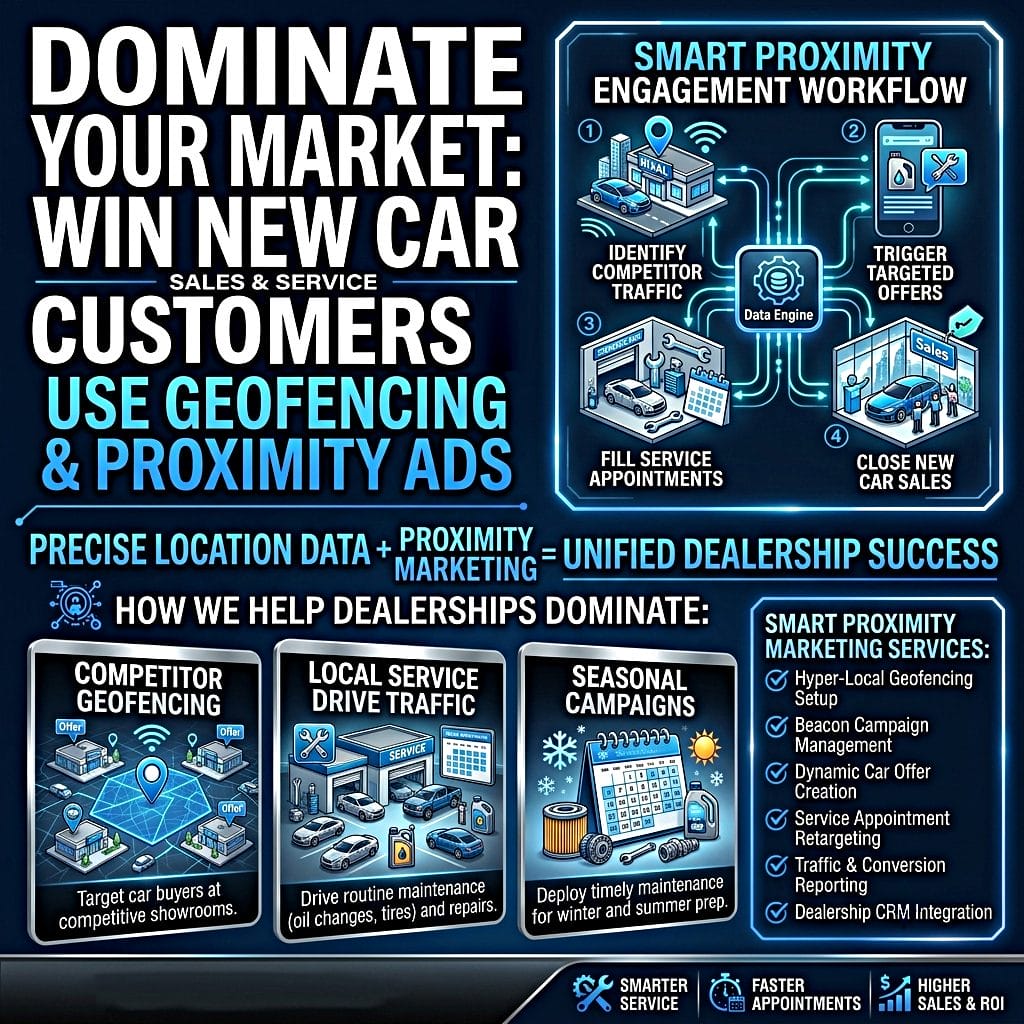
Geofencing a rival dealership, and what to do with the phones you catch
Draw a boundary around a competitor's property, collect the mobile ad IDs of phones that cross it, then advertise to those phones for the next several weeks. That is the whole mechanic.
It works better in car retail than in almost any other vertical because the shopping window is short and getting shorter. Buyers do most of the deciding before they park. By the time someone is walking a lot, they have already narrowed the field, and whoever they visit second is usually confirming a choice rather than making one. An ad that shows up a week after the test drive is an ad for someone who owns a car now.
Radius targeting does not do this job. A one mile circle around a dealership swallows the interstate, the drive-thru across the street, and the apartment complex behind it, and you pay for all of it. The fence has to be drawn point by point around the sales lot, the showroom floor, and the service drive, with the road, the highway ramp, and the unrelated businesses next door cut out of the shape.
Wider fences do have a place. When a national brand is fencing thousands of competitor locations at once, a broader boundary is a reasonable trade for coverage. For a single dealer trying to catch shoppers on one specific lot across town, precision is the whole point.
Phones carry an anonymized Mobile Advertising ID. Apps that have location permission pass that ID along with the coordinates, and the usual sources are the boring ones people leave installed: weather, navigation, news, games. A shopper walking the truck row at 2 pm Saturday shows up as an ID sitting inside your polygon.
There are two ways to spend that ID, and the second one is where the money is. The first is live delivery, a banner or short video on the phone while the person is still on the lot, which is mostly a brand impression. The second is the retargeting pool. Those IDs stack into a custom audience you can serve across mobile apps, desktop, social, and connected TV for a window after the visit. Thirty days is a common setting and longer windows are possible depending on the campaign. That reaches the shopper at home, on the couch, next to the person who actually has opinions about the monthly payment.
A dealership is not one audience. The person killing two hours in the service lounge and the person walking the new car showroom want opposite things, and the same creative will underperform against both.
| Campaign type | Target zone | Message focus | Key metric |
|---|---|---|---|
| Price and incentive match | Sales lot and showroom | Beat any written trade-in quote by $1,000, or an APR comparison | Cost per walk-in |
| In-stock inventory hook | New and used vehicle lots | "Looking for a [Model]? We have 45 in stock, ten minutes away" | Click rate to VDP |
| Service to sales flip | Service center and waiting room | "Don't put $1,200 into that repair. Trade up, $0 down" | Service bay footfall, sales leads |
| Brand comparison | Cross-town rivals | Feature against feature: tow rating, warranty length | Engagement rate, VDP views |
The service bay intercept. This is the zone most dealers skip and it is usually the best one on the list. Service waiting rooms have dwell times of one to three hours, and a good share of the people in them are staring at an estimate for a timing belt on a nine year old vehicle. That is a customer doing math on whether the car is worth keeping. A trade-in calculator or a "same payment, newer vehicle" offer arrives at exactly the moment the question is already open in their head.
Trade-in valuations. Anyone walking a rival used lot is usually there to find out what their current car is worth. Serve dynamic creative offering an instant online appraisal, or a flat cash bonus over whatever number the other store wrote down. You are bidding against a figure the shopper is already unhappy with.
Inventory alternatives. When a model is tight regionally, cross-shoppers walk lots and find three units where they expected thirty. Ads that link directly to live VDPs, with real stock counts and delivery timing, catch people at the point of disappointment rather than the point of research. One Pacific Northwest dealership ran dynamic creative on new inventory only, paired with site retargeting, and brought cost per action to under four dollars over two months.
A Florida dealership built a Memorial Day campaign on fifteen competitor fences plus a quarter of a million addressable households, with streaming TV and dynamic creative on top. Blended cost per action came in around sixteen dollars, against an average vehicle value near 48,500 dollars, alongside 98 measured in-person visits and 235 online conversions.
An off-road vehicle brand ran competitor geofencing with conversion zones across 188 dealerships, each with its own creative and budget, and measured 8,377 in-person visits over twelve weeks. A powersport brand doing the same thing across roughly 200 dealers measured 6,926 visits at 2.88 dollars each.
At national scale, an auto services brand with more than 2,000 stores combined competitor fences, conversion zones, search, and event targeting, and drove 400,000 visits with a geo-conversion lift of roughly 3.5x.
None of these were guaranteed going in. Budget, creative, inventory, and what the sales floor does with the traffic all move the number. What the setup does guarantee is that you can see which of those levers is working.
Draw tight polygons, not circles. If you only want shoppers, exclude the employee parking area, or use dayparting to drop activity outside shopping hours.
Set a dwell threshold so you are not paying for mail carriers, parts runners, and the person who pulled in to check a text. A few minutes inside the fence is usually enough to separate a shopper from a passer-through, and the right number depends on the lot and how it sits relative to the road. Restrict live serving to store hours, something like Monday through Saturday, 9 am to 8 pm.
Extend to the household. On-lot impressions build awareness, but conversions cluster in the retargeting phase. Push delivery to connected TV and desktop browsers on the same network as the captured phone.
Run your own customer list as a second campaign. Service records and recent buyers can be turned into an addressable audience targeted at the home address rather than the lot, which is a different job from conquesting and a good use of data you already own. One dealership running exactly that against service customers and recent buyers hit twice its click rate goal inside three weeks.
Put a second fence around your own store. When a device that saw your ads crosses that line, it registers as a measured visit, and you can see it against the competitor location and date that put the device in the pool. That is the difference between reporting impressions and reporting walk-ins.
From there, the honest next step is scoping the tie-back to closed deals with whoever runs your campaigns. Matching exposure data against sold vehicles and repair orders is doable, but it depends on your CRM, your data access, and what you are permitted to pass between systems. Ask what the process looks like before you launch rather than after, because cost per sold vehicle is the number a dealer principal actually wants, and you cannot back into it later without the plumbing in place.
Location targeting runs on anonymized device data collected through apps where the user granted location permission. We do not attempt to identify specific individuals, and we stay out of restricted categories and child-directed environments. If your legal team wants the compliance documentation behind that, ask for it during the planning stage rather than mid-flight. Any provider worth using will hand it over without a fuss.
On trademarks, keep rival logos and trademarked terms out of your creative unless the use is nominative, as in a straight Ford F-150 versus Chevy Silverado comparison. Point the messaging at your own pricing, incentives, and inventory depth. It converts better anyway, and it does not generate a letter from someone's counsel.