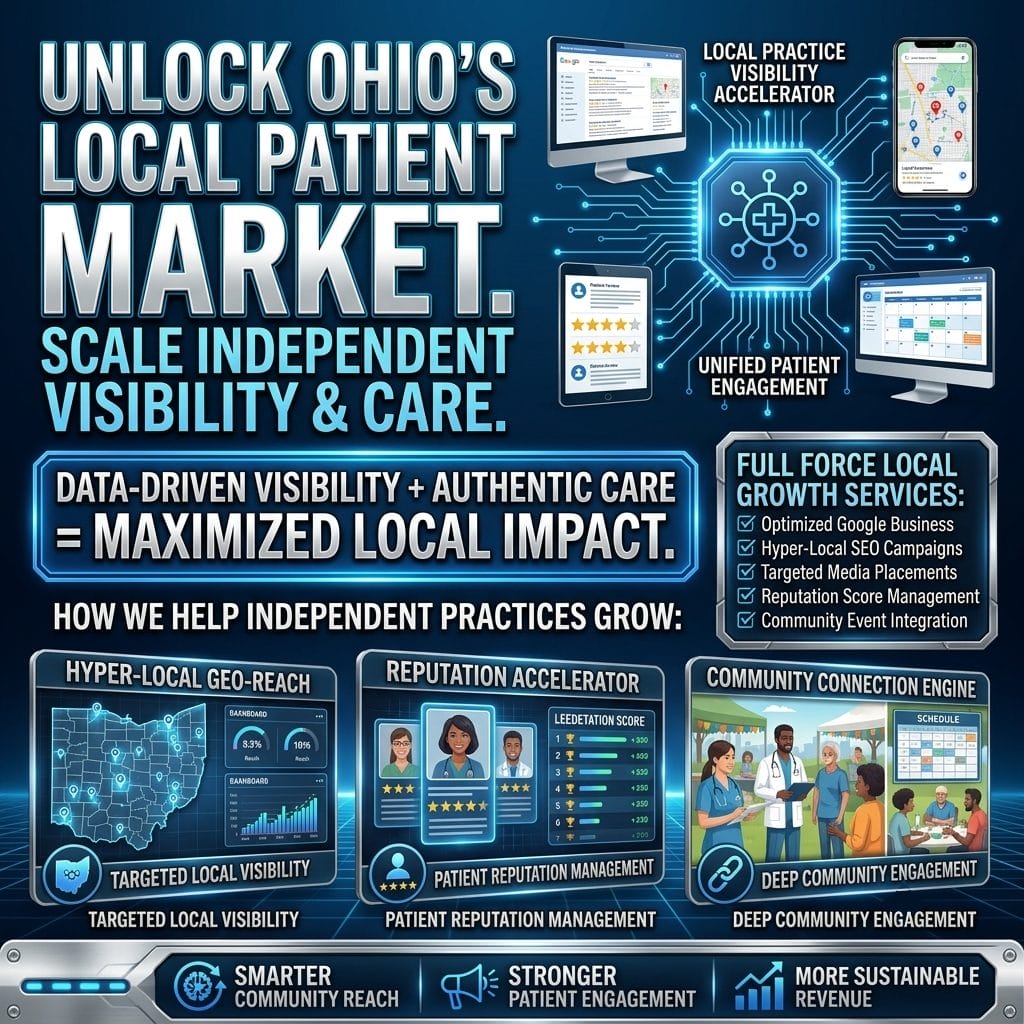
Cleveland Clinic and OhioHealth keep buying local practices, and every acquisition tightens the referral map for everyone still independent. A regional provider or a specialty clinic is not just competing with the practice down the road anymore. The competition is the ambulatory surgery center, the urgent care chain, and whatever comes up when somebody searches on their phone at nine at night or on the smart TV in the living room.
Billboards and network TV still get seen. They just cannot tell you who booked because of them. Programmatic can, though only if the intake process behind the ad is ready to catch what the ad sends.
Buying impressions before intake is ready is the fastest way we know to waste a budget. The AI agent, the CRM, and the EMR connection all need to be doing their job before launch.
The agent on your landing page covers the hours the front desk does not. People look for care at night and on weekends, and when nobody replies for twelve hours they have already booked somewhere else. A decent agent screens the visitor, answers the obvious questions, and puts the appointment on the calendar.
CRM matters most for elective and complex treatments, where a decision takes weeks and usually involves a spouse. Salesforce Health Cloud and HubSpot both handle it. The point is that the person who asked about a knee in March is not treated like a stranger in May.
Connecting campaign data to Epic or Cerner is the step almost everyone skips. It is also the only way to see which channel produced revenue instead of which channel produced clicks, and it can be done without putting patient data anywhere it should not be.
Search alone gets expensive quickly. Medical keywords are some of the most contested in any auction, and outbidding a health system with a national budget is not a plan. So we run the rest of the media day and report on all of it in one place.
Streaming TV gives you 15 and 30 second spots on Roku and Hulu, cut down to a postal code or a household income tier rather than a whole broadcast market. Digital video on news sites and medical portals is where longer explanation belongs: the procedure nobody understands until they see it, or the surgeon a patient would rather meet before the consult. Audio on Spotify and Pandora catches the commute and the gym. Mobile banners inside news and weather apps carry a click-to-call button, which for urgent care is often the whole conversion. Display across regional news and health publishers does most of its work on people who have already been to your site once. And native placements in the feed on sites like Cleveland.com read like the articles around them, so education performs there and a hard offer does not.
Most of the savings come from targeting rather than creative.
Geofencing draws a perimeter around a real place, a competitor's parking lot or a health expo, and serves ads to the people who were inside it. Addressable takes your direct mail list, matches it to the device IDs in those households, and puts the message on the television and the phone at that address.
Search retargeting picks up people who researched a condition elsewhere on the web and shows them display or video, usually well under what the same intent costs inside a search engine. Site retargeting is for the visitors who read three pages and left without booking, and a service-specific video does more there than a brand spot. Contextual sits your ad beside articles on the matching condition and works without cookies, which is worth more every year that passes.
An urgent care network moving into Dublin or Westerville needs walk-in volume this month. Geofence the rival clinics and the sports complexes, put the current wait time in the mobile creative, and let the AI agent hold a spot for people before they get in the car.
Orthopedics runs the other way. Fewer patients, longer decisions, much higher value per case. Hulu spots against households over 45 in Cuyahoga County, search retargeting layered on for anyone already reading about joint pain, then an education sequence tied to the EMR so nobody follows up blind.
Most of the practices we talk to are running three or four vendors and reconciling three or four reports that disagree with each other. We run the channels from one platform. Build and launch takes five to seven business days, and the weekly report shows where the ads ran and what came back.
Book a discovery call and we will map it against your service lines.