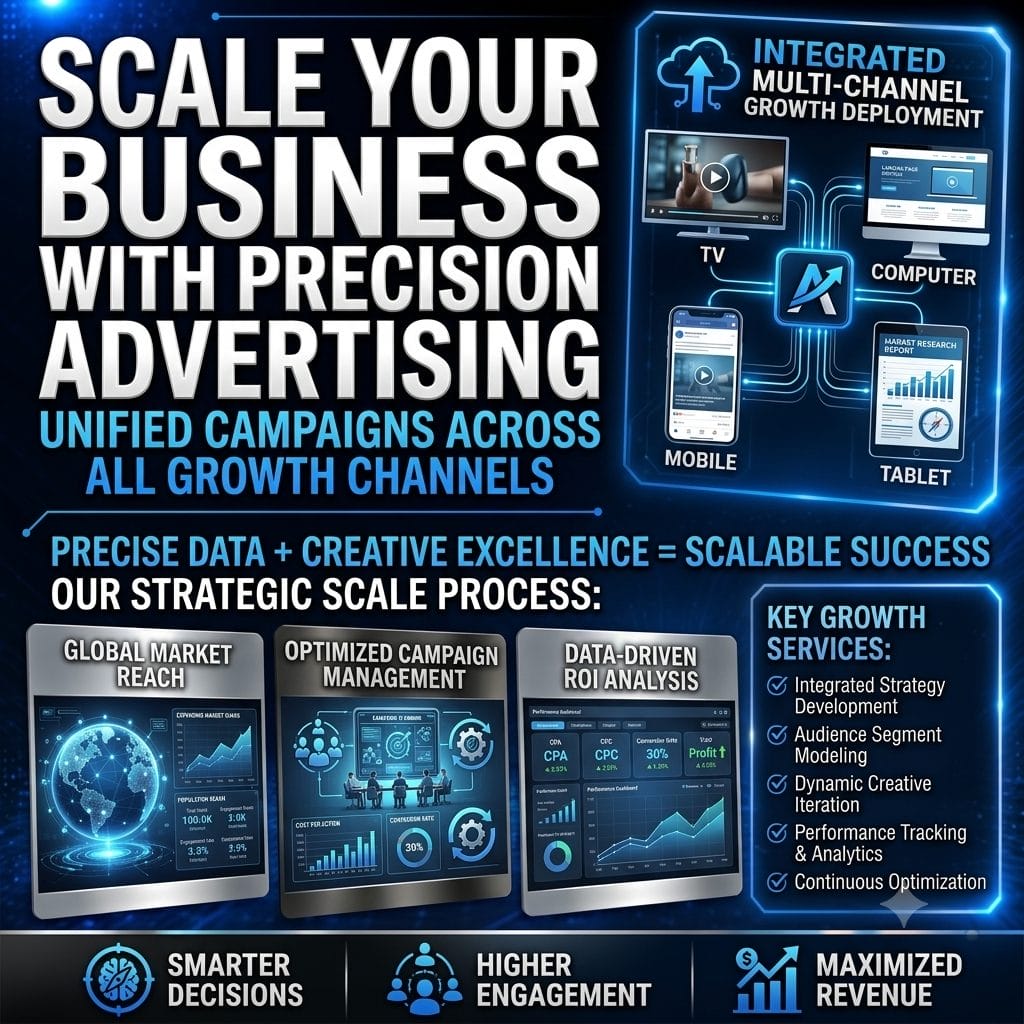
We run a digital advertising agency out of Sandy, Utah, and the pattern we keep seeing in 2026 is simple: clients renew with the agencies that can execute on every screen their buyers actually use.
Right now that is getting harder. Client budgets are audited line by line. The crowded channels keep getting more expensive. And media buyers are logging into six dashboards to answer one question about performance. When a client asks for a full campaign or a real thought leadership push, a single-channel buy does not cover it.
What agencies need is direct access to one programmatic engine instead of six vendor relationships. That is why we built FullForceAds.app, our own platform for buying mobile, contextual, display, streaming TV, audio, and native from a single interface.
For years most agencies pushed everything through two or three of the big ad networks. Four problems have caught up with that approach.
Auction costs keep climbing. Over-saturated auctions have pushed cost per click to record highs in retail, finance, home services, and legal.
Audiences are scattered. One person moves between mobile apps, a smart TV, a podcast, a news site, and a niche blog in a single evening. Any one network sees a thin slice of that.
Blanket targeting wastes money. Broad targeting options spend budget on unqualified clicks, out-of-market users, and people who have no authority to approve a purchase.
Reporting sits in silos. Separate vendors for video, display, and location targeting produce separate numbers, and attribution turns into guesswork.
Buy only in crowded auctions and margins shrink while performance hits a ceiling. Full-funnel strategies work because they follow the audience into the places where they are actually spending time.
A complete media plan runs several formats at once, matched to where the buyer is in the process.
| Channel | What it covers |
|---|---|
| Streaming TV | Big-screen brand impact in the living room |
| Video and audio | Pre-roll video plus audio for screen-free moments |
| Mobile | Location-aware in-app and in-browser placements |
| Display | Retargeting and brand recall banners |
| Contextual | Privacy-safe placements next to relevant content |
Phones are where people research a purchase and where they act on it. Through FullForceAds.com you can run mobile banners, in-app video, and location-triggered placements to people who are out and moving. Someone can tap to call, fill out a short form, or pull up directions without ever leaving the app they were in.
Third-party tracking keeps getting weaker, which has made contextual buying a lot more useful than it was five years ago. Instead of reading someone's browsing history, contextual placement reads the page. If your client sells commercial HVAC service, the ad sits next to trade coverage of building maintenance and energy costs in commercial real estate.
Display banners still do the unglamorous work of keeping a name in front of people. Running display across local news sites, niche publications, and industry blogs keeps a client visible through a sales cycle that can take six months to close.
CTV gives you the television spot without paying for the viewers you do not want. Agencies run 15 and 30 second commercials on Roku, Amazon Fire TV, Hulu, and Apple TV, targeted by ZIP code, household income, or buyer profile, so the budget stays inside the client's actual market.
Audio reaches people on digital audio networks and podcasts, during commutes, workouts, and the rest of the day when nobody is looking at a screen. Native matches the look of the publisher's site, which lets a client show up as something worth reading instead of an interruption.
The channel decides where an ad shows up. Targeting decides who sees it. Layering data segments onto every campaign is how you keep budget off the wrong people.
| Targeting method | How it works | Where agencies use it |
|---|---|---|
| Geofencing | Draws a virtual perimeter around a physical location and picks up the mobile device IDs inside it | Trade shows, competitor locations, specific commercial districts |
| Addressable household | Matches verified street addresses from a CRM or direct mail file to household IP addresses | Running CTV and display against a client's own lead list |
| Search retargeting | Reaches people based on keywords they recently searched across the web | Getting display in front of B2B prospects while they are still shopping |
| Site retargeting | Re-engages visitors who left the site without converting | Bringing bounced traffic back with a specific offer |
| Contextual category | Places ads by page subject, with no cookies involved | Legal or financial ads next to related news and market coverage |
When a client's marketing team asks for thought leadership, they usually mean three separate jobs: research, production, and distribution. Most agencies do the first two well and skip the third.
Step 1: Know who you are talking to. Start with the decision maker. Job title, geography, what actually creates friction in their week, and the questions they ask before they sign anything. Write those questions down, because they become your headings.
Step 2: Write the asset and give it somewhere to go. Draft articles, whitepapers, or video that answer those questions directly. Phrase the headings the way people search. Put a CTA where someone can find it. Keep paragraphs short enough to read on a phone.
Step 3: Pay to put it in front of the right people. A post sitting on a client's blog is not distribution. Run native and contextual ads through FullForceAds.app that point back to the asset, then add addressable retargeting so the decision maker sees it more than once and on more than one device.
Four steps, in order:
Display is the format: the visual banner that appears on a page. Contextual is the targeting method: choosing that page based on its subject matter rather than the visitor's browsing history.
You draw a perimeter around a real place, such as a competitor's parking lot, a trade show floor, or an industrial park, and collect the mobile device IDs that show up inside it. Those devices then get served mobile and display ads.
It puts streaming TV, mobile, display, contextual, audio, and retargeting buying in one platform, with one dashboard and one set of numbers. That means fewer vendors to manage, less admin time, and reporting you can hand a client without stitching four exports together first.
Yes. Upload a physical address list, such as a CRM export or a direct mail database, and addressable targeting maps those addresses to the devices inside those homes, then serves CTV, video, and display to them.