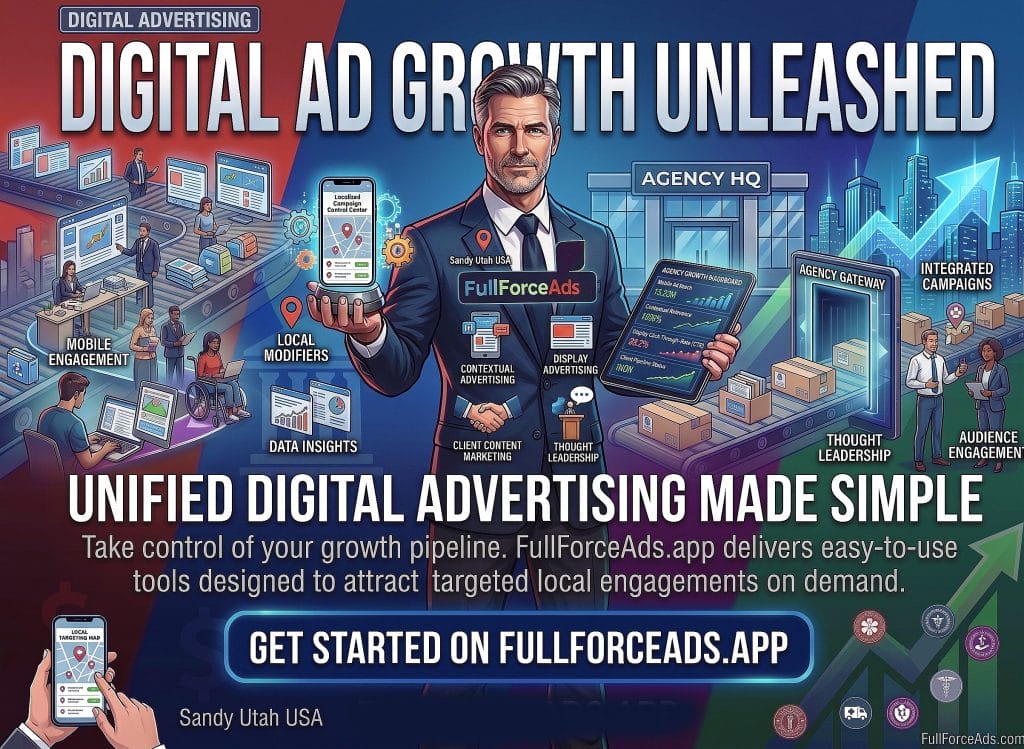
Most agency teams hit the same wall building a client media plan. The client wants wider reach and better numbers. Meeting that ask usually means opening four or five separate ad platforms, splitting the budget across them, and then reconciling reports that never quite agree.
Programmatic buying is how agencies get the reach without living inside the walled gardens, where you rent an audience you can never see across.
FullForceAds is a digital advertising agency in Sandy, Utah. We built our execution platform, FullForceAds.app, so agencies can buy across screens directly instead of managing a pile of vendor accounts.
When you add mobile, contextual targeting, or display inventory to a client proposal, running all of it through one engine keeps the campaign consistent and your margin predictable.
Agencies consolidate to cut the hours spent on media buying and to stop paying twice for the same impression. Running display, audio, streaming video, and mobile in one place also produces one set of numbers instead of four that contradict each other.
+-----------------------------------------------------------------------+
|                    THE UNIFIED AGENCY WORKFLOW                        |
+-----------------------------------------------------------------------+
|  [ Client Brief ]  -->  [ FullForceAds.app Engine ]                   |
|                                |                                      |
|   +----------------------------+----------------------------+         |
|   |                            |                            |         |
| [ Mobile Ads ]          [ Contextual Ads ]         [ Display Ads ]    |
| Location/In-App         Topic/Content Match        Dynamic Retargeting|
|   |                            |                            |         |
|   +----------------------------+----------------------------+         |
|                                |                                      |
|  [ Unified Cross-Device Analytics & Client Reporting ]                |
+-----------------------------------------------------------------------+
Single-channel networks put your buyers in four dashboards to run one campaign, and the damage shows up in a predictable order.
Frequency control breaks first. A user sees the display ad five times and the mobile ad five times, because neither system knows the other exists. Reporting credibility goes next, since every network claims the same conversion and your account team spends the QBR explaining why the reported lead count does not match CRM sales. Then there is the labor. Building creative variants across four portals eats the hours your planners should be spending on strategy.
Route the media through FullForceAds.app and frequency caps apply across every channel at once. If someone sees a mobile ad on their morning commute, the platform updates that cross-device profile, so the evening impression is a contextual display unit or a streaming TV spot rather than the same mobile creative again.
Mobile advertising ties an impression to something the person actually does, using location triggers and mobile device IDs. That puts the ad in front of a buyer near the point of decision instead of hoping they recall the brand later.
The phone is the one screen nearly everyone carries all day. A banner buried in a random app still does nothing for a client, which is why serious mobile targeting now runs on location data.
Geofencing draws a virtual boundary around a place: a trade show hall, a competitor's parking lot, a dealership on a Saturday afternoon. The platform collects the mobile device IDs that cross that boundary during the hours you specify. Location retargeting then keeps serving those same devices for days or weeks after they leave the site. Placement decides whether any of it registers, so the ads run inside apps people already spend real time in rather than in web slots nobody scrolls to.
A regional B2B client running an industry conference in Salt Lake City used this to reach attendees staying at nearby hotels. We mapped the convention center perimeter, served an event-specific offer to the phones inside it, and booth traffic came in 24% higher than the previous year.
Contextual advertising places an ad based on what the page is actually about instead of what a cookie claims about the reader. Relevance stays high and the client stays clear of privacy exposure.
+-----------------------------------------------------------------------+
|                     CONTEXTUAL MATCHING ENGINE                        |
+-----------------------------------------------------------------------+
|  Article Subject: "Commercial Real Estate Interest Rate Trends"       |
|                                |                                      |
|  Page Analysis: Scans keywords, sentiment, and article category       |
|                                |                                      |
|  Ad Placement: Commercial Lending Solutions Banner                    |
|  Result: High relevance, zero third-party cookie dependency           |
+-----------------------------------------------------------------------+
Third-party cookies keep getting less reliable, which has moved contextual targeting from a fallback line item to a core one.
Rather than following someone around the web on the strength of stale browsing data, the system reads the page as it loads: the text, the sentiment, the category it sits in. An article on commercial real estate rates gets your client's commercial lending banner next to it.
That helps a client campaign twice over. The reader is already thinking about the subject, so intent is built into the placement. Verification filters also keep the creative away from negative or unsuitable news, which protects the brand while the campaign runs.
Pair broad topical placement with cross-device dynamic retargeting. Responsive formats on premium publisher inventory keep the brand in front of the buyer through a long consideration cycle.
Display earns its bad reputation when an agency treats it as a static banner dropped onto cheap inventory. Run properly, it takes deliberate creative structure and layered audiences.
Dynamic retargeting carries most of the weight. When someone leaves a client site without converting, the unit rebuilds itself around the exact products or service pages that person looked at. Search retargeting works one step earlier, reaching users based on terms they searched recently across the web, so you catch intent before they ever land on the site. Format decides whether any of it gets seen. Native units and the larger interactive sizes sit inside editorial feeds without interrupting the read, and they get noticed in a way a 300x250 never will.
Cross-device retargeting connects mobile browsing activity to a desktop profile, so a campaign can pick a buyer back up on whichever screen they switch to.
A boutique luxury fashion retailer in Boston, MA had a mobile cart problem. Analytics showed more than 78% of customers were browsing products and adding items on their phones during the MBTA commute, then abandoning the cart once the trip interrupted them.
Single-device retargeting could not fix that. The mobile cookie lost the shopper the moment they opened a laptop or tablet at home that evening.
+-----------------------------------------------------------------------------------+
|                        CROSS-DEVICE RETARGETING IN ACTION                         |
+-----------------------------------------------------------------------------------+
|  1. Consumer browses luxury footwear on mobile while on a Boston train.           |
|  2. Consumer adds item to cart, but abandons due to a real-world distraction.     |
|  3. System maps consumer's cross-device profile (Mobile -> Desktop).              |
|  4. Evening: Animated ads featuring the exact cart item appear on desktop news.   |
|  5. Consumer clicks dynamic ad, completes checkout on high-converting page.       |
+-----------------------------------------------------------------------------------+We put a cross-device dynamic retargeting program in place. The FullForceAds pixel went across the retailer's checkout funnel first, so an abandon on a phone could be matched to that same person's home desktop profile. The platform then built animated display units showing the exact footwear style and colorway sitting in the cart, not a generic brand image. Those units ran on desktop news publications and regional Boston blogs through peak evening hours, when people are settled in and willing to finish a purchase.
Cart recovery rose 310% within two weeks of launch. Acquisition cost landed below what the retailer had been paying to bid on broad search keywords, and the brand picked up placement on high-authority publishers it had not been buying directly.
The right mix depends on the client's goal and where their audience actually spends time. Here is how each channel behaves inside FullForceAds.app.
| Channel | Primary strengths | Recommended target audience | Core capabilities |
|---|---|---|---|
| Mobile advertising | High real-world intent, location accuracy | Event attendees, local retail shoppers, mobile app users | Geofencing, device ID capture, in-app native units |
| Contextual advertising | Privacy-compliant, topic relevance | Niche researchers, B2B decision-makers, news readers | Real-time page scanning, keyword alignment, brand safety |
| Display advertising | Cost-effective reach, visual retargeting | Website abandoners, active searchers, broad category prospects | Dynamic product retargeting, search intent targeting |
| Streaming TV (CTV) | High message recall, unskippable formats | Household decision-makers, cord-cutters | Addressable household matching, demographic filters |
| Programmatic audio | Screen-free engagement, high retention | Commuters, podcast listeners, gym-goers | In-stream audio ads, podcast category placement |
Most agencies plug FullForceAds.app in at three points: the brief comes in, the targeting layers get set, and the reporting goes back out under your own brand.
Our team in Sandy, Utah works directly with your planners and account leads to build the media structure around what the client is actually trying to accomplish.
  STEP 1                 STEP 2                 STEP 3                 STEP 4
+--------+             +--------+             +--------+             +--------+
| BRIEF  | ----------> | TARGET | ----------> | LAUNCH | ----------> | REPORT |
+--------+             +--------+             +--------+             +--------+
 Input client           Select mobile,         Deploy via             White-label
 goals & assets         contextual, &          FullForceAds.app       client updates
display layers in 5-7 days & optimizationIf you want a wider media offering and better margin on the campaigns you already run, take a look at our agency ad solutions or call the strategy team in Sandy, Utah.