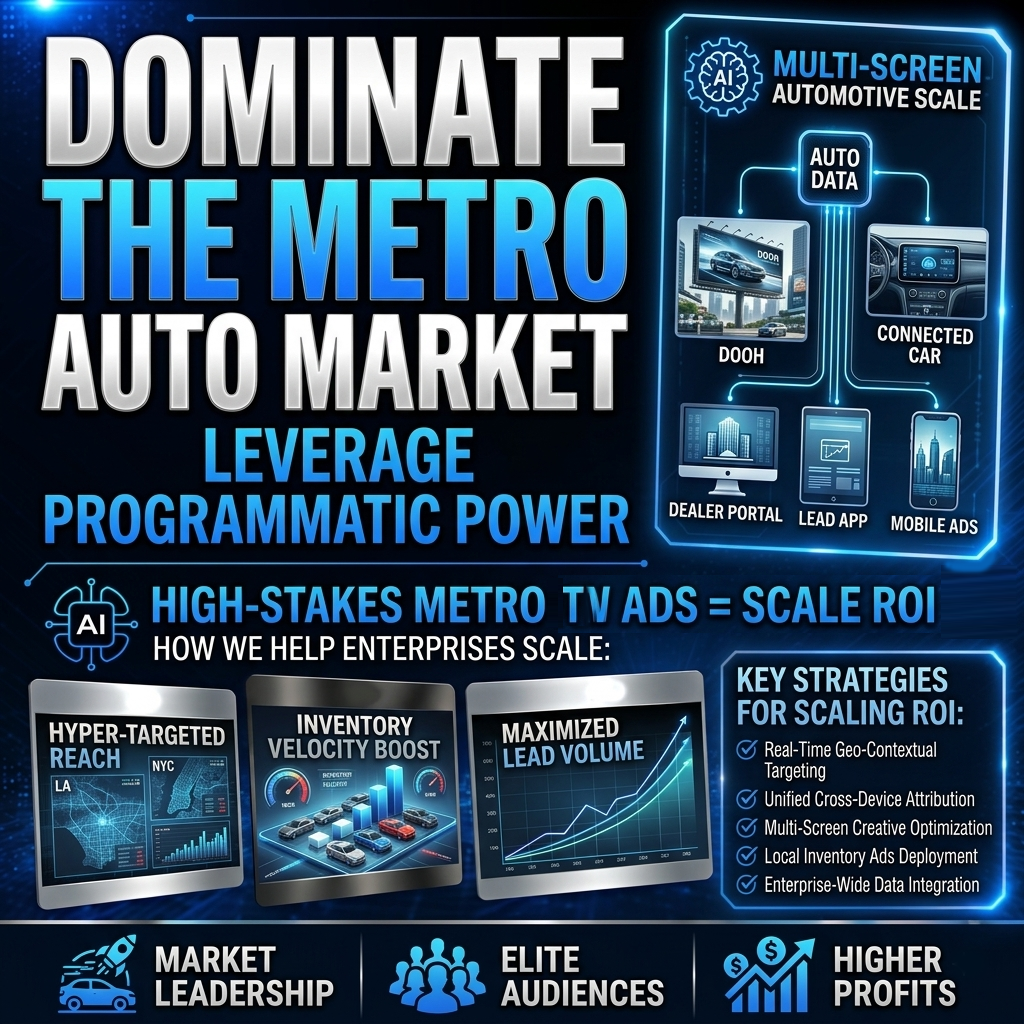
High acquisition costs, fast inventory turns, and squeezed margins have made old automotive marketing playbooks obsolete. Standard search and social campaigns rarely offer enough targeted coverage to move cars off urban lots quickly. To protect margins and keep sales steady, high-volume dealerships are expanding beyond Big Tech platforms into independent programmatic advertising.
Full Force Ads, a digital advertising agency based in Sandy, Utah, provides a programmatic ad system built for local dealers, marketing directors, and media agencies. By placing ads across open-web publishers and streaming networks instead of relying solely on Google or Meta feeds, the agency connects campaigns to hyper-local geofencing and household-level Connected TV (CTV).
This guide covers the core operational pressures facing city dealers—specifically pricing strategy and ad creative fatigue—and outlines how to build a multi-screen programmatic campaign.
Running a high-volume dealership in a major city comes with specific location and financial headaches. Suburban lots often sit surrounded by miles of residential neighborhoods, but urban dealers share tight markets where several stores selling the same brand sit just a short drive apart.
   [ Competitor Rooftop A ] <--- 3 Miles ---> [ Your Dealership ] <--- 4 Miles ---> [ Competitor Rooftop B ]
                              \                    |                    /
                               \                   |                   /
                                +----> [ In-Market Metro Buyer ] <----+
City traffic turns short distances into long commutes, so dealerships have to reach buyers well before they leave home. High land values and smaller lots also raise floor plan holding costs, making it critical to turn over specific vehicles—like aging trade-ins or higher-margin trims—within 30 to 45 days.
Factory incentives usually apply across an entire metro area, which forces nearby stores of the same brand to fight over the exact same local buyers. Meanwhile, heavy ad exposure across city markets leads to ad fatigue, making standard banners and repetitive social posts easy to ignore.
Car shoppers spend hours researching online before setting foot on a lot, comparing lease terms, interest rates, trade-in estimates, and regional discounts.
                          THE METRO BUYER DECISION PATHWAY
[ Search & Review Phase ]  --->  [ Price & Incentive Comparison ]  --->  [ Real-World Lot Visit ]
Contextual & Search Retargeting       Addressable CTV & Display           Building-Level Geofencing
Factory incentives change fast, which can leave static ads showing expired deals or incorrect rates. Cutting prices purely to win web clicks hurts profit margins and brings in bargain hunters who rarely generate long-term F&I revenue. Standard OEM templates also miss local details, such as regional tax rates or specific demand for all-wheel-drive models versus hybrids.
Targeted programmatic channels help dealers deliver distinct pricing offers to specific customer groups. High-income households receive ads for premium leases, while commuters see messages covering fuel efficiency, low down payments, or pre-owned options.

Standard banner templates with static stock photos and generic text rarely break through daily clutter.
                              OMNICHANNEL CREATIVE MIX

+------------------------+      +------------------------+      +------------------------+
|   CONNECTED TV (CTV)   |  +   |     DIGITAL AUDIO      |  +   |  HIGH-IMPACT DISPLAY   |
|  Sight, Sound, Motion  |      | Screen-Free Commutes   |      | In-App & Mobile Units  |
+------------------------+      +------------------------+      +------------------------+
Stock car clips paired with yellow clearance text do little to build long-term brand interest. When buyers move between smart TVs, commute podcasts, and mobile screens, disconnected ads lose their impact. Stock footage of a truck on a desert road also feels irrelevant to someone commuting through downtown traffic or tight parking garages.
Multi-screen messaging builds recognition across daily routines. A buyer sees a 30-second CTV ad on their living room TV, hears an audio spot about express delivery during their morning drive, and gets an interactive mobile ad with test-drive scheduling at lunch.
Search engines and social platforms play a role, but they function as closed environments with limited data access, middleman markups, restricted placements, and no way to track physical showroom visits. Independent programmatic media provides broader reach and clear offline tracking.
                      TRADITIONAL ADVERTISING VS. FULL FORCE ADS
Feature                    Traditional Walled Gardens      Full Force Ads Programmatic Engine
Management Model           Fragmented Multi-Vendor         All Channels, One Centralized Engine
Minimum Spend              High ($10,000+/mo Minimums)      Flexible Budgets, Zero Minimums
Contracts                  Rigid 6-12 Month Commitments    No Long-Term Contracts
Targeting Precision        Broad Zip Code/Radius           Building-Level Geofence Micro-Polygons
Attribution Metrics        Clicks & Impressions Only       Verified Showroom Foot-Traffic
Reporting Depth            Aggregated / Black Box          Transparent Weekly Domain-Level Data
Full Force Ads gives companies and agencies access to programmatic inventory without long-term contracts or high spending thresholds.
Through FullForceAds.app, advertisers manage multi-screen campaigns from one place, placing ads across open-web publishers and streaming networks without depending on Big Tech platforms.
Reaching active buyers requires a clear presence across their daily digital routines.
                              OMNICHANNEL MEDIA DISTRIBUTION
[ STREAMING TV ]      [ DIGITAL VIDEO ]      [ DIGITAL AUDIO ]      [ MOBILE & DISPLAY ]      [ NATIVE CONTENT ]
Roku, Fire TV,        Pre-Roll, Mid-Roll,    Spotify, Pandora,      In-App, Location-Based,   In-Feed Editorial,
Hulu, Peacock         Outstream Video        Podcasts, Radio        High-Impact Banners       Vehicle Comparisons
Targeting accuracy determines whether an ad reaches an active buyer or wastes money. Full Force Ads applies precise targeting overlays across every active channel.
                              PRECISION TARGETING MATRIX

+---------------------------------------+---------------------------------------+
|           GEOFENCING (POLYGON)        |        ADDRESSABLE HOUSEHOLD MAP      |
| Drawing custom micro-polygons around  | Matching CRM lists & street addresses |
| competitor lots & service centers.    | to household smart TVs & devices.     |
+---------------------------------------+---------------------------------------+
|          SEARCH RETARGETING           |         CONTEXTUAL INTELLIGENCE       |
| Reaching users actively searching for | Placing ads next to automotive        |
| specific make, model & trim keywords. | reviews, news, & financial guides.    |
+---------------------------------------+---------------------------------------+
Standard radius geofencing wastes budget on nearby roads, houses, and unrelated businesses. Micro-polygon targeting maps exact property lines instead.
RADIAL GEOFENCING (INACCURATE)            BUILDING-LEVEL MICRO-POLYGON (PRECISION)
+---------------------------------+       +---------------------------------+
|  [Residential]   [Highway]      |       |  [Residential]   [Highway]      |
|         \           /           |       |                                 |
|       +---------------+         |       |       +---------------+         |
|       |  COMPETITOR   |         |       |       |  COMPETITOR   |         |
|       |   DEALERSHIP  |         |       |       |   DEALERSHIP  | <--- Exact Boundary
|       +---------------+         |       |       +---------------+          Only
|         /           \           |       |                                 |
|  [Gas Station]   [Diner]        |       |  [Gas Station]   [Diner]        |
+---------------------------------+       +---------------------------------+
(Wastes ad spend on non-shoppers)         (Captures only actual lot visitors)
Custom polygons outline rival showrooms, independent service shops, and regional auto shows. When target shoppers enter those spaces with a smartphone, the system logs their device ID to deliver follow-up ads. Setting a secondary polygon over your own lot tracks when exposed users walk into your showroom, connecting digital ads to physical foot traffic.
Addressable targeting maps customer lists, lease-end files, or target street addresses straight to household IP addresses and connected devices. Uploading CRM lists lets dealers serve CTV and mobile ads directly to qualified households without wasting spend outside the target area.
Site retargeting re-engages visitors who viewed specific VDPs without filling out a lead form, showing them updated lease options for that model. Search retargeting delivers ads to people who searched for terms like "best luxury electric SUV deals" or "current truck incentives," reaching shoppers early in their research process.
Contextual tools scan page text, headlines, and articles in real time to place display and native ads alongside relevant car reviews, safety ratings, or financing guides without using third-party tracking cookies.
Campaign configurations depend on core business goals. The table below pairs common dealership targets with appropriate channels and targeting methods.
| Dealership Strategic Goal | Recommended Channel Mix | Targeting Tactics Applied |
| Drive Immediate Showroom Traffic | Geofencing + Mobile + Display | Building-Level Polygons + Conversion Zones |
| Conquest Regional Competitors | Geofencing + Addressable + CTV | Micro-Mapped Competitor Lots + Lease Lists |
| Establish Metro Brand Leadership | Streaming TV + Video + Audio | Income Demographics + In-Market Automotive Data |
| Increase VDP Traffic & Leads | Display + Native + Search Retargeting | Keyword Intent + Contextual Auto Articles |
| Recover Unconverted Web Visitors | Site Retargeting + Display + Video | Recency Rules (Visited within 24–72 hours) |
| Mining Lease-End CRM Lists | Addressable + Streaming TV + Display | Household Physical Address Matching |
Full Force Ads provides the practical setup required to run programmatic media without unnecessary overhead.
                         THE FULL FORCE ADS CAMPAIGN CYCLE

 [ Step 1: Discovery ]  --->  [ Step 2: Custom Strategy ]  --->  [ Step 3: Fast Launch ]  --->  [ Step 4: Optimization ]
 Aligning business goals,     Building channel mix &              Live across screens in        Weekly reporting & real-time
 audiences & target markets   precision targeting plans           5 to 7 business days          domain-level adjustments
The agency brings multi-channel media under one workflow, eliminating the need to manage different vendors for CTV, mobile, audio, display, native, and video. Campaigns use precise building boundaries to target real shoppers, while conversion zones verify physical showroom visits.
There are no long-term contracts or mandatory $10,000 monthly spend minimums, so budgets can scale up or down based on inventory levels and market conditions. Weekly reports show domain-level ad placements, video completion rates, click metrics, and verified foot traffic. Campaigns launch within 5 to 7 business days, letting dealers respond quickly to new sales incentives.
In crowded city markets where buyer attention shifts quickly, relying on standard single-channel plans often leads to flat sales. Automotive dealerships can protect margins, move inventory faster, and win local market share by moving to an omnichannel programmatic strategy.
Combining micro-polygon geofencing, addressable household targeting, and Streaming TV builds a connected campaign that turns online researchers into active showroom visitors.
For internal marketing teams and agency leaders expanding their digital capabilities, Full Force Ads offers the technology, targeting precision, and execution needed to succeed.
To discuss your digital campaign, set up a call with Full Force Ads.