Consumer attention is scattered across more screens than at any point before, and that changes what advertising has to do. A single billboard, one radio spot, or a lone search campaign used to be enough to carry a company's revenue goals. Not anymore. The same person streams a show on Hulu before work, catches a podcast on Spotify during the commute, checks news on their phone at lunch, and scrolls social media before bed.
That fragmentation is a real problem for growing businesses. Run ads on one channel, or juggle five vendors that don't share data with each other, and you lose money on wasted impressions, miss the customers who were never on that one channel, and hand market share to competitors who show up everywhere.
The fix is an omni-channel programmatic approach: reaching people across every screen with precise targeting, one unified report, and a budget that can move fast. For most businesses, that means partnering with an agency built for exactly this.
This piece looks at how digital advertising works channel by channel, walks through a regional example (Minnesota, and why static ads fail there), and explains how Full Force Ads, a digital advertising agency based in Sandy, Utah, runs all of it under one roof.
Minnesota is a good example of why one-size-fits-all advertising doesn't work. The state runs from the tech corridors of Minneapolis and St. Paul to manufacturing and farm country in Greater Minnesota, and its weather swings are extreme enough to reshape how people shop.
In winter, people stay inside. Retail foot traffic drops and screen time goes up. In summer, the opposite happens: people head to the cabin, hit outdoor festivals, and spend most of their time away from a desk.
That makes static advertising a liability. An HVAC company running the same ad in January, when a broken furnace is an emergency, and June, when people are shopping for AC installs, is wasting half its budget. A medical device manufacturer in the Twin Cities selling to procurement managers has an even narrower target, and a generic consumer ad won't reach them at all.
How the channel mix shifts by season:
A Duluth auto dealer trying to outsell the dealership across town and a Minneapolis law firm chasing high-intent local searches need different channels, different targeting, and the ability to adjust as the seasons change.
The biggest friction point for marketing directors is vendor fatigue. Run a Hulu campaign through one platform, display through another, and geofencing through a third vendor, and you end up with a black box: multiple markups, PDF reports that don't match up, and no way to track a single user across devices.
Consolidating vendors tends to make both reporting and results better.
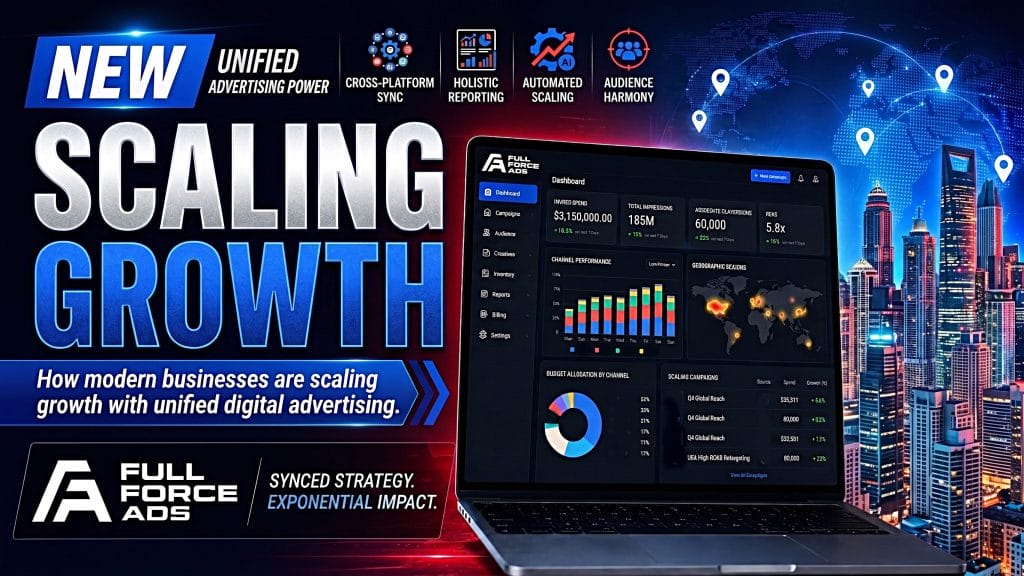
Full Force Ads runs all of it under one roof: planning, execution, and optimization across every channel from a single platform. That means the story stays consistent. If someone sees your CTV ad on their television, Full Force Ads can retarget that same person with a display ad on their phone the next day, instead of starting from scratch on a different platform with different data.
You can't wait for customers to find you. You have to show up where they already are. Full Force Ads runs campaigns across the following channels, all with unified targeting and reporting.
1. Streaming TV (CTV/OTT) Connected TV (CTV) and over-the-top (OTT) ads put your commercial on Roku, Amazon Fire TV, Hulu, Peacock, and similar platforms, without the cost of a broad linear TV buy. Because it runs over the internet, you can target by zip code, household income, and behavioral interest, and the ads themselves are hard to skip. You get a TV commercial's impact with digital-level tracking behind it.
2. Video Advertising Video ads combine sight, sound, and motion, which is why they tend to hold attention better than static formats. This includes pre-roll (the ad before a YouTube video), mid-roll (inserted into longer content), and outstream (video that plays natively as someone scrolls through an article). You get 15 to 30 seconds to make the case for your product, so the format rewards a tight, specific pitch over a vague one.
3. Audio Advertising Not every moment is a screen moment. Driving, working out, cooking: audio ads reach people on Spotify, Pandora, podcasts, and digital radio during all of that. Because most listening happens with headphones in, an ad can feel closer to a recommendation than an interruption, which makes it a solid format for both brand awareness and direct response through a vanity URL or promo code.
4. Mobile Advertising The phone goes everywhere the customer goes. Mobile advertising covers in-app ads (banners inside a game or weather app), mobile web ads, and location-based targeting. Because a phone is tied to a physical location, mobile ads tend to drive faster action, and tap-to-call, tap-to-map, and tap-to-download buttons cut most of the steps between seeing the ad and converting.
5. Display Advertising Display ads, the banner ads on websites and apps, are still the cheapest way to reach a lot of people. A single banner rarely gets an immediate click, but display is the main channel for retargeting: the ad that keeps showing up after someone abandons a cart, reminding them to come back.
6. Native Advertising Most people have learned to tune out banner ads. Native ads work around that by matching the look and format of the content around them, so they read more like an article than an interruption. That's usually why they get better engagement than standard display.
Channels decide where an ad shows up. Targeting decides who sees it, and a great video means nothing if it's shown to the wrong audience. Full Force Ads layers the following targeting strategies onto any channel.
Geofencing (building-level precision) Geofencing targets people based on the real-world locations they visit. Instead of a blanket 10-mile radius, Full Force Ads can fence a single building. Say you run a sporting goods store: draw a fence around your biggest competitor's storefront, and when a shopper walks in, their device ID gets captured. For the next 30 days, you can serve that person ads across their apps and desktop, offering a 20 percent discount to switch. The same approach works on trade shows, concert venues, specific neighborhoods, or hospital campuses.
Addressable targeting Direct mail is expensive and impossible to track. Addressable targeting does the same job digitally: upload a CRM list of home addresses, whether that's past customers or a purchased list of high-income households, and the system matches those addresses to the IPs and devices inside each home. From there, you can serve CTV, display, and video ads to that exact household across every device tied to it.
Site retargeting On average, 97 percent of website visitors leave without buying or filling out a form. Site retargeting is built for that group. A pixel on your site tracks who bounced, and as they keep browsing elsewhere, reading news, checking scores, your ad follows them and pulls them back to finish converting.
Search retargeting Search retargeting targets people based on what they recently searched. If someone in your city searches "best personal injury lawyer near me" and doesn't click your site, you can still reach them: serve display and video ads as they browse other sites later that day. The audience is narrow, but everyone in it was actively looking for what you sell.
Contextual targeting Contextual targeting places your ad next to relevant content. Sell hiking gear, and your ads can show up on articles and videos about national parks, trail reviews, and camping tips, reaching people while they're already thinking about the outdoors.
Most successful campaigns use more than one channel. Here are the combinations Full Force Ads sees working most often, broken out by goal:
Goal: Local awareness and foot traffic Channels: Geofencing + Display + Mobile Strategy: Cover the immediate area around your store. Capture mobile IDs of people near your storefront or nearby hubs, then serve them frequent display banners to build local recognition.
Goal: Conquesting competitors Channels: Geofencing + Addressable Strategy: Geofence your competitor's building, then follow up by targeting the home addresses of their known customers with a better offer.
Goal: Brand building and prestige Channels: Streaming TV + Video + Audio Strategy: Run CTV commercials on Hulu targeted to local zip codes, backed by Spotify audio ads, to build broad presence without a national TV budget.
Goal: Website traffic and lead generation Channels: Display + Native + Search Retargeting Strategy: Find people searching your industry's keywords, serve native ads that read like helpful articles, and route that intent to your landing pages.
Goal: Retargeting past visitors Channels: Site Retargeting + Display + Video Strategy: If someone visited your pricing page and didn't buy, follow up with a video testimonial to close the gap.
Goal: Reach an existing customer list Channels: Addressable + Streaming TV + Display Strategy: Upload your CRM of past buyers and put your new product line in front of them on their TVs and laptops.
Digital advertising has a reputation for inflated promises, hidden fees, and jargon that's hard to parse. Full Force Ads was founded in 2015 to work differently: enterprise-grade programmatic technology without the enterprise price tag.
Onboarding runs in four steps.
Billboard-and-hope advertising doesn't compete with this anymore. Competitors are geofencing storefronts, retargeting website visitors, and running video ads in the living rooms of the exact customers you want.
Whether you're advertising through a Minnesota winter or scaling a national brand from Utah, that takes an approach that can move fast, report clearly, and cover every channel your customers actually use. Full Force Ads builds and runs that for you, or hands you the controls through FulForceAds.app if you'd rather run it yourself.
If you want to talk through which channels and targeting make sense for your business, schedule a discovery call. There's no pressure and no minimum commitment to start the conversation.