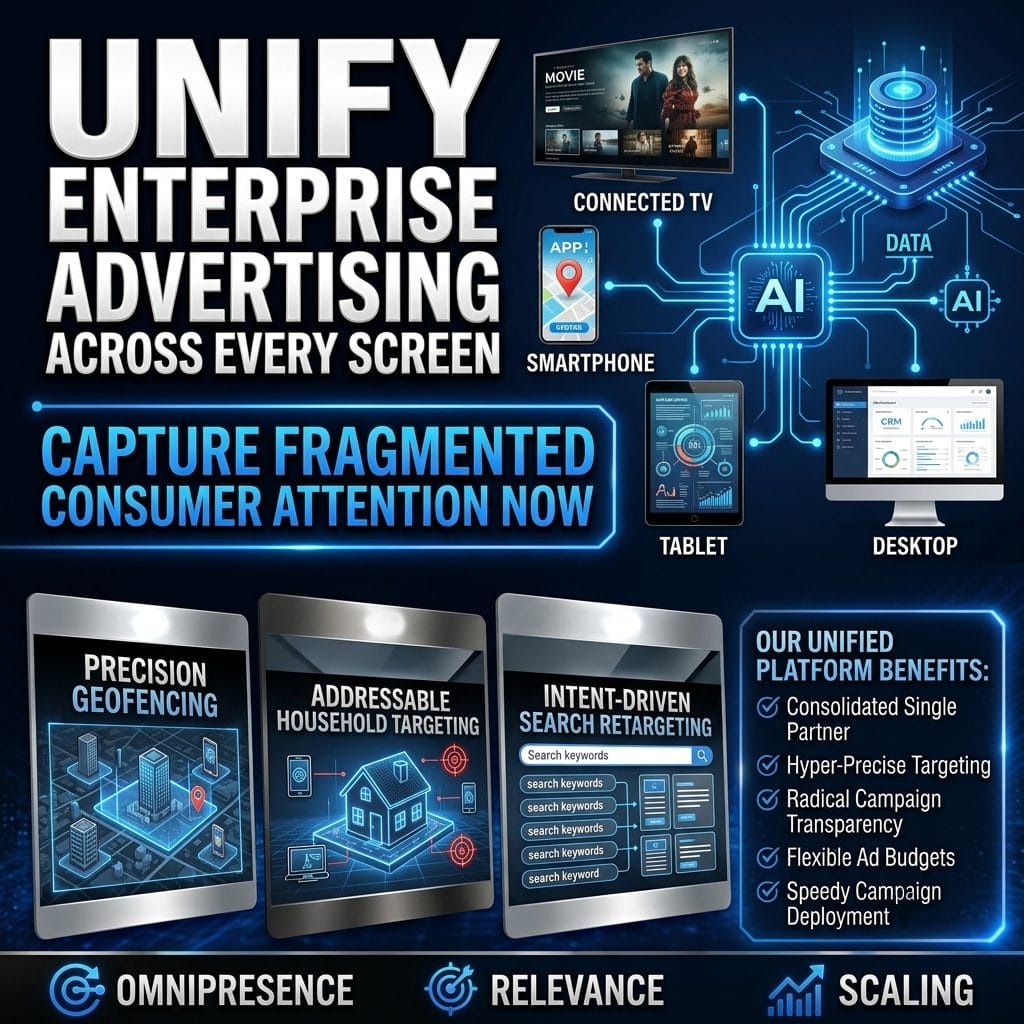
Every morning, the modern consumer wakes up to a hyper-fragmented digital reality. Before their feet even hit the floor, they check a notification on their smartphone. While pouring their first cup of coffee, they stream a podcast on Spotify. During their morning commute or a midday break, they scroll through editorial sites, seeing native content blended into their daily news feed. In the evening, they unwind by browsing a curated dashboard on Hulu, Roku, or Amazon Fire TV.
For the modern business owner, marketing executive, or growth director, this market is both an opportunity and a logistical headache. The consumer is everywhere, yet nowhere long enough to be captured by singular, legacy marketing methodologies.
The era of relying on a single dominant channel, whether that's a standard search campaign, a localized billboard, or a heavily siloed social media budget, is officially over. To survive and dominate in today's marketplace, enterprises must employ a unified, multi-screen, and highly precise strategy.
This thorough guide breaks down the mechanics and frameworks required to build a strong digital presence, specifically utilizing the enterprise-grade ecosystem provided by Full Force Ads, a digital advertising agency in Sandy, Utah. By unifying streaming TV, digital video, programmatic audio, advanced mobile targeting, and tactical retargeting frameworks into a singular engine, businesses can shift from chasing impressions to engineering predictable customer acquisitions.
Most businesses fail to realize that their prospective customers do not live within a single marketing funnel. A consumer does not neatly step from an awareness ad to a consideration page, and finally to a checkout cart in a predictable, linear path. Instead, they operate within a chaotic web of digital touchpoints.
The psychological challenge of 21st-century marketing isn't just generating an impression, it's overcoming ad blindness and cognitive fatigue. The average American is exposed to thousands of commercial messages per day. To protect itself from information overload, the human brain filters out generic, ill-timed banners and uninvited pop-ups.
To bypass this mental firewall, advertising has to achieve two things at once: omnipresence without intrusion, meaning it appears naturally across multiple devices so the brand becomes a familiar part of the consumer's environment, and contextual and behavioral relevance, meaning the message aligns precisely with what the consumer is doing, thinking, or experiencing at that exact moment.
When a brand appears on the living room television via a Connected TV (CTV) spot, reinforces that message via an audio ad during a lunchtime podcast, and follows up with an interactive mobile display ad when the user is near a physical point of purchase, the consumer begins to perceive the brand as a market leader. This happens because the brand has organically integrated into their multi-screen lifestyle.
Businesses that use advanced programmatic architectures can orchestrate this entire journey from a single command center. This eliminates the friction of managing disparate vendors, reporting dashboards, and competing agency partners, ensuring a cohesive brand narrative from top-of-funnel discovery to bottom-of-funnel conversion.
To build a high-performing digital apparatus, leadership teams must understand the unique mechanics and advantages of individual digital media channels. Long-term brand equity is built by matching the right creative format to the appropriate consumer mindset.
Through a full suite of tools, organizations can deploy a highly tailored architecture across six distinct digital channels.
The television remains an authoritative screen in the American household. However, the mechanism of delivery has fundamentally changed. Linear broadcast and cable television are declining, replaced by ad-supported streaming ecosystems including Roku, Amazon Fire TV, Hulu, Pluto TV, and premium network applications.
Connected TV (CTV) combines the emotional punch and unskippable nature of traditional television commercials with the hyper-precise, data-driven targeting capabilities of digital advertising.
The persuasion factor: when your brand appears on an unskippable 30-second spot on a 65-inch living room television, your business instantly inherits institutional authority. You're recognized as a serious operator playing in the major leagues.
Targeting precision: unlike old-school cable buyouts based on broad, wasteful geographic zip codes or generic age demographics, CTV allows brands to target specific households based on purchase intent, income brackets, lifestyle attributes, and real-world behavioral patterns.
Outside of the living room, consumers watch billions of hours of short- and long-form video content on their laptops, tablets, and smartphones. Digital video solutions use pre-roll (ads running before the content), mid-roll (ads running during the content), and outstream configurations (video ads that expand within premium editorial text) to capture active attention.
The persuasion factor: video captures human attention far more effectively than static text or imagery because it uses sight, sound, and motion. It allows brands to tell complex stories, demonstrate physical products, showcase customer testimonials, and evoke immediate responses within a 15-to-30-second window.
One of the most valuable, yet frequently underutilized, spaces in digital media is the screen-free moment. When consumers are driving, working out at the gym, cooking dinner, or focusing at their desks, their eyes are off the screen, but their ears are completely engaged. Programmatic audio drops targeted commercials into premium environments like Spotify, Pandora, digital radio, and top-tier global podcasts.
The persuasion factor: audio is an incredibly intimate medium. Consumers often listen to podcasts or curated music playlists through headphones, creating a one-on-one auditory environment. Delivering a clear, engaging audio message during these personal moments builds deep brand resonance that cuts straight through the visual noise of the internet.
The smartphone accompanies the consumer to every meeting, every store visit, and every travel destination. Mobile-first campaigns use in-app inventory, optimized mobile web placements, and precise, coordinate-based location technology to target consumers precisely where they spend the majority of their digital lives.
The persuasion factor: mobile advertising allows for real-time contextual updates. Because smartphones have GPS locators, campaigns can be designed to trigger compelling creative assets based exactly on where a consumer stands or travels in the physical world, creating an immediate bridge between digital awareness and brick-and-mortar action.
Standard and rich-media banner ads served across millions of verified global websites and mobile apps form the foundation of scaled digital reach. While often viewed as a purely top-of-funnel volume play, display advertising functions as an essential, cost-effective pillar of long-term brand reinforcement and thorough retargeting.
The persuasion factor: display ads keep your brand front of mind at a low Cost Per Mille (CPM). By maintaining persistent, clean visual touchpoints as a user browses business journals, news sites, and lifestyle blogs, display advertising ensures that when the consumer is finally ready to make a purchasing decision, your name is the default option that comes to mind.
Native advertising matches the exact typography, structure, look, and feel of the editorial environment in which it lives. Rather than shouting for attention like a traditional banner, these units present themselves as recommended reading or sponsored content directly inside premium feeds.
The persuasion factor: native advertising enjoys notably higher click-through rates and deep consumer engagement because it doesn't disrupt the user experience. By presenting high-value educational content, industry insights, or compelling case studies in a format that looks like a natural article, you position your firm as an authoritative resource rather than an aggressive salesperson.
Many businesses waste thousands of dollars buying broad digital impressions, bragging about vanity metrics like reach while wondering why their bottom-line revenue remains stagnant. In modern programmatic media buying, the channel is simply the pipe through which the message travels. The real magic lies in the targeting layer.
If you serve a beautifully produced, emotionally compelling video ad to someone who has zero statistical probability of needing your enterprise software, medical services, or high-end retail products, you have effectively incinerated capital. To drive true ROI, organizations must deploy precise targeting solutions that isolate high-intent buyers.
To prevent budget waste, businesses can use five targeting methodologies that can be layered across every single channel mentioned above:
| Targeting layer | Core mechanism | Primary objective |
|---|---|---|
| Location-based geofencing | Virtual perimeters around physical spaces via coordinates | Intercepting competitors' foot traffic and event attendees |
| Addressable targeting | Mapping physical property plots to digital device IDs | Direct CRM or postal list matching with zero waste |
| Site retargeting | Following first-party anonymous website visitors | Recapturing abandoned traffic and moving them to conversion |
| Search retargeting | Intent data mapping based on external search queries | Capturing search intent without the high cost of standard search ads |
| Contextual targeting | Real-time page analysis (text, keywords, metadata) | Aligning ads with the editorial topic the user is reading |
Geofencing allows businesses to draw precise, custom virtual boundaries around physical locations in the real world using exact latitude and longitude coordinates. When a consumer steps inside that boundary with a mobile device, their unique device ID is captured, allowing you to serve targeted ads to them during their visit and for up to 30 days afterward across all their screens.
The strategic play: this is a powerful competitive conquest tool. A commercial B2B supplier can geofence a massive industry trade show or convention center. A luxury automotive dealership can geofence competing dealerships down the street. A specialized medical clinic can geofence complementary health practices. It allows you to intercept high-value prospects based entirely on their real-world physical behavior.
Many corporations possess rich internal data sitting completely idle in a CRM or an offline mailing list of high-value prospects. Addressable targeting takes a list of physical street addresses, maps them against precise property plots, and identifies every single digital device linked to that specific household or commercial building (smart TVs, laptops, tablets, smartphones).
The strategic play: addressable targeting bridges the gap between old-school offline direct mail and digital omnipresence. Instead of sending an expensive postcard that gets thrown directly into the recycling bin, you can systematically serve unskippable Streaming TV ads and native content to the exact executives, decision-makers, or wealthy homeowners on your target account list without wasting a single dime on audiences outside those walls.
The harsh reality of digital commerce is that roughly 95% to 98% of initial website traffic leaves without filling out a form, placing a call, or making a purchase. They get distracted by a text message, close the tab, or simply want to think it over. Site retargeting ensures that these warm prospects are not lost forever.
The strategic play: as these lost visitors travel across the internet, your brand systematically follows them. By serving tailored display banners, native reviews, or subtle testimonial videos across premium sites, you gently pull them back into your acquisition funnel, keeping your company front of mind throughout their evaluation period.
Search engines are incredibly powerful because they capture explicit consumer intent at the exact moment it occurs. However, buying high-intent keywords inside traditional engines can be prohibitively expensive, often turning into an unsustainable bidding war. Search retargeting offers an elegant, highly efficient alternative.
The strategic play: this framework isolates individuals who have recently typed specific, high-intent keywords into search engines. Instead of bidding on the search results page itself, you capture that data and serve highly engaging display, video, or audio ads to those exact users as they continue their journey across the broader web. You gain the benefits of intent-based marketing at a fraction of the traditional search cost.
Contextual targeting completely bypasses reliance on personal user profiles and cookies by focusing entirely on the environment where the ad is placed. This system algorithmically scans the text, metadata, images, and videos of millions of web pages to ensure your ad only appears next to highly relevant content.
The strategic play: if your firm sells premium wealth management services, contextual targeting ensures your video or display assets appear directly inside articles discussing estate planning, tax strategies, or market analysis on major financial journals. Because the user is already in a business-focused frame of mind, your ad feels like an organic extension of their current research, significantly boosting brand credibility.
A common pitfall in digital media execution is the structural misalignment between a company's business goals and their chosen ad channels. There is no such thing as a bad programmatic channel, only poorly chosen channel mixes.
To help corporate leadership teams visualize exactly how to structure their marketing investments, the team at Full Force Ads has compiled a tactical deployment matrix mapping clear business objectives to optimized channel and targeting combinations.
For local and regional awareness, the recommended channel mix is geofencing, display, and mobile, targeted around physical footprints and localized demographics. The expected outcome is dominating local market share and capturing immediate foot traffic from key geographic zones.
For competitive conquest, the recommended mix is geofencing plus addressable targeting, aimed at competitor retail locations and target account lists. The expected outcome is intercepting active prospects directly from your competitors' territories and historical databases.
For enterprise brand building, the recommended mix is Streaming TV, video, and audio, using behavioral modeling and lifestyle targeting. The expected outcome is establishing undeniable marketplace authority, building long-term brand equity, and commanding premium pricing.
For high-volume website traffic, the recommended mix is display, native, and search retargeting, built around intent-based keywords and contextual article matching. The expected outcome is a steady stream of highly qualified, in-market prospects reaching your landing pages and digital funnels.
For recapturing lost prospects, the recommended mix is site retargeting, display, and video, driven by first-party website pixel tracking. The expected outcome is minimizing abandonment rates and maximizing the long-term conversion value of your existing traffic.
For precision database activation, the recommended mix is addressable targeting, Streaming TV, and display, built on B2B/B2C CRM list uploads and matched household profiles. The expected outcome is reactivating stale leads, cross-selling current clients, and reinforcing direct sales outreach at the household level.
One of the most specialized applications of programmatic media buying lies in the event, trade show, and conference arena. For organizations investing substantial resources into hosting large-scale corporate conferences, music festivals, industry trade shows, or community gatherings, filling seats and maximizing ticket sales is a critical operational imperative.
Conversely, for B2B enterprises looking to capitalize on massive industry events without paying astronomical fees for an official corporate sponsorship or an exhibition booth, programmatic systems offer a lucrative workaround.
To successfully maximize event-based ROI, organizations must look beyond the days the event takes place. Programmatic systems allow for a thorough, three-phase event marketing framework.
In the pre-event phase, using lookalike modeling, historic attendee database uploads via addressable targeting, and search retargeting on industry keywords, organizations can target prospective attendees with compelling Streaming TV and native ads to drive early bird registrations and ticket sales.
During the live event, precision geofencing can be deployed over the convention center, hotels, and surrounding entertainment districts. As attendees interact with their mobile devices, browse local apps, or stream content in their hotel rooms, they are consistently met with your brand's messaging. You can use this to drive booth traffic, support breakout sessions, or, if you are a competitor, intercept attendees with your own value proposition.
Once the event concludes, the captured device IDs remain accessible within your custom programmatic audience pool. For the next 30 days, your sales and marketing teams can deliver high-impact follow-up display banners, case studies, and testimonial videos to those exact attendees as they return home across the country, transforming a brief real-world interaction into a long-term, closed-won contract.
The digital market is crowded with agencies making big promises backed by opaque metrics. Many firms lock clients into restrictive, long-term legal agreements, bundle their media buys into ambiguous black boxes, and provide confusing monthly reports that mask a lack of true performance.
Full Force Ads was founded to completely shatter that legacy model. Based in Utah and serving growth-minded brands across the United States, Full Force Ads operates as a true extension of your internal marketing team, built on a foundation of absolute transparency, speed, and agility.
Full Force Ads gives you all channels through one consolidated partner. You no longer need to manage a separate agency for your television buying, another vendor for your podcast ads, and a fragmented internal team handling web banners. Full Force Ads lets you plan, execute, manage, and optimize your entire digital footprint across every single screen and medium from a unified programmatic command center.
Targeting is built for performance, not vanity. Full Force Ads doesn't focus on empty impressions. By integrating state-of-the-art geofencing, addressable household matching, search retargeting, and rich behavioral layers into every single deployment, the agency ensures your ad spend is directed exclusively at individuals who move the financial needle for your firm.
Reporting is radically, uncompromisingly transparent. Say goodbye to monthly black box summaries. Full Force Ads provides transparent, highly detailed reporting workflows, so you'll see precisely where your digital ads ran, exactly who saw them, which devices they interacted with, and the exact behavioral outcomes generated by the investment.
Budget flexibility is engineered for growth. Full Force Ads believes in earning your business every single day, so it doesn't force clients into massive minimum capital commitments or predatory, multi-year contracts. You start at a financial investment level where your executive team is entirely comfortable, then scale up dynamically based on real-world, verified performance.
Deployment happens at speed. In modern business, speed is a definitive competitive advantage. Waiting weeks for a legacy agency to launch a campaign can cause you to completely miss critical market windows. The engineering workflows at Full Force Ads allow most enterprise campaigns to go live in days, not weeks.
Taking the leap into thorough, omnichannel programmatic advertising doesn't have to be a daunting, high-stress endeavor. Full Force Ads uses a highly structured, frictionless four-step deployment process designed to respect your executive team's time while maximizing initial campaign velocity.
Step 1: The initial discovery strategy session. The process begins with a simple, high-value conversation. Full Force Ads sits down with your leadership team to gain a good grasp of your unique corporate model, target client profiles, geographic footprint, historical marketing friction, and core growth objectives. There are no high-pressure sales tactics, just an open, data-driven brainstorming session between peer professionals.
Step 2: The custom strategic recommendation plan. Following the discovery session, the media planning team builds a customized omnichannel recommendations deck tailored specifically to your goals, outlining the exact channel mix, the optimal targeting layers, geographic boundaries, and clear budget allocations mapped directly to your key performance indicators (KPIs).
Step 3: Absolute campaign launch velocity. Once your team approves the strategic plan, the operational staff takes over the heavy lifting: ingesting your creative assets, executing the technical tracking setups, establishing geofences, uploading target address databases, and pushing your campaign live across the premium programmatic web. Thanks to the efficient workflows, most campaigns are fully active and delivering impressions within 5 to 7 business days.
Step 4: Continuous algorithmic optimization and clear reporting. A digital campaign is a living, breathing financial apparatus. Once launched, the optimization team constantly monitors performance metrics, shifting capital away from lower-performing publisher sites and reallocating it to high-performing placements, tweaking creative rotations, refining geofence parameters, and providing your team with transparent reports. You'll always know exactly how your capital is working for you.
In a world where consumer attention is fragmented across an array of smart devices, applications, streaming platforms, and websites, the worst strategic move a business can make is to remain stagnant inside a single marketing silo.
To win your market, establish permanent brand equity, and out-maneuver your competition, you must deploy an omnichannel framework that ensures your brand is seen on the biggest screens, heard in the quietest moments, and felt exactly when a customer is ready to buy.
You don't have to navigate this tricky technological shift alone. Partnering with a dedicated team of programmatic experts lets your business instantly inherit enterprise-grade capabilities without the overhead of complex internal tech stacks.
Are you ready to stop burning budget on unverified impressions and start dominating every single screen your audience interacts with?
Take the first definitive step toward programmatic maturity today. Visit Full Force Ads to review its full capabilities, analyze deep channel case studies, and schedule a discovery call with the veteran strategic team. Let's build a dominant, future-proof advertising apparatus that drives predictable growth for your business.