How omnichannel programmatic advertising actually reaches your buyers
People don't sit still anymore. Someone might watch a streaming show over breakfast, catch a podcast on the drive in, read a dozen articles at work, then scroll apps all evening across two or three devices. Their attention is spread thin, and it moves all day.
For a business trying to grow, that's both good news and bad news. You can reach buyers in more places than ever. Running one clean, profitable campaign across all those places is the hard part, and the old marketing playbook wasn't built for it.
Most companies try to patch it together. They hire five single-channel vendors or juggle a few self-serve dashboards. It usually ends the same way: budget spent twice, messaging that doesn't match from one channel to the next, no idea which channel drove the sale, and money burned on impressions nobody validated.
The fix is to stop buying channel by channel and run one programmatic omnichannel plan instead. Put your brand on the screens your buyers already use, match the message to the moment, and let a single system handle the targeting.
Old-school advertising ran on rating points, broad demographics, and separate buys. You'd get radio from one network, banners from a local site, a billboard from an outdoor company, and social ads from another dashboard. Every piece lived on its own.
That setup breaks down in a few predictable ways.
Your audience gets hammered. With no shared frequency cap, one person might see your banner 30 times in a day and never once see your video. Worse, two of your own platforms can bid against each other for the same viewer and push your CPM up.
Nobody can tell you what worked. When each vendor tracks only its own slice, they all take full credit. A buyer hears your audio ad, clicks a native article, then searches your brand and buys. Three vendors report that one sale as theirs, and your real ROAS disappears.
Everything moves slowly. Separate contracts, dashboards, creative specs, and account reps eat up your team's time. Want to shift strategy mid-campaign? Now it's a project.
The way out is a single partner running the whole media buy from one place. That's what Full Force Ads was built to do.
To reach people, you have to show up on the screens they actually use. Programmatic bidding lets you buy those ad slots in real time.
Cable is fading, and connected TV and over-the-top streaming have taken its place. Streaming TV gives you the reach and polish of a TV commercial without the waste of traditional broadcast.
On Roku, Amazon Fire TV, Hulu, and smart-TV apps, your 15- or 30-second spot plays full screen, with sound, and can't be skipped. Because it's programmatic, it only runs in households that match your ideal customer, so you're not paying to reach people who will never buy.
Video eats up more internet bandwidth and attention than anything else. Video ads catch people mid-browse across news sites, niche publications, and apps.
You've got a few formats to work with. Pre-roll runs before a video, mid-roll sits inside longer content, and outstream video auto-plays inside articles. Sight, sound, and motion stick in memory better than a static banner, which makes video a strong pick for buyers still weighing their options and for building recognition up top.
Screens aren't the whole day. People spend hours listening to music, news, and podcasts while they drive, work out, or do chores, with nothing to look at.
Audio ads reach them in those moments. On Spotify, Pandora, digital radio, and podcast networks, you get someone's attention with nothing else competing for it. A good voice and some sound design go a long way here.
The phone barely leaves anyone's hand. Mobile campaigns meet people inside the apps, games, and mobile sites they check dozens of times a day.
You're not stuck with plain banners, either. Mobile ads can use location triggers and device features to drive an immediate action: pull up directions, place a call, or tap through to your site.
Display is still the workhorse for staying visible and for retargeting. Banners run across millions of sites and apps and give you cheap reach at scale.
Static banners keep your name familiar. Dynamic ones go further, adjusting the creative to what someone just looked at, where they are, or how close they are to buying. That usually brings the cost per acquisition down.
People have learned to tune out banners. Native ads get around that by matching the look and layout of whatever they sit next to.
Slotted into news feeds, content-recommendation widgets, and article streams, they read like a suggested story rather than an ad. That fit tends to earn a higher click-through rate and a little trust up front.
Channels decide where your ads show up. Targeting decides who sees them. Blasting "men aged 25 to 54" wastes money. Programmatic lets you stack behavior, location, and intent data on top of your channel plan.
Geofencing goes past zip codes and radius targeting. It draws a custom boundary around a real place, down to the property line.
You can target people who show up at:
When a phone crosses into that boundary, its mobile ad ID gets captured anonymously. From there you can serve that person ads across their devices while they're there and for up to 30 days after they leave.
Addressable targeting connects a physical address list to digital screens. Upload a list of street addresses, and matching software maps those homes to their IP addresses and connected devices.
Then you can run video, display, and streaming TV ads straight to the households on your list. No budget wasted on homes that were never a fit, which is why it pairs so well with a direct sales team or a direct mail drop.
Fewer than 3% of first-time visitors buy on that first visit. The other 97% leave without calling, filling out a form, or ordering anything.
Site retargeting follows those people as they keep browsing. Instead of a generic brand ad, it shows them ads tied to the exact pages they looked at. Someone who spent three minutes reading about one service keeps seeing ads about that service until they come back.
Search ads catch intent, but bidding on the best keywords gets expensive fast. Search retargeting is the cheaper route.
It targets people based on what they've recently searched across the web, before they ever land on your site. You catch them while they're actively researching and pull them in through display, video, and streaming TV, which cost less than the top search spots.
With cookies going away and privacy rules tightening, contextual targeting has become a staple. Instead of tracking a person, it reads the page they're on.
Language-processing tools figure out the topic and tone of an article or video. Someone reading a piece on commercial building insulation can be served an ad from an HVAC or insulation company right there in the content, where it actually fits.
No channel works alone. The strongest campaigns pair channels and targeting around a specific goal. Here's a starting point for a few common ones.
| Business objective | Recommended channels | Targeting strategies | What you're after |
|---|---|---|---|
| Local market awareness | Geofencing, Display, Mobile | Location polygons, contextual local media | Own the impression share in your immediate geography. |
| Competitor conquesting | Geofencing, Addressable, Mobile | Polygon competitor mapping, conversion zone tracking | Pull foot traffic and share directly from local rivals. |
| National brand building | Streaming TV, Video, Audio | Behavioral demographics, in-market interest groups | Build visual and audio recognition across major segments. |
| High-intent web traffic | Display, Native, Search Retargeting | Keyword search data, topical contextual matching | Catch active researchers and drive cheap site visits. |
| Lead recovery and retargeting | Site Retargeting, Display, Video | Page-level visitor segmentation, recency windows | Re-engage warm leads and lower your CAC. |
| CRM list activation | Addressable, Streaming TV, Display | Direct mail / CRM address matching, device graphing | Surround high-value target accounts across their screens. |
Here's how the pieces come together, using an example from the auto world.
A dealership in Portland, Oregon wanted to take share from rivals by reaching people already shopping at competing lots around the metro. Two aims: win trade-ins, and get active buyers into their showroom instead.
A blanket 5-mile radius around Portland would have swept up commuters and people who weren't shopping at all. Instead, tight fences went around seven rival showrooms and service lots. Mobile display and in-stream video ads carried a direct offer, something like "Thinking of trading in? We'll match any competitor's written trade-in offer and add $1,000. We're 10 minutes away."
Once a shopper's phone entered a rival lot, their device ID joined a conquesting audience. For the next 14 days those shoppers saw video and display ads across their apps, streaming devices, and news browsing. A conversion zone was drawn around the dealership's own showroom, so when a device that had been tagged at a rival lot walked in, the system logged a real store visit.
The dealership stopped paying to reach passive non-shoppers. It tied foot traffic back to specific ad exposure and pulled a steady stream of qualified buyers straight off competitor lots.
Programmatic buying, cross-channel attribution, and tight targeting take real expertise to run well. Full Force Ads is based in Utah and works with clients across the country. We built the agency to replace the old model with something more transparent and a lot less wasteful.
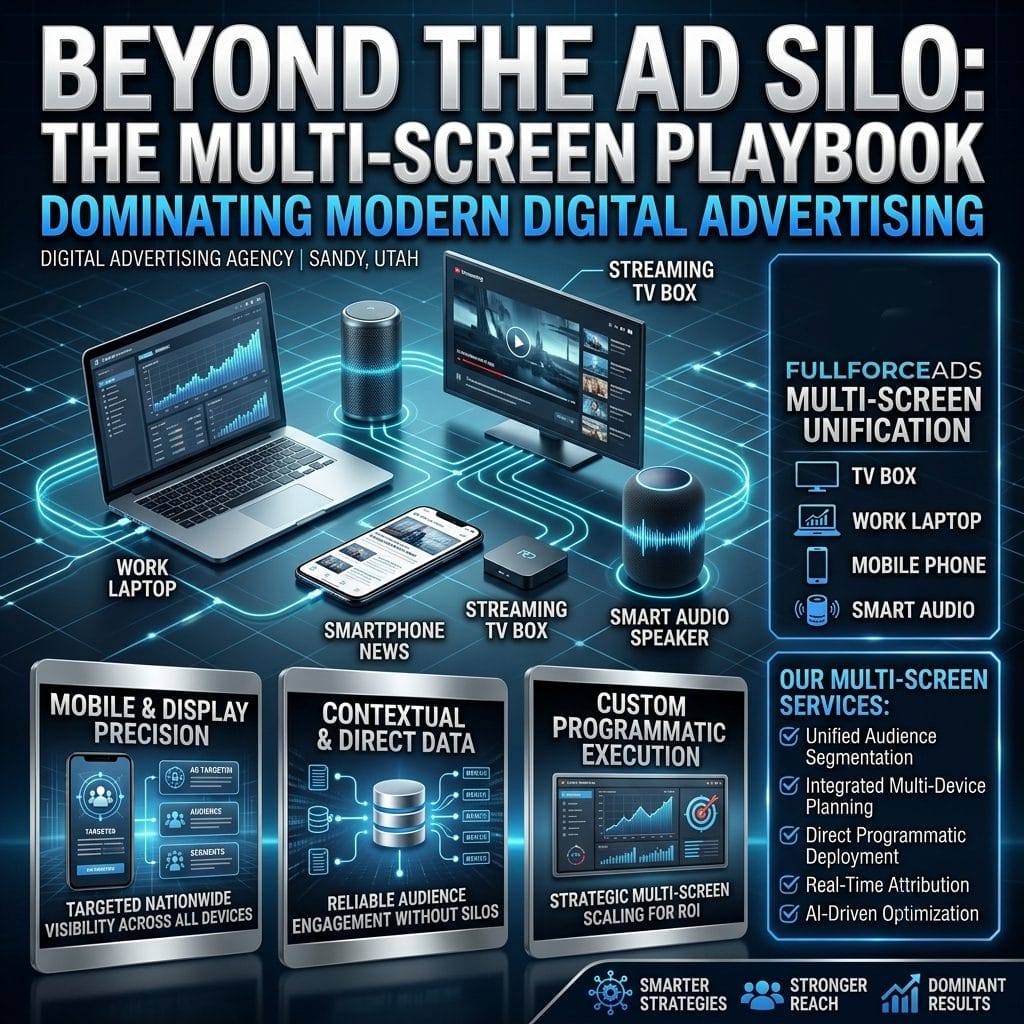
Everything runs through one team. We plan, launch, optimize, and attribute across Streaming TV, Video, Audio, Mobile, Display, and Native from one place, so your messaging and data stay in sync.
Targeting is built into every campaign. We put your budget behind geofencing, addressable lists, search retargeting, or contextual mapping, not raw impression volume, so it goes to prospects worth reaching.
Reporting is plain. A lot of agencies hide performance behind black-box reports that bury real media costs. We send a clear weekly report: where your ads ran, who saw them, how the budget was spent, and what people did as a result.
Budgets stay flexible. No huge minimums, no long lock-ins. Start small, check the return, and scale when the revenue shows up.
Launches are fast. Legacy agencies take weeks or months to get moving. We get targeted campaigns live in 5 to 7 business days.