In today's digital market, relying strictly on traditional ad placement or closed ad platforms leaves money on the table. Managing campaigns across separate vendors, dealing with unpredictable pricing on closed networks, and negotiating manual media buys slow down execution and raise customer acquisition costs.
To build scalable growth, businesses and marketing agencies need direct access to real-time, cross-channel audience targeting. Programmatic display advertising solves this problem directly.
By automating the buying and selling of digital ad space through real-time bidding (RTB) and direct programmatic deals, businesses can deliver targeted messages to specific audiences across every screen. Here is how programmatic display advertising operates, how targeting strategies drive conversions, and why partnering with Full Force Ads, a specialized digital advertising agency based in Utah, gives your business a clear edge.
At its core, programmatic display advertising automates the purchase and optimization of digital ad space using software, real-time bidding algorithms, and audience data.
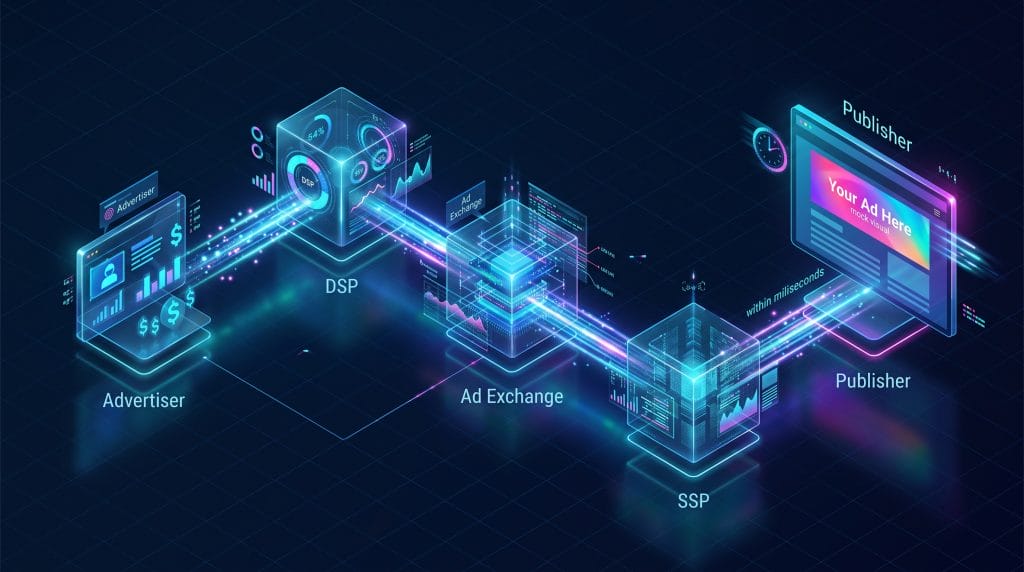
In legacy banner buying, advertisers manually reached out to individual publishers, signed insertion orders, and paid flat rates regardless of who saw the ad. Programmatic media buying evaluates individual ad impressions in milliseconds while a user loads a webpage or mobile application.
[User Visits Page] $\rightarrow$ [Demand-Side Platform (DSP)] $\rightarrow$ [Ad Exchange (RTB)] $\rightarrow$ [Supply-Side Platform (SSP)]
When a user opens a web page or mobile app, an automated signal alerts the system. The ad platform analyzes the user's location, browsing intent, and demographic profile, then places a real-time bid on that specific inventory. The highest bidder's ad renders instantly on screen before the page finishes loading.
Automated bidding relies on four primary components:
Many agencies rely on search or social ad platforms that lock you into closed ecosystems with opaque pricing and limited placement control. Full Force Ads operates as an independent digital advertising agency in Utah running its own programmatic advertising platform.
Full Force Ads does not sell Google Ads, Meta Ads, or traditional social media management. Instead, Full Force Ads provides direct programmatic access across millions of websites, premium connected TV networks, mobile apps, and audio channels from one hub.
Effective advertising meets consumers where they spend their time. Rather than running separate campaigns on isolated platforms, a single programmatic setup allows brands to run coordinated, multi-screen campaigns.
Channels dictate where ads appear, but targeting strategies determine who sees them. Buying broad, un-targeted impressions wastes budget. Precision targeting ensures ad dollars go toward actual prospects.
| Targeting Solution | Strategy & Mechanism | Primary Application |
| Geofencing | Creates virtual boundaries around physical locations. Collects device IDs from people entering competitor locations, trade shows, auto dealerships, or specific neighborhoods. | Serves ads while interest is fresh and allows retargeting for up to 30 days. |
| Addressable Household Targeting | Connects physical address lists with digital ad campaigns by uploading a list of street addresses (from CRM records or direct mail lists). | Matches addresses to household devices to run ads across Connected TV, desktop, and mobile devices in specific homes. |
| Site Retargeting | Uses tracking pixels to identify visitors who left your site without converting. | Keeps your brand visible as visitors browse news or entertainment sites so they can return to complete a purchase. |
| Search Retargeting | Reaches prospective buyers based on search activity outside major search engines (targeting specific keywords across web properties). | Captures intent early in the research process at lower costs than search engines charge. |
| Contextual Targeting | Reaches users based on what they are reading rather than tracking cookies, scanning page text, article topics, and content categories. | Places ads next to relevant articles while maintaining privacy compliance and brand safety. |
The right channel mix depends on business goals. Here are programmatic combinations built for specific outcomes:
Every marketing team operates differently. Full Force Ads provides options based on how hands-on you want to be:
Partnering with Full Force Ads simplifies media buying compared to juggling multiple vendors:
Launching a programmatic campaign with Full Force Ads follows four steps:
Juggling multiple vendor dashboards or depending entirely on closed ad networks wastes time and ad spend. Programmatic display advertising gives you the reach and audience precision needed to target real buyers across every screen.
Whether you need a fully managed agency partner or a self-serve account on FullForceAds.app, Full Force Ads provides the system to scale your campaigns.