For over a decade, digital media planning ran on a predictable loop. Marketers put a chunk of the budget into search, poured the rest into social media walled gardens, and crossed their fingers that the algorithms handed back a decent ROAS.
That setup is breaking down.
Rising CPMs, tighter privacy rules, and black-box optimizations leave brands paying more for less visibility and shrinking market share. Modern companies cannot afford to rely on closed platforms that mark their own exams, hide their supply chains, and keep raw audience data under lock and key.
Real growth means owning the customer journey across every touchpoint. Brands need to reach people wherever they watch or listen to media, whether streaming a show on the couch, tuning into a podcast during a commute, or reading industry news on a phone.
This means moving past legacy walled gardens toward independent, multi-channel programmatic execution powered by real-time bidding exchanges and unstructured intent data.
Based along Utah’s tech corridor, Full Force Ads builds unified ad infrastructure for high-growth enterprises, agile solo operations, and scaling agencies. Instead of reselling Google Ads or Meta placements, Full Force Ads operates its own programmatic DSP and DMP technology stack. That gives buyers direct access to real-time inventory, target audiences, and clear cross-channel attribution.
Understanding the architecture of modern digital advertising solutions
To capture market share in a fragmented market, an ad strategy has to balance Media Channels (where your message lives) with Targeting Solutions (who receives your message).
The full media spectrum: Reach audiences on every screen
People switch devices dozens of times a day. Restricting your message to a single format creates friction in the buying journey. Running a complete media setup keeps your brand consistent across every screen.
Streaming TV (CTV): CTV puts your brand alongside long-form content on platforms like Roku, Hulu, Fire TV, Paramount+, and Peacock. Unlike traditional linear television, CTV programmatic ads deliver unskippable video and audio tied to specific household targeting.
Video: Pre-roll, mid-roll, and outstream video placements across thousands of mobile apps and publisher sites build visual interest before a prospect ever lands on your site.
Audio: Screen fatigue is real, but screen-free moments offer long attention spans. Audio placements reach active listeners streaming on Spotify, Pandora, iHeartRadio, and podcast networks while they drive, work out, or go about their day.
Mobile: Reaching consumers within mobile web environments and in-app placements opens immediate routes for local engagement, clicks, and location tracking.
Display: Visual banner placements across high-traffic domain networks form the foundation for top-of-funnel reach and reliable mid-funnel retargeting without blowing through budgets.
Native: Native ads match the layout, typography, and context of the publication where they appear. By blending into a reader’s content feed, they bypass banner blindness to drive higher click-through rates and stronger post-click engagement.
Precision targeting: Reaching intent, not just eyeballs
Distributing creative across good inventory is only half the battle. Driving profitable campaign yield comes down to audience selection. Broadcasting ads to broad zip codes wastes impressions; serving ads based on real-world behavior and specific digital intent drives revenue.
Building-Level Geofencing: Traditional location advertising relies on loose radius boundaries that waste money on nearby highways and unrelated storefronts. Advanced geofencing traces the physical outlines of a target location, such as competitor storefronts, trade shows, auto dealerships, or medical facilities, collecting mobile device IDs to serve targeted campaigns during and long after their visit.
Addressable Household Targeting: Physical direct mail is slow, expensive, and hard to track. Addressable targeting converts a client mailing list, CRM database, or physical address file into digital endpoints. You can serve custom video, display, or CTV ads directly to specific homes across all connected household devices.
Site Retargeting: Over 95% of initial web traffic leaves without converting. Site retargeting keeps your value proposition in front of high-intent visitors as they navigate the web, guiding them back to finish a booking, form submit, or purchase.
Search Retargeting: Reach buyers based on the specific search terms and keywords they query across the web. This captures active commercial intent without paying inflated search engine pay-per-click rates.
Contextual Targeting: By analyzing page content, articles, and media categories, contextual targeting displays your ads on pages tied directly to your industry vertical.
Strategic campaign alignment: Channel mix solutions
Every commercial objective requires a distinct combination of media channels and targeting strategies. Here is how businesses align programmatic assets to hit measurable targets.
| Campaign Objective | Primary Media Channels | Recommended Targeting Strategy | Primary Metric of Success |
| Local Foot-Traffic & Retail | Geofencing + Mobile In-App + Display | Building-level competitor location mapping | Physical Conversion Zone visits & Cost Per Store Visit |
| Direct Competitor Conquesting | Geofencing + Addressable Household | Competitor office/store mapping + matched home address lists | Market share displacement & Qualified Lead Volume |
| Enterprise Brand Building | Streaming TV (CTV) + High-Impact Video + Audio | Regional demographic & household income layering | Video Completion Rate (VCR) & Total Brand Lift |
| High-Intent Web Acquisition | Native + Search Retargeting + Display | Keyword search history & Contextual topic alignment | Cost Per Acquisition (CPA) & High-Value On-Site Actions |
| Retargeting & Abandoned Funnels | Site Retargeting + Pre-Roll Video + Display | Custom first-party website event pixel triggers | Return on Ad Spend (ROAS) & Conversion Rate (CVR) |
| B2B Account-Based Marketing | Addressable + Streaming TV + Native | Uploaded corporate account lists & targeted office locations | Account-level engagement & Pipeline Velocity |
The programmatic advantage: Why independent infrastructure wins
Most ad networks rely on pre-packaged, broad audience segments. They lump users into rigid categories like "auto enthusiasts" or "homeowners," then mark up the cost of those static lists.
Full Force Ads operates on an unstructured data model. Instead of buying pre-bundled audiences with hidden margins, the platform processes raw search, location, and contextual data points in real time. This unstructured approach gives brands direct control over bidding, targeting parameters, and impression values.
LEGACY MEDIA BUYING (BLACK BOX)
[ Ad Budget ] ──► [ Intermediary Brokers ] ──► [ Pre-Packaged Audience Pools ] ──► [ Opaque Placements ]
FULL FORCE ADS PROGRAMMATIC ENGINE
[ Ad Budget ] ──► [ Direct RTB Exchange Access ] ──► [ Unstructured Real-Time Intent ] ──► [ Targeted Screen ]
Transparent reporting vs. black box algorithms
Opaque reporting remains a major headache in digital marketing. Many platforms show high-level vanity metrics, like total impressions or raw clicks, without revealing where ads ran or whether those views translated into real business value.
A solid performance partnership relies on clear data. Businesses should receive transparent reporting that highlights:
Exact Publisher Deliverables: See which domain names, CTV applications, and mobile environments served your ads.
Conversion Zone Foot Traffic: Track physical walk-ins to measure how many people who saw an ad physically walked through your doors.
Cross-Device Attribution: Track how an initial view on a connected TV transformed into a search query on a phone and a final purchase on a desktop.
Frequency and Recency Controls: Prevent ad fatigue by setting cap limits on how often a single household sees your message across their devices.
Scaling digital advertising: Enterprise managed vs. self-serve control
Different organizations need different operational support. Whether a brand wants a managed agency setup or demands hands-on platform control, campaign execution needs to stay flexible.
Through FullForceAds.app, users access a self-serve programmatic platform. The portal lets in-house operators configure and launch omnichannel programmatic campaigns in minutes.
The platform enables fast campaign deployment by letting operators build geofences, upload CRM address files, select media channels, and push campaigns live through a single workflow. In-house buyers track impressions, CTRs, video completion rates, and physical conversion data in real time as events unfold. Granular budget control allows teams to adjust daily spend, modify bid ceilings, and reallocate budget across high-performing channels on the fly without contract lock-ins or administrative lag. Agencies also get white-label execution capabilities to run client accounts through a central dashboard with white-labeled performance reporting without enterprise SaaS licensing fees.
Practical application: Multi-channel plan examples
Here is how these channels and targeting strategies work together in real-world scenarios across different commercial verticals.
Scenario A: The Regional Auto Dealership Network
Objective: Increase showroom foot traffic and capture buyers shopping at competing regional dealerships.
Execution Strategy:
Building-Level Geofencing: Map rival automotive dealerships within a 20-mile radius.
Mobile & Display Retargeting: Deliver dynamic inventory ads to car shoppers' mobile devices while they browse competitor lots.
Streaming TV Follow-Up: Serve 15-second local promotional video ads on living room TVs once those prospect devices reconnect to home Wi-Fi networks.
Attribution: Draw a digital "Conversion Zone" around the client's own showroom to measure precise foot-traffic walk-ins generated by the campaign.
Scenario B: B2B Enterprise Software Provider
Objective: Penetrate target accounts, engage key corporate decision-makers, and shorten sales cycles.
Execution Strategy:
Addressable Household Match: Upload a high-value prospect list of account executive street addresses.
Streaming TV & Audio: Run targeted CTV video spots and podcast audio placements directly into those households.
Search Retargeting & Native: Deliver educational content and case studies on trade publications whenever decision-makers search for relevant industry keywords.
Site Retargeting: Maintain high-frequency display banners to re-engage prospects who visit product landing pages, keeping the software solution front of mind.
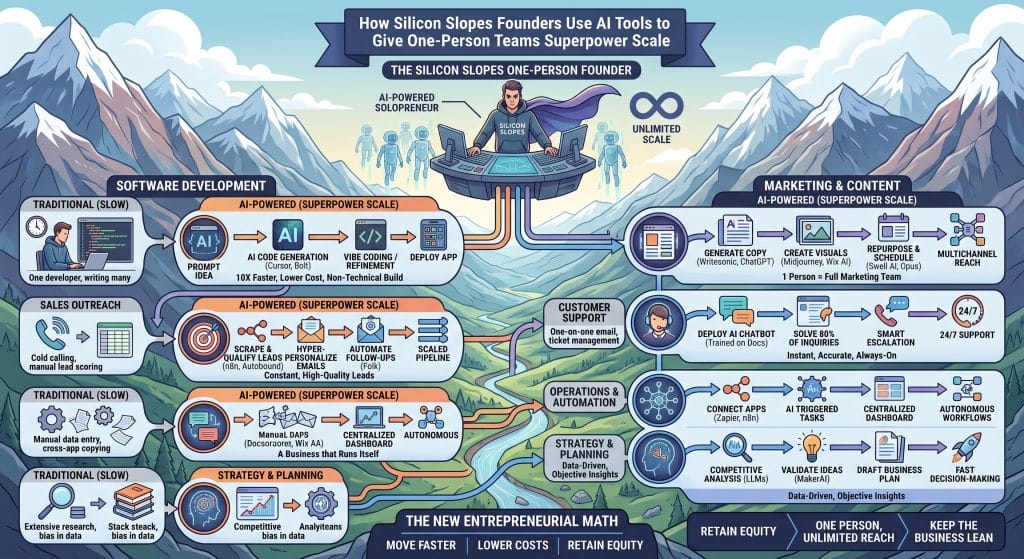
The Silicon Slopes playbook: How solo founders use AI tools to scale
Across Utah’s tech corridor—famously dubbed Silicon Slopes—a major shift is happening in how lean startups launch and grow. Founders, boutique agencies, and solo operators are leaning on modern software stacks to run full-scale operations without hiring bloated teams.
Running a high-tier marketing department used to require a graphic designer, a media buyer, a data analyst, and a programmatic trading engineer. Today, single-person teams combine AI tools with programmatic ad platforms to match the output of traditional departments.
A solo founder can now execute what previously required a multi-million-dollar corporate budget:
AI-Generated Ad Creative: Using generative image, video, and copy software, a solo marketer can spin up dozens of display variants, native headlines, and audio scripts in an afternoon.
Programmatic Channel Distribution: Instead of juggling half a dozen isolated ad managers, the founder uploads those assets into a unified platform like FullForceAds.app to distribute campaigns across CTV, display, audio, and mobile networks simultaneously.
Automated Real-Time Optimization: Machine learning algorithms analyze incoming bids automatically, blacklisting underperforming publishers and shifting budget toward high-converting placements.
This setup levels the playing field. Solo founders can geofence enterprise competitors, run unskippable TV commercials, and deliver addressable ads to hyper-specific households, operating with the speed, precision, and market presence of a much larger company.
Execution process: Launching your campaign in days
Digital campaigns shouldn't take six weeks to launch. A deployment process moves at the speed of business, launching targeted assets within 5 to 7 business days.
• Monitor real-time performance analytics and conversion zones.
• Deliver transparent weekly reports detailing publisher placements and store visits.
Discovery Call: A straightforward conversation to map out target audiences, growth goals, and key performance indicators.
Custom Strategy: Receive a tailored channel mix and targeting plan built around your budget, not a rigid template.
Campaign Launch: Creative assets go live across selected networks within 5 to 7 business days, backed by flexible terms and no long-term lock-ins.
Ongoing Optimization & Weekly Reporting: Bids, contexts, and device placements undergo continuous refinement. Clear weekly reports track impressions, video completions, web actions, and foot traffic.
Take control of your media strategy
Digital advertising does not need to be a guessing game played inside closed, black-box networks. Combining broad-reaching media channels with targeted location, search, and addressable data gives brands a resilient, scalable growth engine.
Whether you prefer fully managed agency services or hands-on self-serve control through FullForceAds.app, accessing unified programmatic infrastructure gives your business a distinct edge.
Cut out wasted impressions, connect with your exact target audience across every screen, and drive real revenue.
Visit Full Force Ads Advertising Solutions today to explore channel options, evaluate target audiences, and schedule a platform demo.