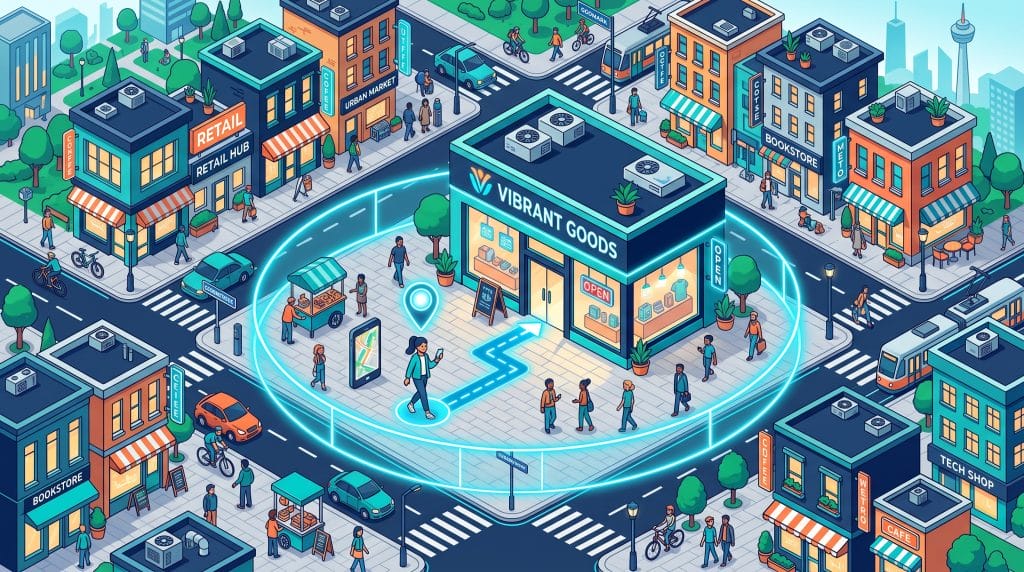
The Shift to Physical Retail and Mobile Geofencing
The shift toward e-commerce hasn't killed physical retail, but it changed how stores bring people through the door. Shoppers walk down aisles with smartphones in hand, expecting quick, local details. For retail marketers, franchise owners, and local media planners, mobile geofencing offers a direct link between digital ads and physical foot traffic.
Instead of showing generic banners to broad audiences, geofencing uses real-time location data to send an offer when someone is close enough to step inside.
Geofencing draws a virtual boundary around a specific location. When a phone with location services enabled crosses that line, it triggers an action—such as serving an ad, sending a push notification, or entering the device into a real-time ad auction.
Three technologies handle the positioning:
Demand-Side Platforms (DSPs) and location service providers combine these signals to map custom boundaries around buildings, parking lots, or regional landmarks.
Drawing a simple circle around your front door rarely gives you the best return. Better results come from placing boundaries based on where your customers are and what they are doing.
Set boundaries in layers:
A well-timed location trigger fails if the ad itself feels generic. Effective mobile ads give users immediate details based on where they are standing.
Plaintext
       [ Location Trigger ]
                │
                ▼
  [ Real-Time Contextual Creative ]
  • Dynamic Distance/Directions
  • Time-Sensitive Promotion
  • Low-Friction Digital Coupon
                │
                ▼
    [ Physical Store Visit ]
Ads with live distance or directions perform better than static slogans. Writing "You are 3 minutes away from 20% off" forces an immediate decision. Flash sales or countdown timers encourage quick detours rather than forgotten plans. Keeping redemption simple—like an Apple Wallet pass, a clear QR code, or a single tap for driving directions—stops people from giving up on complicated mobile forms.
Unlike billboards, print, or radio, mobile geofencing connects ad views directly to physical store visits.
| Metric | Formula | What It Tells You |
| Cost-Per-Walk-In (CPW) | $\frac{\text{Total Campaign Spend}}{\text{Total Verified Store Visits}}$ | Calculates the real cost of bringing a customer through the door compared to digital acquisition costs. |
| Incremental Lift | $\frac{\text{Conversion Rate of Exposed Group}}{\text{Conversion Rate of Unexposed Control Group}}$ | Isolates your ad's actual impact by separating ad-driven visits from organic shoppers. |
| Walk-Through Rate (WTR) | $\frac{\text{Total Verified Store Visits}}{\text{Total Ad Impressions Delivered}}$ | Measures how well your creative and boundary choices drive physical action. |
Adjusting boundary lines, ad copy, and bid strategies based on Cost-Per-Walk-In keeps digital ad spend tied directly to real store visits.
The digital advertising market has a real problem right now. Companies spend more every year, but reaching people who care keeps getting harder. Media channels are fragmented, costs per click on major platforms are high, and generic ad impressions do little to move the needle.
To grow consistently, businesses need to move past vanity metrics and use targeted, multi-screen campaigns. Full Force Ads, an agency based in Utah, designs custom advertising campaigns across digital channels. Using location tracking and targeted audience layering, companies can look beyond standard platform limits and connect with audiences across their devices.
                  THE MODERN CONSUMER DEVICE JOURNEY

  [Streaming TV]  -->  [Digital Audio]  -->  [Mobile Web & Apps]
  Morning News         Commute Podcast       Workday Browsing
         │                     │                     │
         └─────────────────────┼─────────────────────┘
                               ▼
                  [Unified Cross-Screen Ad Engine]
                               │
            ┌──────────────────┴──────────────────┐
            ▼                                     ▼
   [Hyper-Targeted Ads]                [Attributable Conversion]
   Geofence / Addressable              In-Store Visit / Web Sale
For a long time, companies split their marketing across separate vendors. They hired one team for social media, another for search ads, and middleman brokers for web banners. That approach usually led to mixed messaging, wasted budgets, disjointed analytics, and little insight into which ads actually made money.
Most people use multiple devices throughout the day. A prospective buyer might watch the news on a smart TV over breakfast, stream a podcast on their commute, check apps during work, read articles on a laptop, and listen to music in the evening.
Reaching people across those daily habits takes a single plan that connects messaging across every screen without forcing you to manage six different dashboards.
Major advertising platforms mainly focus on selling space inside their own systems. While they offer huge user bases, they often bring rising impression costs, strict targeting rules, and internal metrics that hide actual return on investment.
Independent ad networks run through open programmatic auctions. Advertisers can bid for ad space across millions of popular websites, streaming apps, and podcast platforms at the same time. Instead of locking money inside one closed platform, independent setups search the web for places to reach the right audience regardless of where they are online.
A complete digital strategy puts the right ad on the right device when a customer is making a decision. Full Force Ads combines six main channels into a single campaign setup to cover the market:
Connected TV has changed video advertising. Traditional television ads used to require large five-figure budgets, covered broad geographic areas, and gave you almost no way to track direct sales.
With streaming ads, local and regional businesses can run unskippable video campaigns on platforms like Roku, Amazon Fire TV, and Hulu. Combining the visual appeal of television with digital data targeting lets companies show ads only to households that match their customer profile.
Media consumption goes well beyond screens. Millions of people listen to podcasts, custom playlists on Spotify, or radio stations on Pandora while driving, cooking, or working out.
Digital audio ads reach listeners when they are away from their screens. Because people rarely skip audio tracks while busy with other tasks, audio spots see high completion rates and good recall.
Standard banner ads suffer from banner blindness, where web users train themselves to ignore sidebar graphics. Native advertising addresses this by mimicking the typography, color scheme, and layout of the site hosting it.
When an ad looks like a regular article or sponsored review on a reputable news site, readers trust it more, leading to better engagement and higher click rates.
                    THE 5 LAYERS OF INTENT TARGETING

  [1. Addressable]       --> Matches physical CRM addresses to IP/Device
  [2. Geofencing]        --> Real-world location boundaries (GPS)
  [3. Search Retargeting]--> Captures users based on intent keywords
  [4. Contextual]        --> Aligns ad creative with page context
  [5. Site Retargeting]  --> Re-engages past website visitors
Getting an ad onto a good website is only half the battle. Delivering it to the person who actually needs your service determines whether the campaign turns a profit. Channel distribution acts as the pipeline, but targeting accuracy dictates efficiency.
Geofencing uses location tech like GPS, Wi-Fi networks, and cellular data to draw virtual boundaries around physical locations. When a customer carrying a smartphone enters a fenced area, the system logs their device ID into an audience list. That phone, along with other connected devices on the home network, can then receive targeted display, video, or audio ads.
              ┌───────────────────────────────────┐
              │     COMPETITOR LOCATION / ZONE    │
              │  ┌─────────────────────────────┐  │
              │  │  Prospect enters with phone │  │
              │  └──────────────┬──────────────┘  │
              └─────────────────┼─────────────────┘
                                │
                                ▼
              ┌───────────────────────────────────┐
              │    MOBILE ID CAPTURED IN ZONE     │
              └─────────────────┬─────────────────┘
                                │
                                ▼
              ┌───────────────────────────────────┐
              │ CROSS-DEVICE AD DELIVERY BEGINS   │
              │   - Mobile Display Ads            │
              │   - Streaming TV Video            │
              │   - Digital Audio & Web Banners   │
              └─────────────────┬─────────────────┘
                                │
                                ▼
              ┌───────────────────────────────────┐
              │    PROSPECT VISITS YOUR STORE     │
              │  (Verified by Conversion Zone)    │
              └─────────────────┴─────────────────┘
Companies run geofencing in three main ways:
Addressable targeting applies direct mail precision to digital campaigns. Using physical location data, businesses can upload a list of client addresses or sales leads directly into the platform.
The system matches street addresses to home Wi-Fi networks and device IDs. Ads then appear on smart TVs, laptops, and mobile phones inside those specific households, reducing wasted impressions on non-qualified leads.
Search retargeting connects with people based on what they search for across the web, capturing interest before someone lands on your site.
When a user searches for specific keywords, products, or industry terms on search engines, their profile gets tagged. Search retargeting then shows display, video, or native ads to those individuals as they browse news sites, blogs, and apps elsewhere online.
More than 95% of first-time website visitors leave without filling out a contact form, making a call, or buying anything. Retargeting keeps those prospective customers from disappearing completely.
By placing a small tracking pixel on your website, the system notices when a visitor leaves and continues browsing online. Retargeting then shows ads to those past visitors to answer common questions, highlight customer reviews, and encourage them to return and finish their purchase.
Contextual targeting matches ads with related online content. Language algorithms evaluate web page text, article topics, and video descriptions in real time.
When the system finds relevant articles, like a piece on home remodeling, it places a home improvement ad directly on that page. This reaches users while they actively read about topics tied to what you sell.
For physical retail stores, car dealerships, clinics, and restaurants, digital ads need to produce actual walk-ins. Location-based mobile ads powered by geofencing connect digital impressions directly to real-world visits.
Geofencing campaigns follow a clear process from ad view to physical entry:
| Goal | Recommended Channels | Targeting Approach | Primary Success Metric |
| Local Brand Awareness | Geofencing, display, mobile | Proximity geofencing, neighborhood mapping | Local impression reach, cost per thousand |
| Compete with Rivals | Geofencing, addressable | Competitor store geoconquesting | Verified store walk-ins |
| Broad Brand Building | Streaming TV, video, audio | Demographic, behavioral, contextual | Video completion rate, brand lift |
| Capture High Intent | Display, native, search retargeting | Keyword retargeting, contextual matching | Click-through rate, site engagement |
| Re-Engage Past Site Visitors | Site retargeting, display, video | Pixel-based visitor tracking | Cost per acquisition, direct sales |
| Target Existing Customer Lists | Addressable, streaming TV, display | Physical address matching | Customer lifetime value, list match rate |
Full Force Ads operates its own advertising platform rather than working as a reseller for major social networks or basic search accounts. Campaigns buy inventory directly across streaming networks, mobile app ecosystems, and digital publishers without extra network markups.
Instead of hiring separate vendors for CTV, mobile display, and retargeting, campaigns run from a single dashboard. Centralized management maintains consistent ad limits per user, aligned messaging across devices, and clear attribution across channels.
You get weekly performance reports detailing ad locations, target demographics, verified store visits, and website actions. That level of tracking shows where your budget goes and what it achieves.
Campaigns feature flexible structures, allowing companies to start with a manageable budget, check performance, and adjust spending based on verified returns. Launch timelines run quickly, with most campaigns going live within 5 to 7 business days.
For teams that prefer direct management, FullForceAds.app offers self-serve access. Internal marketing teams can launch, adjust, and evaluate programmatic display, mobile geofencing, and streaming campaigns on their own schedule.
Setting up a campaign follows a four-step process: