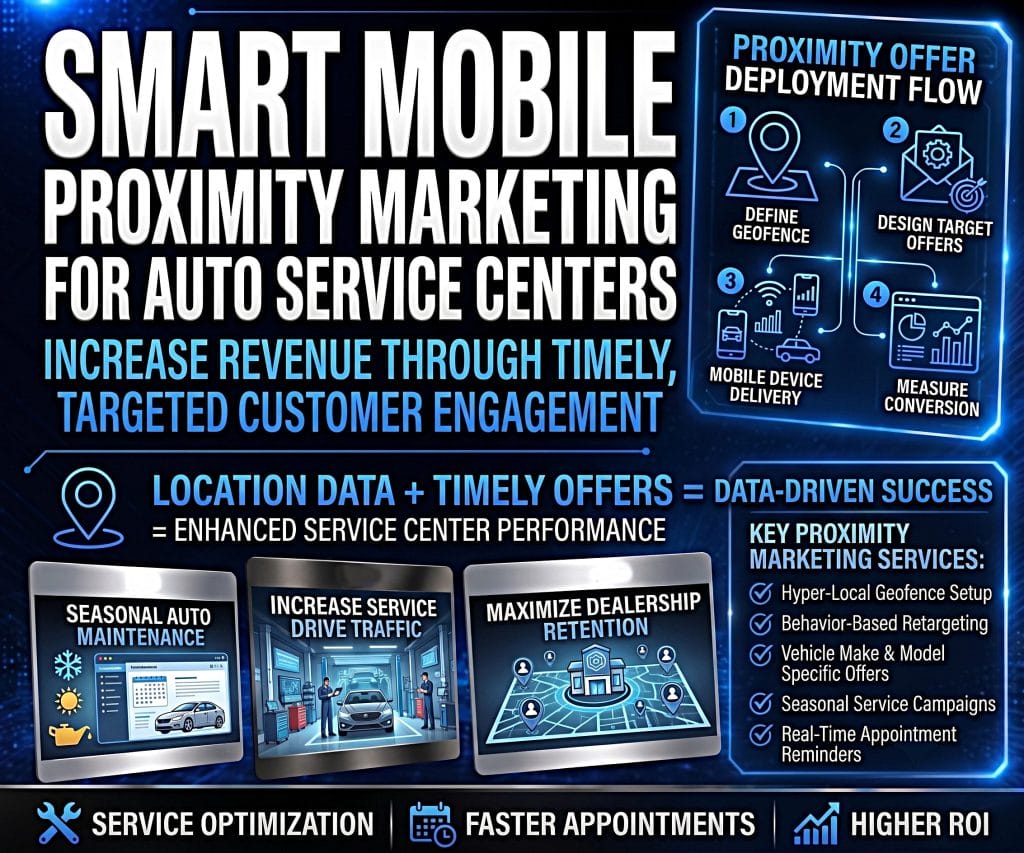
Mobile proximity marketing gives auto dealership service departments a direct way to fill open repair bays by reaching drivers who are already on the road nearby.
New car sales margins keep shrinking across the automotive industry. Most franchise dealerships now make 40% to 60% of their total gross profit from Fixed Operations, even though the service drive brings in a smaller piece of top-line revenue. Keeping those lifts occupied with high-margin repair orders takes a consistent stream of vehicles.
Traditional marketing struggles to deliver that consistency. Direct mail postcards usually end up under a stack of mail on the kitchen table. Static billboards get ignored by commuters on autopilot. Email blasts sent on a Tuesday afternoon rarely prompt someone to book an oil change until something actively breaks down.
When a commuter hears a grinding sound from their front brakes on their way home, or when a sudden cold morning kills an old battery, they do not dig through paper mail. They look for the nearest convenient option.
By running location-targeted display campaigns through FullForceAds.com, dealership service departments can reach drivers right when vehicle problems happen near their location.
Mobile proximity marketing is a digital strategy that uses geographic data—like GPS coordinates, cell tower triangulation, and local mobile app activity—to deliver ads to smartphones within a specific physical boundary.
Instead of buying broad regional media or relying on generic demographic filters, location-based advertising lets you draw dynamic virtual borders around exact physical points.
+-------------------------------------------------------------------+
|                     MOBILE PROXIMITY WORKFLOW                     |
+-------------------------------------------------------------------+
  1. Vehicle enters geofenced zone (1-3 miles from service bay)
     │
     ▼
  2. Driver opens a weather, navigation, or local news mobile app
     │
     ▼
  3. FullForceAds.app matches device location and dynamic trigger
     │
     ▼
  4. Contextual display ad appears with local offer and 1-tap route
     │
     ▼
  5. Driver routes straight into express service lane
Geofencing creates a digital perimeter around places like major commuter highways, shopping centers, corporate parks, or competing quick-lube locations. When a mobile device enters that zone, the FullForceAds.app platform makes real-time ad inventory available across popular mobile apps, including local news, weather trackers, and navigation tools.
Beacons handle short-range indoor micro-location tasks. Placed at the service drive entrance or inside the customer waiting room, BLE beacons send short-range signals to mobile phones on site. This helps you communicate with customers who are already waiting, offering targeted upsells like cabin air filter replacements or tire alignments while their vehicle is up on the lift.
Contextual advertising pairs location data with live environmental conditions. If local temperatures drop below freezing, or if heavy rain causes hazardous road conditions in the Salt Lake Valley, your ads automatically update to highlight battery tests or fresh wiper blades.
More than 70% of out-of-warranty vehicle owners choose independent repair shops over franchise dealerships. When asked why, car owners consistently point to three things: distance, convenience, and clear pricing.
Traditional service marketing fails to address these concerns in real time:
Mobile display advertising bridges this gap. It places a concrete offer with a clear turn-by-turn route right in front of a driver who is already within a five-minute drive of your facility.
Seasonal weather changes put predictable physical strain on vehicles. The main challenge for service directors is not convincing drivers that maintenance matters; it is catching them before they pull into an independent quick-lube shop down the street.
Winter freeze-thaw cycles create severe potholes that knock wheels out of alignment and wear out suspension parts. Setting up mobile boundaries along heavily damaged commuter corridors allows you to offer quick digital alignment checks to drivers passing by.
Summer heat places heavy stress on cooling loops, air conditioning units, and older batteries. Targeting drivers near shopping hubs, recreation sites, and highway interchanges before holiday weekends helps capture families preparing for long road trips.
As autumn temperatures drop, older batteries lose cold-cranking capacity, and worn brake pads struggle on wet leaves and rain. Targeting suburban residential pockets and office parks during morning commute hours catches vehicle owners right when they notice slow engine cranks.
The first snowstorm or hard freeze causes immediate demand for battery replacements and winter tire mounts. Setting up geofences around competitor tire stores with real-time stock updates lets you capture customers who are facing long wait times elsewhere.
+----------------------------------------------------------------------------------------------------+
|                                 SEASONAL PROXIMITY CAMPAIGN MATRIX                                 |
+--------------------------+-----------------------+------------------------+------------------------+
| SEASON                   | TARGET ZONE           | TRIGGER EVENT          | PROXIMITY OFFER HOOK   |
+--------------------------+-----------------------+------------------------+------------------------+
| Spring Alignment         | Damaged Highway Corridors | Post-Winter Thaw       | Free Digital Alignment |
| Summer Travel Prep       | Shopping Malls & Exits| Heatwave Warning       | $49 AC & Multi-Point   |
| Fall Battery Defense     | Corporate Parks       | Morning Temp Drops     | 2-Minute Battery Test  |
| Winter Tire Conquest     | Competitor Tire Hubs  | First Snowfall/Freeze  | In-Stock Winter Mounts |
+--------------------------+-----------------------+------------------------+------------------------+
Service departments get the best results when they move away from broad brand claims and run direct, action-oriented campaigns. Here are four practical playbooks you can run on FullForceAds.app.
Proximity marketing gets even more effective when connected to your existing customer databases. Geographic tracking shows where a device is, but your Dealership Management System (DMS) and Customer Relationship Management (CRM) tools tell you who the customer is and what vehicle they drive.
┌──────────────────────────┐      ┌──────────────────────────┐
│  DMS / CRM DATA LAYER    │      │  LOCATION INTELLIGENCE   │
│  • Vehicle Year & Model  │      │  • Real-Time Geofence    │
│  • Last Service Date     │  +  │  • Speed & Direction     │
│  • Open Recalls / Need   │      │  • Distance to Service   │
└────────────┬─────────────┘      └────────────┬─────────────┘
             │                                 │
             └────────────────┬────────────────┘
                              │
                              ▼
           ┌─────────────────────────────────────┐
           │ HYPER-LOCAL PROXIMITY DISPLAY AD    │
           │ "Your 2022 SUV is due for its 30k   │
           │ service. Express bay 0.5 mi ahead!" │
           └─────────────────────────────────────┘
By linking your DMS platform (such as CDK Global, Reynolds & Reynolds, or Tekion) to FullForceAds.app, you can build smart campaign triggers:
When running location campaigns, compliance with regulations like the TCPA and CCPA is essential.
Digital metrics like clicks and ad views matter, but service directors need physical store visits and repair revenue to justify ad spend.
                  KEY REVENUE METRICS

  ┌───────────────────────┐      ┌───────────────────────┐
  │   Drive-To Rate (DTR) │      │ Cost Per Repair Order │
  │                       │      │        (CPRO)         │
  │  Physical visits      │      │ Campaign cost divided │
  │  divided by ad views  │      │ by booked service ROs │
  └───────────┬───────────┘      └───────────┬───────────┘
              │                              │
              └──────────────┬───────────────┘
                             │
                             ▼
  ┌──────────────────────────────────────────────────────┐
  │                 REVENUE ATTRIBUTION                  │
  │   • Average Repair Order (ARO) Growth                │
  │   • Multi-Point Inspection Upsell Conversion         │
  │   • Long-Term Service Retention Rate                 │
  └──────────────────────────────────────────────────────┘
Drive-To Rate measures the percentage of mobile users who saw your proximity ad and then drove into your service bay within a set timeframe (usually 7 to 14 days). DTR provides clear physical proof that your mobile ads converted into real foot traffic.
Calculate your Cost Per Repair Order by taking your total campaign spend and dividing it by the number of completed repair orders generated by the campaign:
Cost Per Repair Order = Total Campaign Cost / Completed Service Repair Orders
Comparing CPRO against your average repair order gross profit ensures your campaign delivers positive net revenue.
Track whether proximity customers generate solid revenue compared to regular walk-ins. Even if a driver comes in for a discounted express oil change, a structured multi-point inspection helps your service advisors identify and address necessary maintenance issues while the car is in the bay.
If you are ready to use location-targeted display campaigns to keep your service drive busy, follow this setup process:
Review your service bay records for the past year. Spot the specific days or time windows where lift utilization drops, and note which express services bring in solid margins with fast turnarounds.
Map out your target digital boundaries in FullForceAds.app:
Design simple display banners optimized for phone screens. Keep text short, highlight clear pricing or turn-around guarantees, and send clicks to clean landing pages with one-tap navigation links and fast phone dialing.
Link your customer lists to reach lapsed drivers, and turn on automated weather triggers for freeze warnings, rainstorms, or summer heatwaves.
Match physical vehicle visits against campaign views every week. Shift your ad budget toward the highest-performing locations and routes, cutting back on zones that do not drive physical visits.
As a digital advertising agency based in Sandy, Utah, FullForceAds.com builds hyper-local mobile and contextual display campaigns that keep service drives full across the country. By matching location timing with real driver needs, your dealership can capture nearby repair business and keep those lifts turning profit day after day.