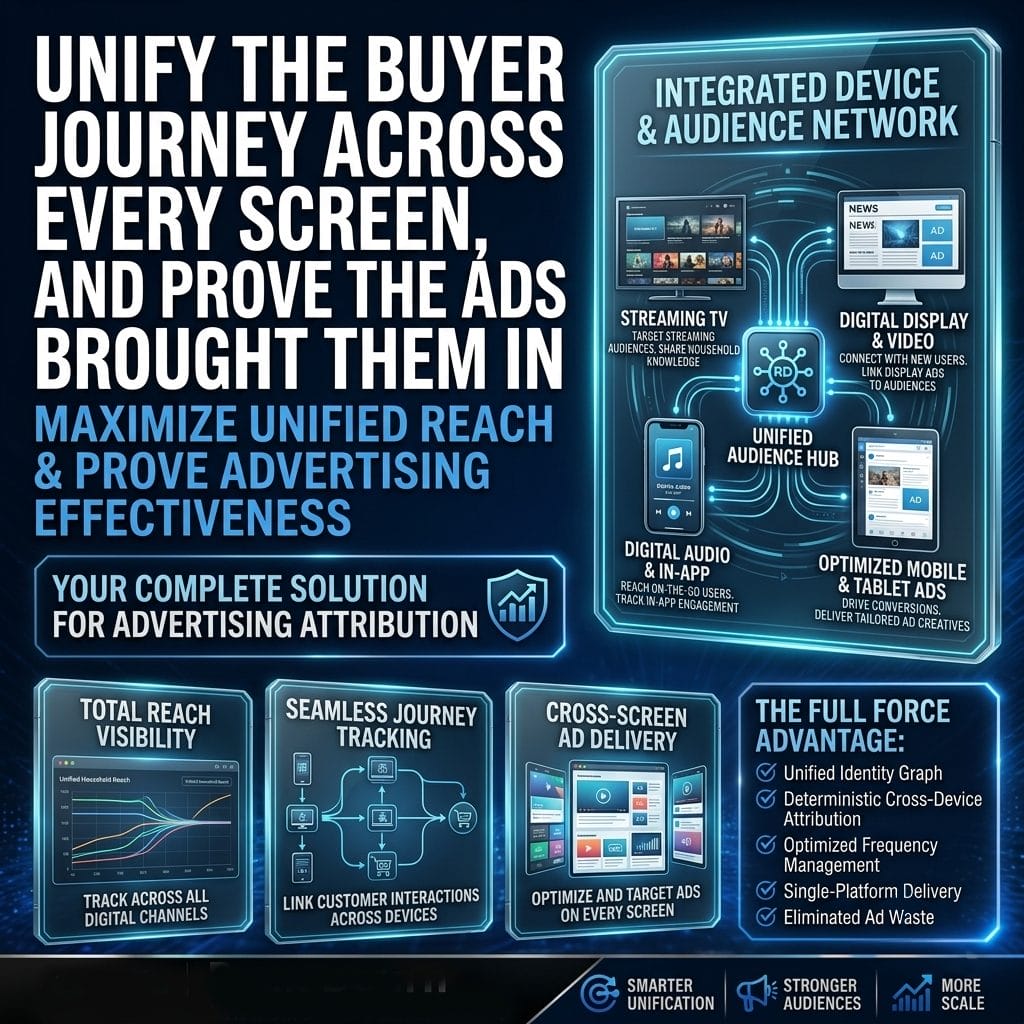
Your buyers watch Hulu after dinner, stream Spotify on the drive in, and read the local news site at their desk. A radio buy catches maybe one of those. Search catches them only after they have already decided to go looking. And when the rest gets split across four vendors, you pay twice for the same household and get four reports that never quite line up. Most media buyers paper over that with impression totals, which is the easiest number in the business to run up. The privacy changes of the last few years broke a good deal of the tracking that used to backfill the rest.
Full Force Ads runs all of it from one platform, so the household that saw your streaming spot is a household your display and audio budget already knows about.
Roku, Fire TV, Hulu, Apple TV. Full screen, no skip button, and you are buying specific households rather than the whole state the way a broadcast buy does.
Pre-roll and mid-roll on desktop and inside mobile apps. This is the format people still recall a week later, which matters when your sales cycle is longer than a click.
Spotify and Pandora put you in the commute and the workout, hours when there is no screen competing for attention.
Banners and location units inside apps, with GPS deciding who sees them. Useful when proximity is the whole pitch and the person is already three blocks away.
Standard banner sizes across the open web. Nobody builds a campaign on display alone, but it carries most of your retargeting and keeps your name in front of people between visits.
Sponsored posts styled like the site they appear on. They live in news feeds and tend to pull from readers who are already deep in a topic.
Channels decide where an ad shows up. Targeting decides who sees it, and that is where budget gets saved or wasted.
Draw a boundary around a real place: a competitor's parking lot, a trade show floor, a hospital campus, an industrial park. Devices that cross the line get picked up, and you can keep serving those devices for the next thirty days.
Export street addresses from your CRM and upload them. We match those addresses to home networks so your ad runs on the streaming TV and browsers inside those specific houses. The neighbors do not see it.
Almost everyone who lands on your site leaves without calling or filling anything out. A pixel on your pages lets you follow them and ask a second time.
Someone searches your service, reads a few articles, and is not ready yet. You can run display and video against them for the rest of that research window.
Ads matched to what is on the page instead of to a cookie. It has become the dependable option now that third-party cookies are not, and it catches people while the subject is still in front of them.
Minnesota contractors get whipsawed by the seasons, and their search costs move right along with the weather. Contextual sidesteps the bidding war.
In January, furnace repair ads run next to articles about frozen pipes and sub-zero forecasts. By July the same budget goes to AC repair beside heatwave coverage and home efficiency guides. The weather feed can be wired straight into the campaign, so furnace ads go live across Minneapolis news sites the morning a cold snap lands.
Two things come out of that. Acquisition cost drops, because you are not bidding against every HVAC company in the metro for one keyword. And your name ends up inside publications people already read and trust.
| Separate vendors | Full Force Ads | |
|---|---|---|
| Management | A platform per channel, a bill per platform | TV, video, audio, display, mobile, and native in one place |
| Targeting | Broad demographic rules with heavy spillover | Building-level geofencing, address matching, contextual signals |
| Reporting | A monthly PDF with impression totals | Weekly reporting on placements, devices, conversions |
| Contracts | Annual terms with fixed minimums | Budgets that move with performance |
| Time to launch | Four to eight weeks | Five to seven business days |
If the goal is local awareness, geofencing and mobile display do most of the work. Going after a competitor's customers means geofencing paired with addressable, so you reach them at the competitor's location and again at home. Expanding the brand into a new market calls for streaming TV and digital video. When you want traffic that is already in-market, run native alongside search retargeting. And if the list you want back is your own customer file, addressable streaming TV and display will put you in front of it again.
It starts with a discovery call: who you are trying to reach, what you have already run, what happened, and where you want to grow. We come back with a channel mix and a targeting plan, written with reach and frequency numbers you can hold us to.
Creative goes live across the programmatic networks within five to seven business days.
After launch, someone is looking at the numbers daily rather than monthly. Bids get adjusted. Geofence boundaries get redrawn when the data says the first ones were wrong, and contextual rules get tightened so budget follows whatever is producing. A report lands every week with placements, devices, and conversions in it.
Book a discovery call at fullforceads.com.