
Your agency sends you a monthly report. It shows impressions, clicks, CTR, and platform-specific ROAS. Everything looks directionally positive. And yet revenue isn't growing the way it should.
The brands outperforming their competitors in 2026 aren't watching ad platform metrics. They're watching their business engine,a completely different set of numbers that connects marketing activity directly to revenue, profitability, and long-term growth.
Here are the five metrics we track for every client from day one. If your current agency has never mentioned these, that's the most important thing this article will tell you.
In a cookieless, multi-platform world, relying on CTR and CPM is like driving with a broken dashboard. You know the car is moving. You have no idea if you're getting anywhere.
Platform-reported ROAS is increasingly unreliable. Attribution windows are inconsistent across channels. Click-based metrics measure ad activity, not business outcomes. And as third-party data degrades, the gap between what platforms report and what actually happened in your business continues to widen.
The CMO in 2026 is no longer just the creative director. They are the financial architect of growth,and that role requires a different set of instruments.
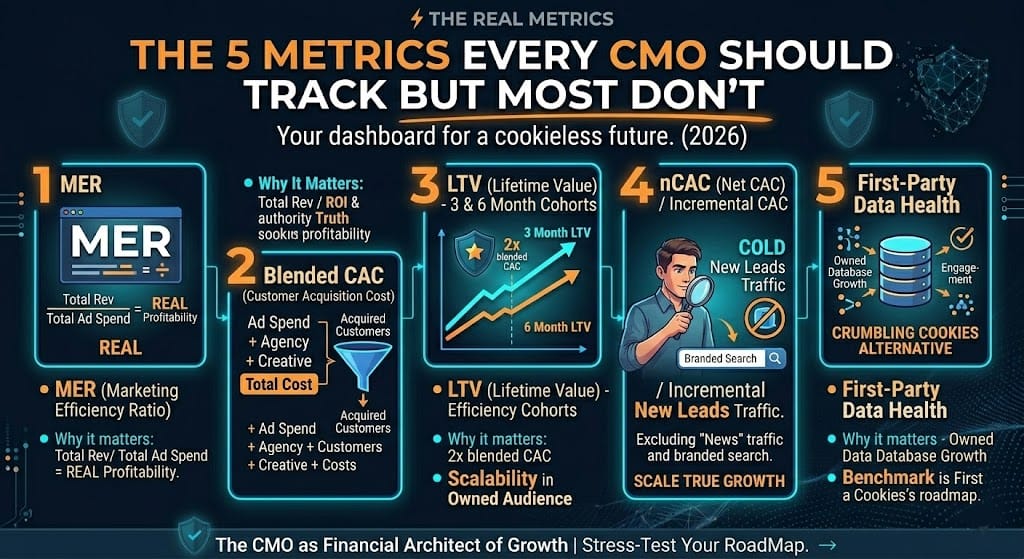
What it is: Total Revenue divided by Total Ad Spend. A single, clean ratio that tells you how hard your entire marketing budget is working.
Why it matters: When customers touch CTV, native, search, and social before converting, no single platform gets accurate credit. Platform ROAS is inflated by design,every channel claims the conversion. MER cuts through the noise by measuring total output against total input, giving you the ground truth of marketing profitability across your entire mix.
2026 benchmark: Varies by industry and margin structure, but a healthy baseline is a minimum MER of 2.5–3.0. Below that threshold, your marketing spend is likely not sustaining viable unit economics.
What it is: Total Marketing Costs (ad spend + agency fees + creative production) divided by the number of net new customers acquired in the same period.
Why it matters: Channel-specific CAC from Facebook or Google excludes the fixed overhead required to operate those platforms. It flatters the number. Blended CAC is the true cost of growth,and it is the only version of CAC that tells you whether your business model is actually viable at current spend levels.
2026 benchmark: Blended CAC must be significantly lower than your 3-month customer LTV. If it isn't, you are acquiring customers at a loss and scaling that loss with every dollar of additional spend.
What it is: The average revenue generated by a new customer within their first 90 or 180 days with your brand, tracked by the cohort of when they were acquired.
Why it matters: You cannot set a rational Target CAC without knowing your LTV. Beyond the number itself, cohort tracking reveals something more important: whether your customer quality is improving or declining over time. If your 3-month LTV is shrinking quarter over quarter, your acquisition channels are pulling in lower-value customers,regardless of what your conversion volume looks like.
2026 benchmark: Your 3-month LTV should be at minimum 2x your blended CAC. Below that ratio, growth is structurally unsustainable.
What it is: The cost to acquire a customer who has never previously interacted with your brand,calculated by isolating cold prospecting spend from retargeting and branded search.
Why it matters: Many brands are unknowingly paying to re-acquire their own existing customers through retargeting and branded keyword bidding, then counting those conversions as new growth. nCAC strips that out and measures only the efficiency of true cold acquisition, the engine that actually scales a business.
In a cookieless environment where third-party lookalike audiences are degrading, nCAC becomes the single most important indicator of whether your prospecting strategy is working or deteriorating.
What to watch: If your blended CAC is stable but your nCAC is rising, you are becoming increasingly dependent on re-engaging existing customers to hit your conversion numbers. That is a scaling ceiling, not a growth engine.
What it is: Two connected measurements: the rate at which your owned database (email, SMS, zero-party data) is growing, and the percentage of that database that is actively engaging or purchasing.
Why it matters: As third-party cookies continue to deprecate and platform targeting loses fidelity, your owned audience becomes your most defensible marketing asset. First-party data is the foundation of your retargeting capability, your lookalike modeling, your CTV audience matching, and your geofencing seed lists.
If this metric is flat or declining, your ability to run efficient paid campaigns across every channel is quietly eroding,regardless of what your current ROAS reports show.
What healthy looks like: Database growth outpacing customer churn, with an activation rate demonstrating that new subscribers are converting to purchasers within a defined window.
These five metrics do not require enterprise-level tooling. They require clear definitions, consistent data inputs, and a weekly or monthly review cadence that connects marketing activity to business outcomes rather than platform activity.
The starting point is a 30-minute roadmap session that maps each metric to your current data sources, identifies where the gaps are, and establishes the baseline numbers you're actually working from. Most brands discover in that session that they have the data, it just isn't being organized into the right view.
The brands that win in 2026 aren't outspending their competitors. They're out-measuring them.
What is MER in marketing and how do you calculate it? MER, or Marketing Efficiency Ratio, is calculated by dividing total revenue by total ad spend over the same period. It provides a holistic view of marketing profitability that accounts for multi-touch customer journeys where no single platform receives accurate attribution credit.
What is the difference between CAC and blended CAC? Standard CAC is typically reported at the channel level by ad platforms and excludes agency fees and creative costs. Blended CAC includes all marketing-related costs divided by total new customers acquired, giving a true picture of what growth actually costs the business.
What is nCAC and why does it matter in a cookieless world? nCAC, or net Customer Acquisition Cost, measures the cost to acquire a genuinely new customer by isolating cold prospecting spend from retargeting and branded search. As third-party audience targeting degrades in a cookieless environment, nCAC is the clearest indicator of whether prospecting efficiency is improving or declining.
How do you measure first-party data health? First-party data health is measured by tracking two rates: the growth rate of your owned database (email, SMS, zero-party data) and the activation rate of that database (the percentage converting to purchases within a defined window). Both metrics should be reviewed monthly alongside paid media performance.
What LTV to CAC ratio should marketers target in 2026? A healthy benchmark for 2026 is a 3-month LTV of at least 2x blended CAC. Below this ratio, customer acquisition is structurally unprofitable at scale. Tracking LTV by acquisition cohort also reveals whether customer quality is improving or declining over time.
Your competitors aren't outspending you. They're out-measuring you. Fix the dashboard first.
