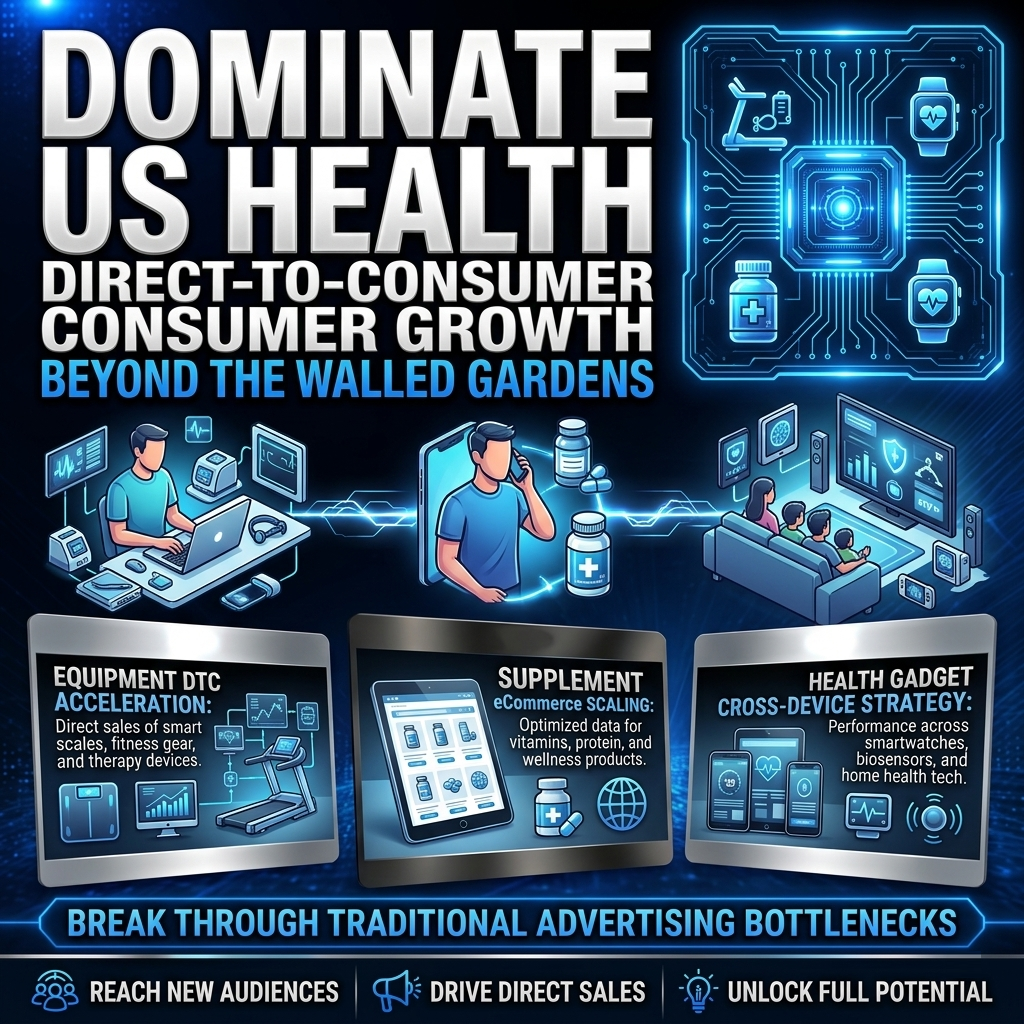
The direct-to-consumer market for health equipment, supplements, and wellness gadgets in the US has hit a wall. Brands in these categories see strong customer interest, but their growth stalls out when they rely entirely on standard digital ad platforms.
For years, eCommerce founders relied on standard search and social media feeds. That approach is no longer working. Rising customer acquisition costs, ad account suspensions over health claims, privacy updates, and severe platform saturation have turned those legacy networks into expensive treadmills with shrinking returns.
To build reliable growth, health and wellness companies are looking past traditional digital platforms. Many are moving to programmatic advertising, using a network that offers real-time targeting, multi-screen reach, and clear reporting without platform lock-in.
Based in Sandy, Utah, Full Force Ads builds independent media buying infrastructure for companies that need precision and speed. The company does not operate as a social media or search agency. Instead, it runs its own programmatic DSP and DMP stack.
Note: Full Force Ads focuses strictly on programmatic multi-channel media buying across its own platform network. It does not provide Google Ads, Meta Ads, social media management, or SEO services.
Selling health products online in the US involves managing regulatory limits, buyer skepticism, high average order values, and long decision cycles.
Challenge A: The high-ticket hurdle for health equipment
Products like red-light therapy panels, recovery boots, home rehabilitation setups, and infrared saunas cost anywhere from $300 to over $3,000. Buyers rarely purchase these on impulse. They need clear explanations, proof that the product works, and repeated brand exposure across devices over a 30-to-90-day window. Simple banner clicks and static social posts do not build that level of buyer trust.
Challenge B: Compliance flags and feed saturation for food supplements
The US supplement market, including nootropics, gut health formulas, longevity compounds, and sports nutrition, is crowded. Brands using mainstream social networks often run into flagged ad accounts, rejected copy, or sudden account bans when automated content filters misinterpret standard health claims. Standing out among endless bottle photos in a crowded social feed is equally difficult.
Challenge C: Demonstration needs for health gadgets and wearables
Continuous glucose monitors, posture trainers, sleep rings, and biohacking wearables need clear demonstrations. Customers want to see the hardware in use, understand the companion app, and see how the device fits into their daily routine. Static images cannot communicate those details well.
To clear these hurdles, health brands need to spread their media spend across several digital formats. Through Full Force Ads, companies can manage campaign delivery across six primary media channels from one central system.
| Media channel | Role for health and wellness eCommerce | Typical inventory and networks |
| Streaming TV (CTV) | High-impact video storytelling for higher-priced health equipment and gadgets. | Hulu, Roku, Peacock, Fire TV, Paramount+, YouTube TV |
| Video | Pre-roll and mid-roll clips showing product features, unboxings, and clinical details. | Top digital publishers, niche health sites, news apps |
| Audio | Audio touchpoints targeting listeners during workouts, walks, and commutes. | Spotify, Pandora, iHeartRadio, wellness podcasts |
| Mobile | In-app and mobile web ads combined with location data. | Tier-1 iOS and Android apps, mobile publishers |
| Display | High-frequency retargeting and foundational awareness banners across niche media. | Millions of niche content websites and digital publications |
| Native | Editorial-style content matching surrounding article layouts. | News platforms, health magazines, wellness blogs |
Streaming TV (CTV)
Place health equipment or new gadgets on the largest screen in the home. Full Force Ads runs targeted CTV campaigns across streaming platforms like Hulu, Roku, Peacock, Paramount+, and YouTube TV. Unlike traditional cable, CTV allows brands to target specific household income tiers and health-interest profiles, keeping ad spend focused on qualified buyers.
Video advertising
Capture user attention with sight, sound, and movement. Using pre-roll, mid-roll, and outstream video across websites and apps, brands can demonstrate how a device works or feature customer stories for dietary supplements.
Digital audio
Health-focused consumers listen to a lot of digital audio. Reaching users on Spotify, Pandora, iHeartRadio, and niche health podcasts lets brands connect with buyers during workouts, daily commutes, or evening routines.
Mobile advertising
Reach consumers on the devices they check constantly throughout the day. Full Force Ads runs optimized in-app, mobile web, and location-based ad placements that send interested users straight to an online store.
High-impact display
Display ads form the backbone of retargeting and broad category outreach. Placing banners across millions of vetted websites and mobile apps maintains steady brand awareness without overspending.
Native advertising
Native ads match the visual design and layout of the publisher site hosting them. For supplement brands that need space to explain a product, such as a new probiotic strain or recent clinical testing, native advertorials drive higher engagement than standard banners.
Broad reach without audience controls leads to wasted spend. Channels determine where an ad appears, while programmatic targeting determines who sees it. Full Force Ads builds several targeting methods directly into its platform setup.
Building-level geofencing precision
While legacy platforms limit advertisers to wide zip codes or broad radius circles, Full Force Ads uses precise location polygons. Brands can map the exact physical outlines of specific locations.
Equipment brands can geofence physical therapy clinics, sports medicine offices, crossfit gyms, and wellness expos. Supplement brands can trace competing retail shops, specialty stores, bodybuilding events, and marathon halls. Gadget brands can target tech conferences, fitness clubs, and electronics expos.
When a potential buyer enters these mapped areas with a mobile device, the platform captures an anonymized device ID. Ads can then serve to that user in real time and continue across their home devices through cross-device mapping.
Addressable household targeting
If a business maintains a customer relationship management (CRM) database, prospect list, or direct-mail file, Full Force Ads can upload those street addresses directly. The platform matches physical addresses to internet-connected devices operating in those homes, serving custom CTV, display, and video ads directly to target households.
Search retargeting
Capture active buying intent without bidding on expensive pay-per-click search terms. Search retargeting tracks users based on recent search terms submitted across the web. If someone searches for "best red-light therapy for muscle recovery" or "top liposomal glutathione supplement," the platform serves display, native, or video ads to that user as they browse other sites.
Site retargeting
Most first-time site visitors leave an eCommerce store without buying. Site retargeting re-engages visitors who dropped off a product page or abandoned a shopping cart. Serving follow-up ads across CTV, display, and video brings interested buyers back to complete their order.
Contextual targeting
Contextual targeting places ads alongside web articles, digital reviews, and videos covering related topics. For example, a smart sleep-tracker ad can run inside articles about sleep optimization, or a supplement ad can appear next to content about joint health.
Every eCommerce company operates with different internal resources and team preferences. Full Force Ads supports both managed execution and direct platform access.
Option A: Fully managed agency services
For brands that want to focus on product inventory, development, and overall strategy, Full Force Ads operates as an extension of the internal team.
Clients work with Utah-based programmatic media managers who build plans tailored to target order values and growth goals. Onboarding is fast: campaigns go live in 5 to 7 business days rather than the six-week onboarding common at traditional agencies. Reporting stays clear, with weekly updates on placements, impressions, video completion rates, click performance, and conversion metrics.
Option B: Self-serve access via FullForceAds.app
For digital agencies, white-label partners, and in-house buying teams that want direct operational control, the platform offers self-serve access through FullForceAds.app.
Teams log in to build target audiences, upload creative assets, adjust bidding rules, and launch campaigns directly. The built-in Data Management Platform (DMP) processes unstructured data, refines audience groups, and scales active segments. Budgets stay flexible: users can adjust daily spending, pause low-performing placements, or shift budget across CTV, mobile, and display based on incoming sales data.
Companies looking to combine these channels can use several starting setups based on specific business goals.
Scenario 1: Intercepting competitor audiences (conquesting strategy)
This setup targets customers who are actively researching or buying from competing equipment or gadget brands. The channel combination uses geofencing and addressable targeting: geofence competitor retail stores, trade shows, and distribution locations, then map those captured device IDs to deliver offers highlighting better product specifications, longer warranties, or lower pricing.
Scenario 2: Building category trust for high-ticket health tech
This approach builds market trust for recovery gear or health tech priced above $500. The channel combination uses CTV, video, and digital audio: run 15- and 30-second CTV ads on platforms like Hulu and Roku targeting households earning over $100,000 with fitness interests, then follow up with pre-roll video demos on desktop and mobile alongside audio ads during workout sessions.
Scenario 3: Scaling direct-to-consumer supplement sales
This strategy drives qualified traffic to subscription pages for daily supplements or wellness products. The channel combination uses display, native, and search retargeting: reach users searching for specific ingredients, send that traffic to native advertorials explaining clinical research, and keep display banners running across health sites to maintain visibility.
Scenario 4: Recapturing abandoned carts and site visitors
This setup turns lost website traffic into completed orders. The channel combination uses site retargeting, display, and video: place retargeting pixels across checkout pages and main product sections, then serve creative with customer reviews, unboxing clips, and time-sensitive offers across web properties to encourage return visits.
When evaluating media partners, eCommerce brands often face strict contract terms, high minimum spending requirements, and vague reporting. Full Force Ads structures its service to avoid those constraints.
| Feature / capability | Typical media vendors | Full Force Ads |
| Monthly budget requirements | Often $10,000+ minimums | Flexible budgets built to scale |
| Contract commitments | 6 to 12-month lock-ins | No long-term contracts |
| Geofencing precision | Broad zip-code radiuses | Building-level polygons |
| Channel aggregation | Requires multiple vendors | All 6 channels in one DSP |
| Reporting transparency | Monthly aggregated PDFs | Weekly transparent reporting |
| Platform access | Closed agency system | Managed or FullForceAds.app |
By operating its own programmatic stack, Full Force Ads cuts out extra vendor markups, putting those funds directly toward media placement efficiency.
Getting started with programmatic media does not require months of onboarding or technical setups. The launch workflow gets campaigns live quickly.
Taking control of eCommerce media execution
Scaling a US health equipment, supplement, or gadget brand requires looking beyond traditional advertising platforms. Diversifying into targeted Streaming TV, pre-roll video, digital audio, mobile, display, and native ads backed by geofencing and search retargeting helps build consistent growth across buyer touchpoints.
Whether using managed services through Utah programmatic specialists or self-serve tools via FullForceAds.app, brands gain direct access to programmatic technology built for business growth.