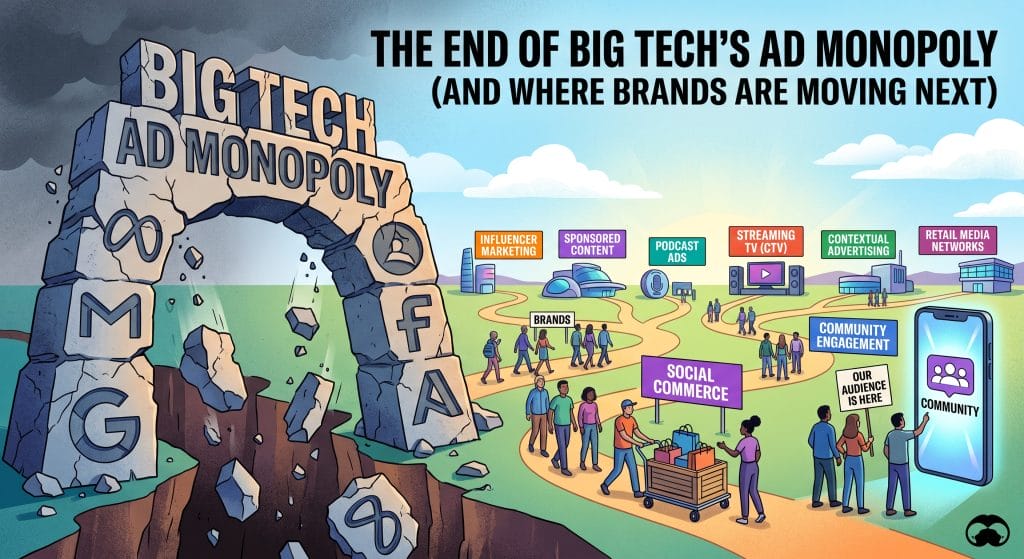
The traditional digital marketing playbook is broken. For years, the strategy was simple: drop 80% of your budget into search engines and social feeds, throw the rest at basic display networks, and hope for the best.
Rising acquisition costs, lower returns, ad fatigue, and privacy restrictions have turned those walled gardens into expensive auction houses with shrinking yields. Most business owners spend more every quarter just to get the same lead volume they had three years ago. The issue usually isn't the ad copy or the creative. It's the distribution infrastructure. When you rely solely on big tech platforms, you bid against millions of competitors inside the same closed ecosystems, paying top dollar for inflated impressions and vague metrics.
To build predictable growth, brands are shifting toward independent, omnichannel programmatic advertising. Instead of buying ads on isolated platforms, programmatic tech lets you bid directly on ad inventory across the web. That includes streaming TV, online video, digital audio, mobile apps, display, and native placements, all managed with unified attribution.
At Full Force Ads, an agency based in Sandy, Utah, we help brands move past these platform limits. We give businesses direct access to over 95% of the web and streaming ecosystems without massive spend requirements, long-term contracts, or black-box reporting.
Omnichannel advertising isn't about running ads everywhere at once. It means meeting prospects at specific points in their buying process with the format that actually drives action. We run campaigns across six core channels to coordinate your reach across the web:
Channels dictate where your message appears, but targeting determines who pays attention. The primary reason campaigns waste money is loose, demographic-only targeting that pays for irrelevant impressions. We layer data models onto every channel so your dollars target active prospects.
Geofencing uses location technology to build virtual perimeters around physical sites down to the property line. You can fence competitor storefronts to serve targeted ads to their clients, capture attendees at trade shows, or target specific commercial yards.
Addressable targeting matches physical street addresses directly to household internet routers and connected devices. This lets you serve digital ads to direct-mail lists or customer databases, pairing print mail with streaming TV, mobile, and display ads.
Search retargeting lets you reach users based on active search queries entered across search engines and niche portals without paying high search engine pay-per-click markups. If a customer searches for specific enterprise software, your video or display ad can show up while they read the news later in the day.
Contextual algorithms scan web page text, video metadata, and category structure in real time. This places your ad next to relevant content, like putting corporate finance ads right alongside articles on quarterly market trends, all without relying on third-party tracking cookies.
When financial firms test new growth channels, they don't bet their whole quarterly budget on unproven tactics. They run controlled tests to gather real performance data first.
First, set aside 10% to 15% of your monthly media budget strictly for programmatic channel testing. Keep the remaining 85% in your proven core channels to protect your cash flow.
Second, avoid testing single channels in isolation. Pair a top-of-funnel driver with a low-funnel capture channel, like pairing Streaming TV with site retargeting, or geofencing with search retargeting.
Third, let campaigns run for 14 days without manual interference to gather baseline data. On Day 15, run a placement audit to cut low-performing publisher domains and shift budget toward top-converting zip codes and creative variations.
Finally, scale the budget into a campaign only after achieving clear cost-per-acquisition or lead-quality metrics that fit your unit economics.
While enterprise brands often prefer managed agency services, many internal marketing teams and media buyers require direct control. That is why we built FullForceAds.app, a self-serve platform for campaign management.
The platform allows media buyers to launch multi-channel campaigns through a single interface. You can draw custom geofences around target locations, upload addressable street lists, set frequency caps, and connect directly to major ad exchanges for streaming TV, native, video, audio, and display inventory. The dashboard provides real-time tracking for impressions, click-through rates, placement domains, and conversions.
Every business goal needs a distinct channel combination to eliminate wasted ad spend:
| Business Goal | Recommended Channel Mix | Key Metrics |
| Local Market Awareness | Geofencing, Mobile Ads, Localized Display | Impression Share, CTR, Store Visit Lift |
| Competitor Conquesting | Micro-Geofencing, Addressable Household, Mobile Retargeting | CTR, Conversion Rate, Cost Per Lead |
| Regional Brand Building | Streaming TV, Pre-Roll Video, Digital Audio | Video Completion Rate, Audio Completion Rate, Brand Recall |
| Website Traffic & Lead Gen | Search Retargeting, Contextual Native, Standard Display | Cost Per Click, Bounce Rate, Form Fills |
| Re-Engaging Past Visitors | Dynamic Site Retargeting, Native Banners, Short Video | Return Visitor Rate, Conversion Rate, Overall CPA |
| Account-Based / List Reach | Addressable Household, Streaming TV Addressable, B2B Display | Match Rate Percentage, Account Engagement, Pipeline Velocity |
Traditional agencies often lock clients into long contracts, hide fees behind bundled pricing, or pass account management off to junior staff. We built our agency around simple transparency and flexible terms.
We plan, execute, manage, and optimize your entire campaign architecture across streaming TV, video, audio, mobile, display, and native from a single platform. Advanced geofencing, addressable IP matching, search retargeting, and behavioral overlays ensure your ad dollars reach real human prospects rather than bot traffic. Weekly reporting shows you precisely where your ads ran down to the exact publisher domain, streaming network, device type, and location.
We offer month-to-month flexibility with no mandatory long-term contracts or massive enterprise retainers. And while traditional media agencies take three to six weeks to onboard, our launch team gets targeted campaigns live in five to seven business days.
Getting started with our team follows four straightforward steps:
Whether you need a fully managed partner or direct access to our self-serve portal at FullForceAds.app, you can scale across every screen with precision data. Contact our media team today to review your channel strategy or schedule a campaign consultation.