The digital ad market hit a ceiling recently. For over ten years, American companies threw most of their ad dollars at Google, Meta, and a few major social platforms. But as customer acquisition costs keep rising and algorithm updates feel more random, those standard channels are yielding worse results for the price.
Getting in front of actual buyers today takes more than running basic search ads or boosting social posts. It takes showing up across the actual mix of screens people use every day.
Full Force Ads, an agency based in Sandy, Utah, handles that broader footprint. They run a programmatic ad platform that reaches past social feeds and standard search networks to buy ad space across the rest of the web.
The strategic shift: Moving beyond walled gardens
Relying strictly on mainstream social feeds or basic search terms puts your budget into overcrowded auctions. Bids go up, ad quality drops, and reaching a specific audience turns into an expensive guessing game.
Performance marketing works better when you can buy across the whole open web. People do not spend their lives on a single social feed or typing questions into a search bar. They stream shows on Roku and Hulu, play podcasts on Spotify, read local news on mobile apps, and drive to physical stores every afternoon.
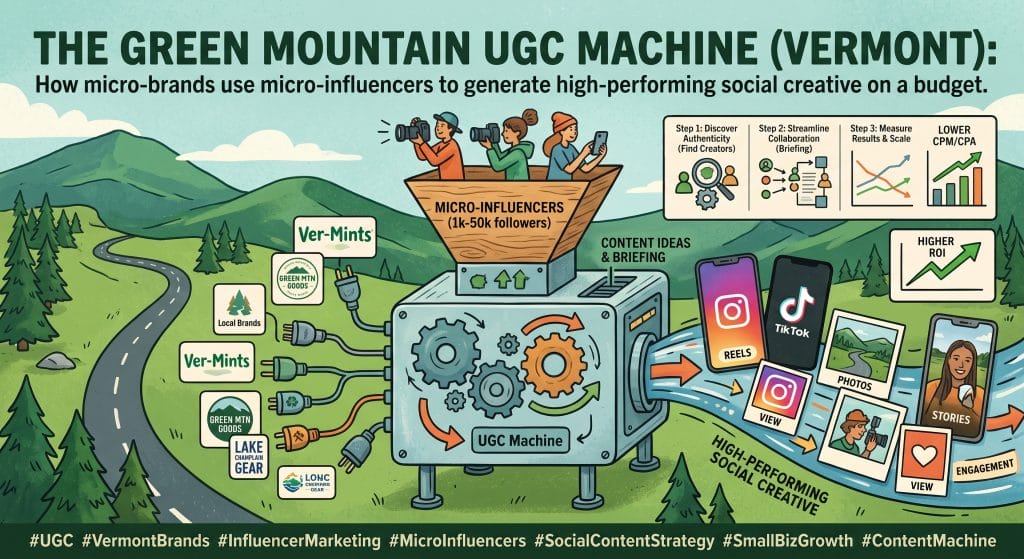
Small consumer brands in Vermont, from local food makers to outdoor gear shops, have built a cheap, reliable way to churn out social media ads. Marketers call it the "Green Mountain UGC Machine," but at its core, it is just a systematic way to get hundreds of short videos without paying an agency.
Instead of dropping five figures on polished ad campaigns or paying big influencers for a single post, these brands treat content like a simple assembly line. They hire small creators to make authentic, unpolished videos on a tight budget.
The system relies on four basic steps:
Agency Production vs. In-House UGC Assembly
| Metric | Traditional Agency | Green Mountain Model |
| Average cost | $5,000 to $15,000 per campaign | $100 to $300 per asset package |
| Asset volume | 1 to 3 polished videos | 15 to 30 raw videos |
| Usage rights | 1 to 6 months | Full perpetual rights |
| Style | High production value | Informal and direct |
| Speed | 4 to 8 weeks | 7 to 10 days |
Setting up the system
Full Force Ads handles this shift by opening up programmatic ad inventory across every major digital channel through one platform and team.
| Strategic focus | Walled gardens (social / standard search) | Full Force Ads programmatic platform |
| Inventory reach | Limited to specific platform apps and feeds | Millions of websites, apps, CTV networks, and audio streams |
| Location precision | Broad ZIP-code or city-level radiuses | Custom, building-level geofencing polygons |
| Household targeting | Approximate demographic groupings | Addressable household-level device matching |
| Channel unified view | Disjointed reporting across platforms | Unified multi-channel strategy and consolidated reporting |
| Attribution | Click-focused, self-reported metrics | Verified foot-traffic and Conversion Zone physical attribution |
Omnichannel advertising: Reaching audiences across every screen
To build recognition and turn intent into sales, your message needs to follow people naturally through their daily routines. Full Force Ads runs managed campaigns across six main formats.
Streaming TV puts video ads on living room screens, targeting specific homes with non-skippable ads on Roku, Fire TV, Hulu, Peacock, and YouTube TV. Digital video uses sight, sound, and motion across pre-roll, mid-roll, and outstream slots on popular websites and apps. Digital audio reaches people during screen-free time, running ads on Spotify, Pandora, podcast networks, and digital radio while listeners commute or work out. Mobile ads catch people on their phones through in-app, mobile web, and location-based placements. Display banners maintain a steady visual presence across millions of vetted websites to handle basic retargeting and brand exposure. Finally, native ads blend directly into the layout and editorial design of host websites, pulling higher click rates through a less intrusive feel.
You can view the full channel setup on the Full Force Ads Advertising Solutions page.
High-precision targeting: Getting ads in front of actual buyers
Buying millions of ad impressions does not mean much if those screens belong to people who will never buy your product. Channels dictate where an ad lands; targeting rules decide who sees it. Full Force Ads builds a few distinct targeting layers into its setups:
Case plan: Regional micro-brands and local growth
Consider how this works for a local brand in a competitive market. Businesses like the small regional brands operating inside the Green Mountain UGC Machine setup in Vermont often have to compete with large national budgets on modest marketing funds.
Instead of burning cash on broad, generic campaigns, a local business can combine geofencing, display ads, and addressable targeting. They can draw a geofence around a local trade show, gather device IDs on site, and follow up over the next week with user-generated style video ads across mobile apps and connected TVs.
That approach keeps every dollar focused on people who were physically present at a relevant location.
Recommended strategy matrix based on business goals
Different companies run on different performance metrics. The matrix below shows how Full Force Ads sets up multi-channel campaigns based on specific business targets:
| Business goal | Strategic channel mix | Primary audience focus |
| Local foot-traffic and awareness | Geofencing + Mobile + Display | Nearby physical shoppers and event attendees |
| Conquest competitor market share | Geofencing + Addressable Targeting | Active customers visiting competitor locations |
| High-impact brand building | Streaming TV (CTV) + Pre-roll Video + Audio | Household decision-makers on premium media |
| In-market website traffic | Display + Native + Search Retargeting | Users actively searching for industry keywords |
| Convert bouncing site visitors | Site Retargeting + Native + Display | Warm leads who left without submitting a form |
| Activate CRM and customer lists | Addressable + Streaming TV + Mobile | Matched residential physical addresses |
Agency managed services vs. self-serve platform (FullForceAds.app)
Full Force Ads offers two main ways to run campaigns, depending on your team's size and technical preferences:
Full service and agency managed services
For companies that prefer to hand off execution entirely, Full Force Ads manages the whole process. The Utah-based team handles target planning, creative setup, campaign launches, and daily optimization.
Direct self-serve platform access (FullForceAds.app)
For in-house marketing teams, media buyers, and independent agencies that want direct control, Full Force Ads opens up its underlying self-serve tool at FullForceAds.app.
The self-serve interface lets you launch campaigns, upload creative assets, and adjust targeting rules whenever you want. You get direct access to global ad exchanges and building-level geofencing without big enterprise spend requirements or long contracts. Agencies can also white-label the software to manage multi-channel runs for their own client rosters.
1.Discovery call:
A straightforward consultation to go over your current market, main offer, audience demographics, and performance targets.
2.Custom strategy recommendation:
The team builds a specific channel and targeting plan for your budget and sales cycle rather than pulling out a generic template.
3.Rapid campaign launch:
Once you approve the creative materials, campaigns go live across CTV networks, mobile apps, and audio streams within 5 to 7 business days.
4.Continuous optimization and transparent reporting:
You get weekly reports showing exact ad placements, user interactions, and real-world store visits. Bids and audiences are tuned continuously based on incoming performance data.
Why Utah businesses and national brands choose Full Force Ads
Full Force Ads started in Utah in 2015 with a simple approach: deliver transparent, targeted multi-channel advertising without high spending minimums, vague reporting, or long contracts.
Weekly reports show the exact websites and apps where your ads ran, video watch rates, and real foot-traffic numbers tied to your campaign. With no long-term contracts, you can adjust or scale your ad spend based on performance instead of being locked into a multi-month deal. Physical store visits are tracked directly through Conversion Zone location data, giving you clear offline attribution for your online ad spend.
If you want to update your ad setup and reach active buyers across multiple screens, head over to the Full Force Ads Advertising Solutions page to check out channel details or schedule a quick walk-through with their team.