Modern businesses face a quiet growth problem. Ad budgets get eaten up by rising costs, closed platforms, and scattered vendors. Brands keep paying more for less, facing higher CPMs, vague metrics, and disconnected platforms that do not bring in sales or foot traffic.
To grow consistently, companies need to drop piecemeal ad setups and switch to unified programmatic targeting. Based in Utah, Full Force Ads runs an ad platform built to trim wasted spend and connect with verified buyers across all their devices.
Instead of reselling standard social media ads, Full Force Ads acts as an independent platform. It gives brands direct access to inventory across Streaming TV, Video, Audio, Mobile, Display, and Native channels.
Marketing teams often run into trouble managing too many separate vendors. Handling different partners for streaming, display retargeting, and location-based mobile ads creates extra work and silos your data.
       ┌─────────────────────────────────────────────────────────┐
       │             FULL FORCE ADS PLATFORM                     │
       └────────────────────────────┬────────────────────────────┘
                                    │
    ┌──────────────┬────────────────┼────────────────┬──────────────┐
    │              │                │                │              │
┌───▼────┐   ┌─────▼──────┐   ┌─────▼──────┐   ┌─────▼──────┐   ┌───▼────┐
│Streaming│   │ Video/Audio│   │   Mobile   │   │ Display    │   │ Native │
│   TV   │   │  Pre-Roll  │   │ Location-  │   │ Banners &  │   │ In-Feed│
│ (CTV)  │   │ Digital AM │   │   Based    │   │ Retargeting│   │ Content│
└───┬────┘   └─────┬──────┘   └───┬────┘   └───┬────┘   └───┬────┘
    │              │                │                │              │
    └──────────────┴────────────────┼────────────────┴──────────────┘
                                    │
       ┌────────────────────────────▼────────────────────────────┐
       │             UNIFIED HYPER-TARGETING & DATA              │
       │ (Geofencing, Addressable Household, Site/Search Intent) │
       └─────────────────────────────────────────────────────────┘
When ad channels operate on their own, customer journeys fall apart in three clear ways. Frequency caps stop working, which annoys users or wastes views. Attribution gets messy, making real acquisition costs hard to track. Finally, data platforms cannot share audience signals across formats.
To build a steady presence, businesses need to treat digital touchpoints as a connected network. A customer might see an unskippable CTV ad on Hulu, hear a supporting audio ad on Spotify during work, and buy something after clicking a native ad on a news site.
Full Force Ads brings these channels together under one platform. Running everything through a single system cuts out extra middleman costs, protects data accuracy, and keeps every impression focused on conversions.
Good advertising matches how people actually use their devices throughout the day. Full Force Ads provides direct access to six media channels through its core system.
| Channel | What it does |
| Streaming TV (CTV) | Full-screen video ads on living room TVs |
| Online Video | Pre-roll, mid-roll, and outstream video placements |
| Digital Audio | Audio ads during commutes and screen-free moments |
| Mobile & In-App | Location-based tracking down to specific devices |
| Display Networks | Standard banner ads for broad reach and retargeting |
| Native Content | In-feed article ads that match surrounding site design |
Traditional TV does not reach everyone like it used to. Cable cutting shifted viewers over to apps like Roku, Fire TV, Hulu, and Peacock. Connected TV (CTV) puts video ads directly on living room screens. Instead of buying broad TV regions, streaming campaigns use real household data to show specific ads to chosen neighborhoods or physical addresses.
Holding interest on phones and computers takes a mix of movement and sound. Through options like pre-roll, mid-roll, and native video, brands run campaigns across news sites and apps.
Screen-free audio catches people while driving, working out, or working. Digital audio campaigns on Spotify, Pandora, and podcast networks let brands reach listeners directly, combining audio spots with clickable banners to spur immediate action.
Mobile location data turns real-world footsteps into clear audience groups. Because mobile devices capture spatial details, Full Force Ads uses app location signals to show relevant ads inside popular apps and websites.
For wide reach and retargeting, standard display ads remain useful. Placing banner ads across verified websites helps businesses keep their brand visible and run retargeting at manageable CPMs.
Native ads blend directly into the layout, fonts, and style of the surrounding article. Skipping standard banner boxes gives native ads higher click rates from readers who usually ignore normal ads.
Good creative work still needs accurate targeting to pay off. Broad filters like "men aged 25 to 54" usually burn through money without bringing in sales.
                     AUDIENCE TARGETING STRATEGIES
                                   │
      ┌────────────────────────────┼────────────────────────────┐
      │                            │                            │
┌─────▼──────┐              ┌──────▼─────┐              ┌───────▼──────┐
│ LOCATION   │              │ HOUSEHOLD  │              │  BEHAVIORAL  │
└─────┬──────┘              └──────┬─────┘              └───────┬──────┘
      │                            │                            │
      ├─ Building-Level Geofence   ├─ Addressable Household     ├─ Site Retargeting
      │  (Competitors, Events)     │  (CRM & Direct Mail Lists) │  (Engaged Visitors)
      │                            │                            │
      └─ Conversion Zone Tracking  └─ Cross-Device Mapping      └─ Search Intent
         (Physical Attribution)       (Household Graphing)         (In-Market Keywords)
Full Force Ads swaps vague profile tags for three direct targeting methods. Building-level geofencing uses drawn location maps instead of wide city circles. Addressable household targeting connects offline customer lists to digital home devices. Search and intent targeting reaches people actively searching for specific words or reading related pages.
City-wide radius circles end up covering empty space, roads, and non-prospects. Full Force Ads draws shapes right around exact property lines instead. These custom boundaries can outline competitor stores, event spaces, trade show halls, medical centers, or commercial blocks.
  TRADITIONAL RADIAL GEOTARGETING         FULL FORCE ADS POLYGON PRECISION

      / - - - - - - - - - \                    +------------------+
    /     [Wasted Area]     \                   |  TARGET BUILDING |
   /                         \                  |  +------------+  |
  |    +-----------------+    |                 |  | Exact      |  |
  |    | Target Building |    |                 |  | Polygon    |  |
  |    +-----------------+    |                 |  +------------+  |
   \                         /                  +------------------+
    \    [Unfocused Radius] /                    [Zero Wasted Footprint]
      \ - - - - - - - - - /
When an opted-in phone enters a mapped area, its anonymous ID joins a target list. The system serves ads while the user is on-site and follows them across devices for up to 30 days after they leave.
Addressable targeting connects physical mailing lists to digital ad buys. Marketers can upload customer addresses or mailing databases right into the system.
Full Force Ads matches physical street addresses to network IP addresses and device sets. This lets brands run digital campaigns on home TVs, phones, and tablets at the same time direct mail hits the mailbox.
Reaching people while they search for answers yields better responses.
Search retargeting shows image and video ads to users who recently searched for specific keyword terms online, capturing active buyers.
Contextual targeting checks page text, article themes, and video topics to place ads next to relevant content, avoiding dependence on third-party tracking cookies.
Most website visitors leave without buying on their first visit. Dynamic retargeting keeps your business in view while those lost visitors browse other sites and apps. Changing ad images based on the specific pages viewed or abandoned carts turns early browsing into completed orders.
To see how tight targeting beats old methods, look at a common local issue: running out of audience.
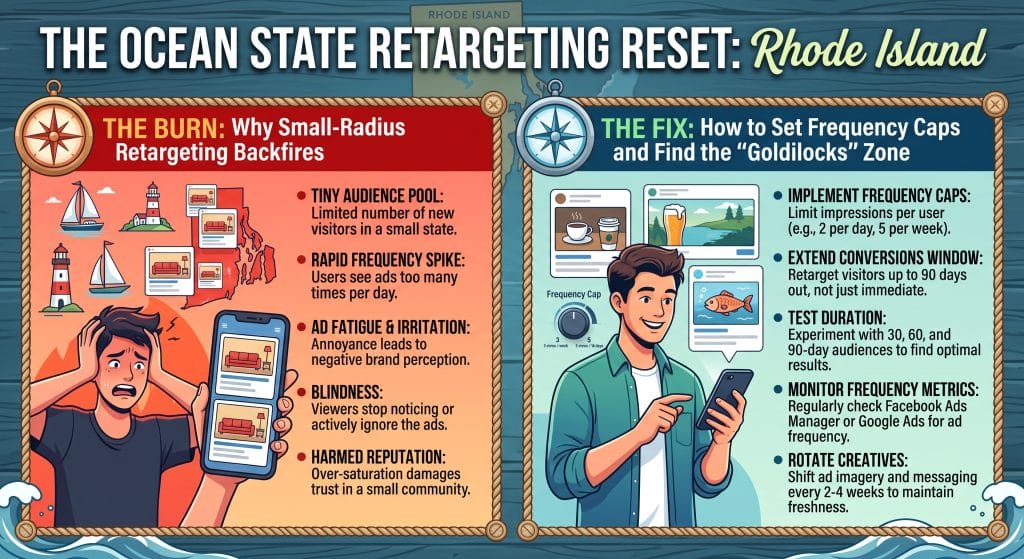
A Rhode Island business launched a campaign across channels to book local services. Using standard settings, the team drew a simple 3-mile circle around their location and set retargeting to run constantly.
In three weeks, performance sank. Click rates dropped 68%, acquisition costs jumped 2.5 times, and customers complained about seeing the exact same ad all day long.
When running ads in a small area like Rhode Island, general delivery settings exhaust the local population quickly. Setting loose frequency rules forces a small group of people to see the same banner dozens of times. That burns budget, annoys potential clients, and stops working fast.
       LOCAL RETARGETING FATIGUE LOOP

       +-------------------------------+
       | Broad Small-Radius Targeting  |
       +---------------+---------------+
                       |
                       v
       +-------------------------------+
       | High Ad Frequency per User    |
       +---------------+---------------+
                       |
                       v
       +-------------------------------+
       | Audience Burnout & Ad Blindness|
       +---------------+---------------+
                       |
                       v
       +-------------------------------+
       | Dropping CTRs & Escalating CPA |
       +-------------------------------+
Full Force Ads reset the campaign settings using tighter programmatic controls.
The team replaced the 3-mile circle with exact shape maps around key target spots, cutting out non-prospects. Cross-channel caps limited ad views to 3 times per user every 24 hours across all devices.
The team also set up ad sequencing so users saw fresh messages based on past actions. Prospects got a video ad first, display banners on day two, and native article ads on day four. Retargeting groups were split by interest level, giving casual visitors lower bid priority while spending more on people who checked pricing pages.
Fixing audience caps and location settings smoothed out ad delivery. Click rates climbed 112%, ad spend went further, and overall customer acquisition costs dropped 41% within 30 days.
Every campaign needs a setup built around its specific market, item cost, and purchase cycle.
| Primary Growth Goal | Strategic Media Mix | Target Audience Strategy |
| Local Foot Traffic | Geofencing + Mobile + Display | Competitor location maps and conversion zone foot-traffic tracking |
| Conquesting Competitors | Geofencing + Addressable Household | Competitor site shapes and cross-device targeting |
| Brand Building & Scale | Streaming TV (CTV) + Video + Audio | Living room streaming apps and audio platforms |
| High-Intent Web Traffic | Search Retargeting + Display + Native | Search keyword users and contextual page placements |
| Re-Engaging Visitors | Site Retargeting + Video + Display | Unconverted site visitors split by page activity |
| Customer List Activation | Addressable Household + Streaming TV + Display | Customer CRM lists matched to residential IP networks |
Physical locations like car dealerships, health clinics, stores, and repair services need to pull in nearby buyers.
Combining mobile tracking with display ads reaches customers who are nearby. Setting up a digital Conversion Zone around your store tracks when a device that saw an ad enters your business, measuring real foot traffic.
Taking business from established competitors requires smart positioning. Drawing geofences around competitor stores lets you show targeted ads to active shoppers while they are comparing options.
B2B vendors and premium consumer brands often sell to specific client lists. Addressable targeting maps physical customer lists straight to home devices, letting you serve TV and web ads directly to target decision-makers.
Full Force Ads handles full-service execution and provides self-serve access for in-house teams.
For businesses wanting expert management without hiring an internal ad buyer, Full Force Ads offers full campaign management. The agency handles setup, audience logic, cross-channel adjustments, and clear reporting.
Management starts with a discovery review to align business goals, location bounds, and buyer details. Next, the team builds a media layout matched to your channels and budget. From there, campaigns launch within 5 to 7 business days, followed by ongoing updates and reporting that tracks views, clicks, and conversions.
For agencies, internal teams, and growth marketers who want direct control, the company runs FullForceAds.app, a self-serve ad dashboard.
| Capability | What you can do |
| Fast Setup & Launch | Build campaigns, set budgets, and upload ads quickly |
| Custom Geofencing | Draw exact location shapes directly on the dashboard map |
| Real-Time Bidding (RTB) | Bid on ad space across major ad exchanges |
| Unified Reporting | Track performance, store visits, and sales across all channels |
The self-serve app gives teams direct control over bids, targeting, and ad schedules. Marketers can adjust campaign settings instantly, scale winning ad groups, and move budgets between channels from one dashboard.
Relying completely on standard social media platforms or search networks limits how far you can grow. As ad costs rise on big platforms, brands need flexible ad setups to keep acquisition costs under control.
| Feature | Generic Ad Resellers | Full Force Ads |
| Delivery Setup | Single-channel focus | Unified Omnichannel Platform |
| Geographic Precision | Zip codes or broad radius circles | Building-level spatial shapes |
| Contract Commitments | Long-term contracts and spend minimums | Flexible terms built to scale |
| Reporting Transparency | High-level summary reports | Detailed weekly placement data |
| Offline Attribution | Clicks and online views only | Real-world foot-traffic metrics |
Full Force Ads operates independent infrastructure focused on transparency and results.
Flexible spend rules remove artificial spending minimums so companies can launch campaigns easily and adjust funding based on verified performance. Client agreements use flexible terms instead of rigid vendor contracts. Detailed weekly analytics show where ads ran, who saw them, and how audiences responded.
Scaling a business takes more than generic digital ad tactics. By combining location targeting, household lists, and independent ad tech, brands build steady conversion channels across every screen.
Whether you want a managed team to handle cross-channel campaigns or self-serve access via FullForceAds.app for your internal staff, Full Force Ads delivers the tools to grow efficiently.
Stop losing ad budget to poor targeting and fragmented tools. Connect with the media team in Utah to review your target market and build a custom plan for your business.
👉 Explore Full Force Ads Solutions to schedule a demo and launch your next digital campaign.